Cai Dongbo, Zhang Bowen, Zhu Jiang, Xu Haixia, Liu Pei, Wang Zhi, Li Junhui, Yang Zhifan, Ma Xin, Chen Shouwen
State Key Laboratory of Biocatalysis and Enzyme Engineering, Environmental Microbial Technology Center of Hubei Province, College of Life Sciences, Hubei University, Wuhan, China.
Key Laboratory of Fermentation Engineering (Ministry of Education), Hubei Provincial Key Laboratory of Industrial Microbiology, School of Food and Biological Engineering, Hubei University of Technology, Wuhan, China.
Front Bioeng Biotechnol. 2020 Apr 7;8:305. doi: 10.3389/fbioe.2020.00305. eCollection 2020.
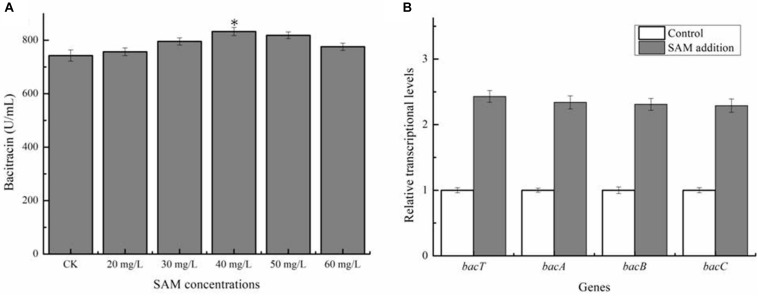
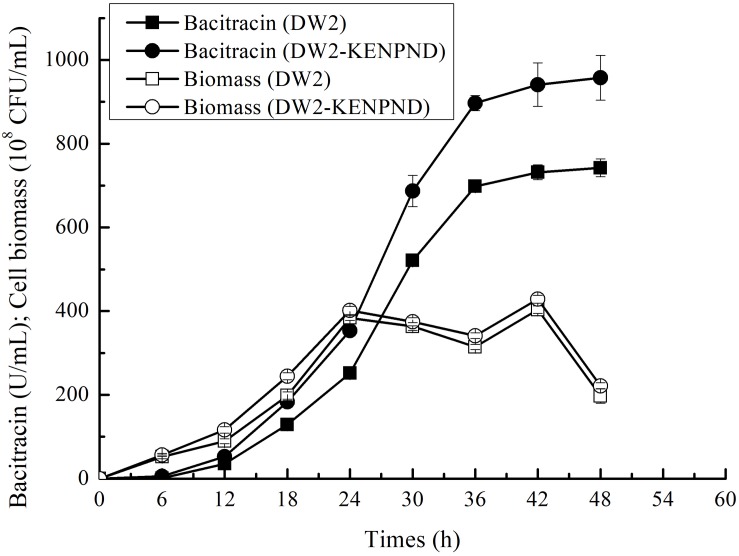
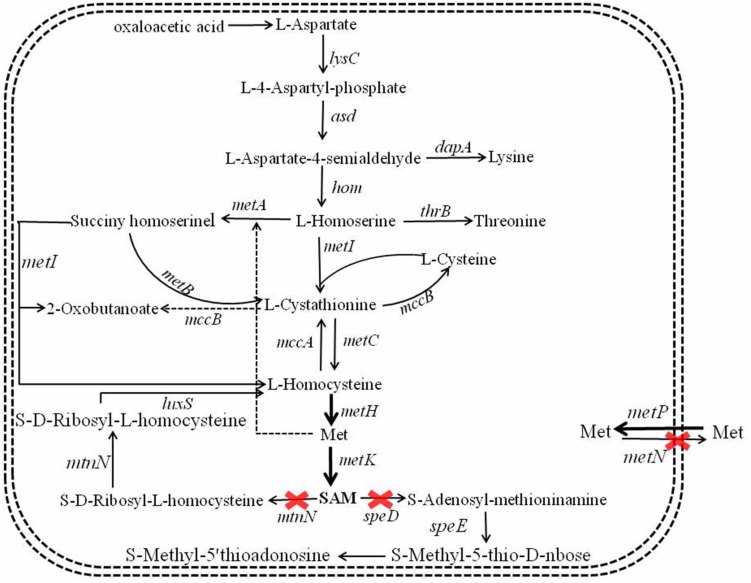
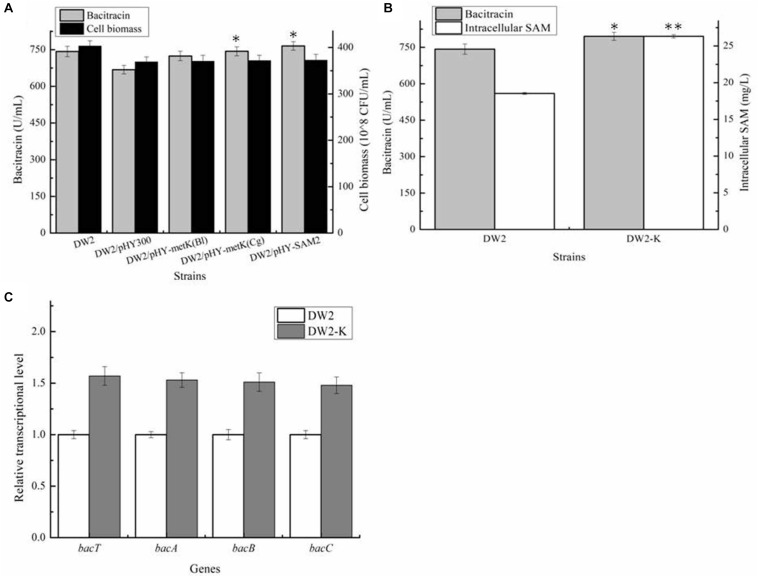
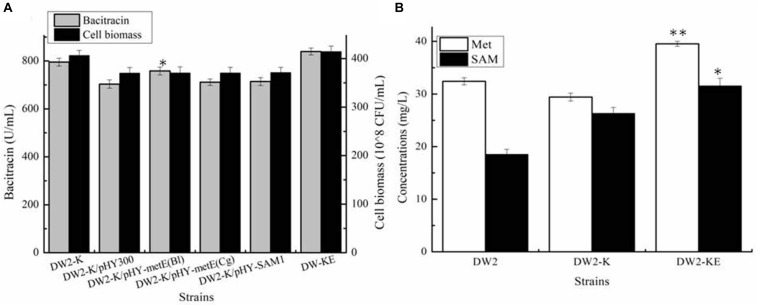
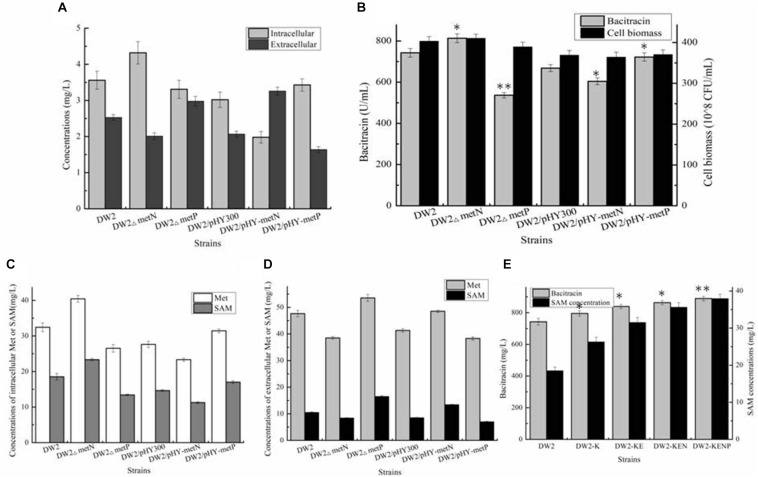
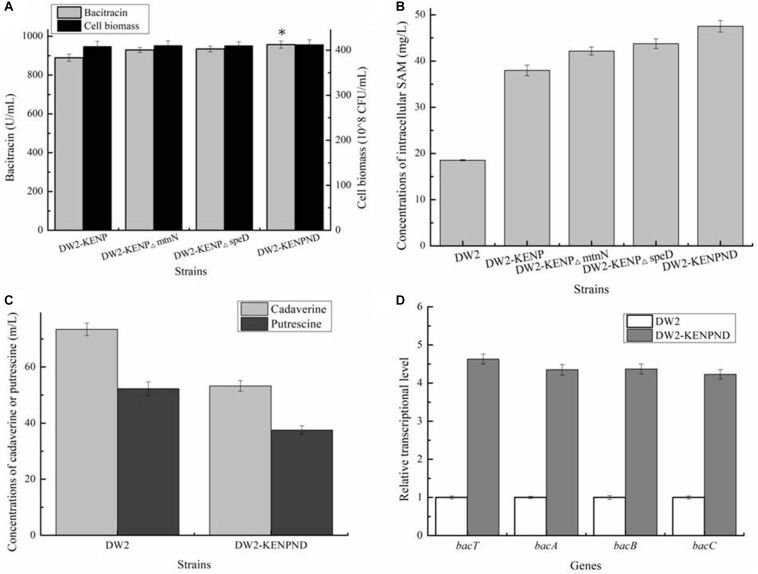
Bacitracin is a broad-spectrum veterinary antibiotic that widely used in the fields of veterinary drug and feed additive. S-Adenosylmethionine (SAM) is a critical factor involved in many biochemical reactions, especially antibiotic production. However, whether SAM affects bacitracin synthesis is still unknown. Here, we want to analyze the relationship between SAM supply and bacitracin synthesis, and then metabolic engineering of SAM synthetic pathway for bacitracin production in . Firstly, our results implied that SAM exogenous addition benefited bacitracin production, which yield was increased by 12.13% under the condition of 40 mg/L SAM addition. Then, SAM synthetases and Methionine (Met) synthetases from , , and were screened and overexpressed to improve SAM accumulation, and the combination of SAM synthetase from and Met synthetase from showed the best performance, and 70.12% increase of intracellular SAM concentration (31.54 mg/L) and 13.08% increase of bacitraicn yield (839.54 U/mL) were achieved in resultant strain DW2-KE. Furthermore, Met transporters MetN and MetP were, respectively, identified as Met exporter and importer, and bacitracin yield was further increased by 5.94% to 889.42 U/mL via deleting and overexpressing in DW2-KE, attaining strain DW2-KENP. Finally, SAM nucleosidase gene and SAM decarboxylase gene were deleted to block SAM degradation pathways, and bacitracin yield of resultant strain DW2-KENPND reached 957.53 U/mL, increased by 28.97% compared to DW2. Collectively, this study demonstrated that SAM supply served as the critical role in bacitracin synthesis, and a promising strain DW2-KENPND was attained for industrial production of bacitracin.
杆菌肽是一种广谱兽用抗生素,广泛应用于兽药和饲料添加剂领域。S-腺苷甲硫氨酸(SAM)是许多生化反应中的关键因素,尤其是抗生素生产。然而,SAM是否影响杆菌肽的合成仍不清楚。在此,我们想分析SAM供应与杆菌肽合成之间的关系,然后对SAM合成途径进行代谢工程改造以用于杆菌肽的生产。首先,我们的结果表明,外源添加SAM有利于杆菌肽的生产,在添加40mg/L SAM的条件下,产量提高了12.13%。然后,筛选并过表达了来自[具体菌种1]、[具体菌种2]和[具体菌种3]的SAM合成酶和甲硫氨酸(Met)合成酶以提高SAM积累,来自[具体菌种1]的SAM合成酶和来自[具体菌种2]的Met合成酶的组合表现最佳,在所得菌株DW2-KE中细胞内SAM浓度增加了70.12%(31.54mg/L),杆菌肽产量增加了13.08%(839.54U/mL)。此外,Met转运蛋白MetN和MetP分别被鉴定为Met输出蛋白和输入蛋白,通过在DW2-KE中删除[相关基因1]并过表达[相关基因2],杆菌肽产量进一步提高了5.94%,达到889.42U/mL,得到菌株DW2-KENP。最后,删除SAM核苷酶基因[相关基因3]和SAM脱羧酶基因[相关基因4]以阻断SAM降解途径,所得菌株DW2-KENPND的杆菌肽产量达到957.53U/mL,与DW2相比增加了28.97%。总体而言,本研究表明SAM供应在杆菌肽合成中起关键作用,并获得了一株有前景的菌株DW2-KENPND用于杆菌肽的工业化生产。