León-Buitimea Angel, Balderas-Cisneros Francisco de Jesús, Garza-Cárdenas César Rodolfo, Garza-Cervantes Javier Alberto, Morones-Ramírez José Rubén
Facultad de Ciencias Químicas, Universidad Autónoma de Nuevo León (UANL), San Nicolás de los Garza, Mexico.
Centro de Investigación en Biotecnología y Nanotecnología, Facultad de Ciencias Químicas, Parque de Investigación e Innovación Tecnológica, Universidad Autónoma de Nuevo León, Apodaca, Mexico.
Front Bioeng Biotechnol. 2022 May 4;10:869206. doi: 10.3389/fbioe.2022.869206. eCollection 2022.
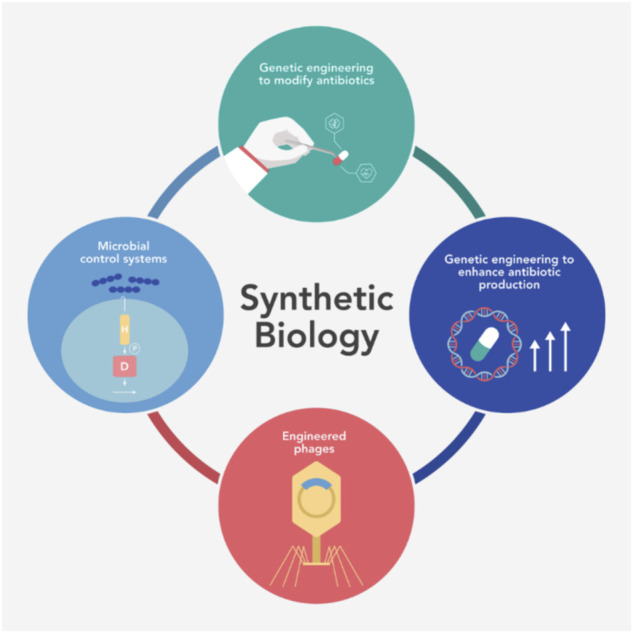
With the increase in clinical cases of bacterial infections with multiple antibiotic resistance, the world has entered a health crisis. Overuse, inappropriate prescribing, and lack of innovation of antibiotics have contributed to the surge of microorganisms that can overcome traditional antimicrobial treatments. In 2017, the World Health Organization published a list of pathogenic bacteria, including , and (ESKAPE). These bacteria can adapt to multiple antibiotics and transfer their resistance to other organisms; therefore, studies to find new therapeutic strategies are needed. One of these strategies is synthetic biology geared toward developing new antimicrobial therapies. Synthetic biology is founded on a solid and well-established theoretical framework that provides tools for conceptualizing, designing, and constructing synthetic biological systems. Recent developments in synthetic biology provide tools for engineering synthetic control systems in microbial cells. Applying protein engineering, DNA synthesis, and design allows building metabolic pathways and biological circuits to control cellular behavior. Thus, synthetic biology advances have permitted the construction of communication systems between microorganisms where exogenous molecules can control specific population behaviors, induce intracellular signaling, and establish co-dependent networks of microorganisms.
随着多重耐药性细菌感染临床病例的增加,世界已进入一场健康危机。抗生素的过度使用、不恰当处方以及缺乏创新导致了能够抵御传统抗菌治疗的微生物激增。2017年,世界卫生组织公布了一份致病细菌名单,包括粪肠球菌、金黄色葡萄球菌、肺炎克雷伯菌、鲍曼不动杆菌、铜绿假单胞菌(ESKAPE)。这些细菌能够适应多种抗生素,并将其耐药性传递给其他生物体;因此,需要开展研究以寻找新的治疗策略。其中一种策略是致力于开发新型抗菌疗法的合成生物学。合成生物学建立在坚实且成熟的理论框架基础之上,该框架为合成生物系统的概念化、设计和构建提供了工具。合成生物学的最新进展为在微生物细胞中设计合成控制系统提供了工具。应用蛋白质工程、DNA合成和基因设计能够构建代谢途径和生物回路以控制细胞行为。因此,合成生物学的进展使得能够构建微生物之间的通信系统,在外源分子能够控制特定群体行为、诱导细胞内信号传导并建立微生物相互依赖网络的情况下。