Quest Diagnostics Nichols Institute San Juan Capistrano CA.
Stanford Cardiovascular Medicine and Cardiovascular Institute and the FH Foundation Stanford CA.
J Am Heart Assoc. 2020 May 5;9(9):e015807. doi: 10.1161/JAHA.119.015807. Epub 2020 Apr 22.
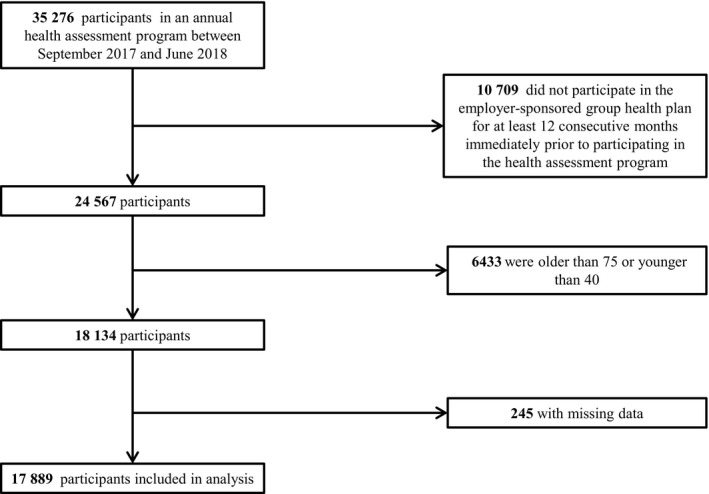
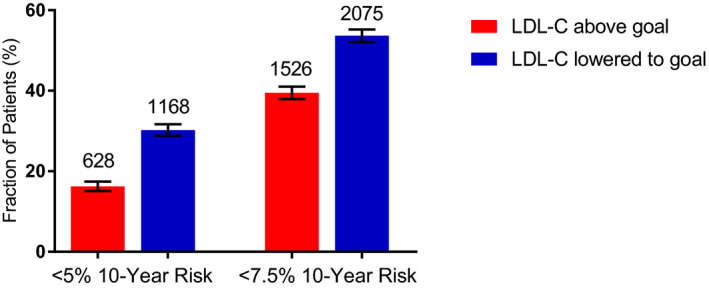
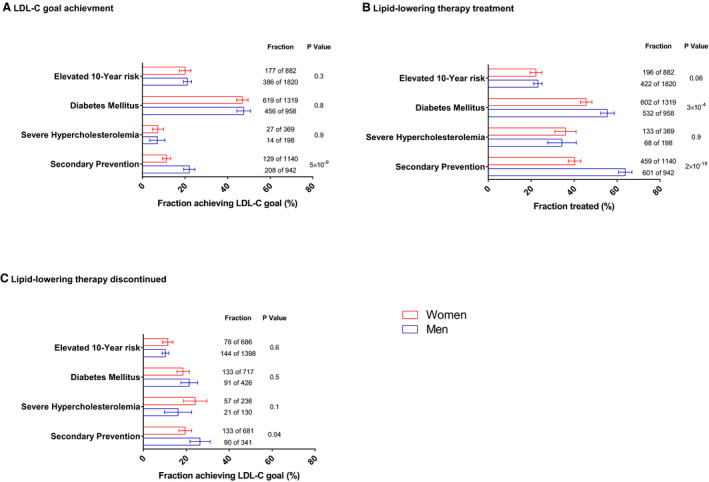
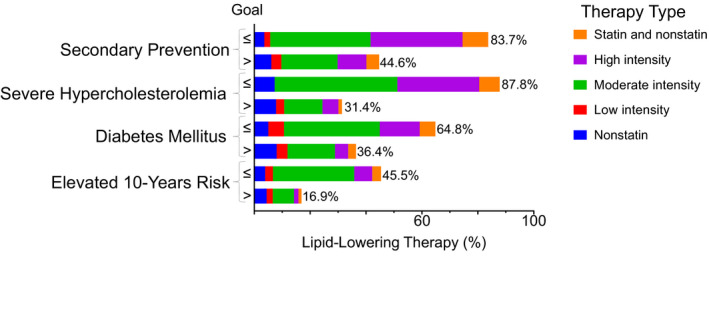
Background The American Heart Association and American College of Cardiology guidelines defined patient-management groups that would benefit from lowering of low-density lipoprotein cholesterol (LDL-C). We assessed gaps in dyslipidemia care among employees and spouses with health benefits. Methods and Results We studied 17 889 employees and spouses who were covered by an employer-sponsored health plan and participated in an annual health assessment. Using medical claims, laboratory tests, and risk assessment questionnaires, we found that 43% of participants were in one of 4 patient-management groups: secondary prevention, severe hypercholesterolemia (LDL-C ≥190 mg/dL at least once in the preceding 5 years), diabetes mellitus, or elevated 10-year risk of cardiovascular disease. To assess gaps in dyslipidemia care, we used LDL-C ≤70 mg/dL as the goal for both the secondary prevention group and those in the elevated 10-year risk group with >20% risk; LDL-C ≤100 mg/dL was used for the other groups. Among those in patient-management groups, 27.3% were in the secondary prevention group, 7.4% were in the severe hypercholesterolemia group, 29.9% were in the diabetes mellitus group, and 35.4% were in the elevated 10-year risk group. About 74% of those in patient-management groups had above-goal LDL-C levels, whereas only 31% had evidence of a lipid-lowering therapy in the past 6 months: 45% in the secondary prevention group, 31% in the severe hypercholesterolemia group, 36% in the diabetes mellitus group, and 17% in the elevated 10-year risk group. Conclusions The substantial gaps in LDL-C treatment and goal attainment among members of an employer-sponsored medical plan who were mostly aware of their LDL-C levels indicate the need for gap-closure initiatives.
美国心脏协会和美国心脏病学会指南定义了将从降低低密度脂蛋白胆固醇(LDL-C)中获益的患者管理人群。我们评估了有健康福利的员工及其配偶的血脂异常治疗差距。
我们研究了 17889 名参加雇主赞助的健康计划并参加年度健康评估的员工及其配偶。使用医疗记录、实验室检查和风险评估问卷,我们发现 43%的参与者属于以下 4 种患者管理组之一:二级预防、严重高胆固醇血症(过去 5 年内至少有一次 LDL-C≥190mg/dL)、糖尿病或心血管疾病 10 年风险升高。为了评估血脂异常治疗的差距,我们将 LDL-C≤70mg/dL 作为二级预防组和 10 年风险升高(≥20%)组的目标;对于其他组,使用 LDL-C≤100mg/dL。在患者管理组中,27.3%处于二级预防组,7.4%处于严重高胆固醇血症组,29.9%处于糖尿病组,35.4%处于 10 年风险升高组。约 74%的患者管理组 LDL-C 水平高于目标值,而在过去 6 个月内仅有 31%有降脂治疗证据:二级预防组为 45%,严重高胆固醇血症组为 31%,糖尿病组为 36%,10 年风险升高组为 17%。
在雇主赞助的医疗计划中,大多数患者知晓自己的 LDL-C 水平,但 LDL-C 治疗和目标达标方面存在很大差距,这表明需要采取差距关闭措施。