Department of Earth and Planetary Sciences and Origins of Life Initiative, Harvard University, Cambridge, Massachusetts, 02138-1204, United States.
Repsol Technology Lab, c/ Agustín de Betancourt, s/n., 28935, Móstoles, Madrid, Spain.
Sci Rep. 2020 Apr 22;10(1):6814. doi: 10.1038/s41598-020-63576-6.
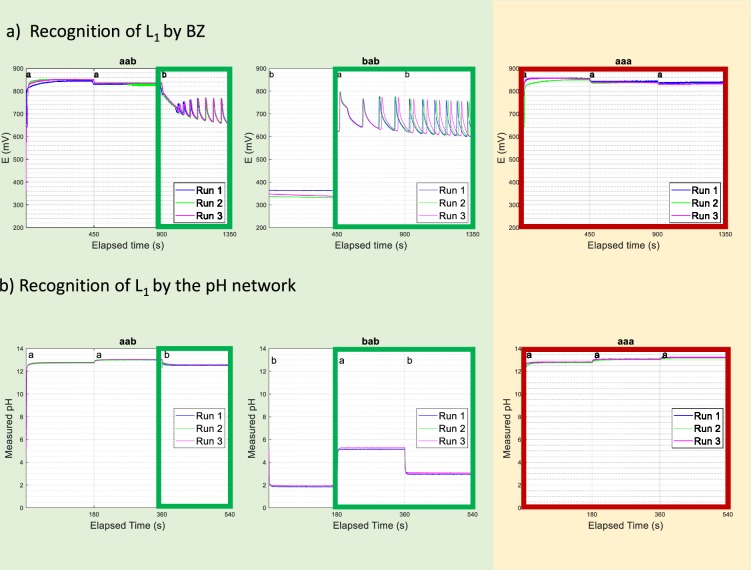
Living systems process information using chemistry. Computations can be viewed as language recognition problems where both languages and automata recognizing them form an inclusive hierarchy. Chemical realizations, without using biochemistry, of the main classes of computing automata, Finite Automata (FA), 1-stack Push Down Automata (1-PDA) and Turing Machine (TM) have recently been presented. These use chemistry for the representation of input information, its processing and output information. The Turing machine uses the Belousov-Zhabotinsky (BZ) oscillatory reaction to recognize a representative Context-Sensitive Language (CSL), the 1-PDA uses a pH network to recognize a Context Free Language (CFL) and a FA for a Regular Language (RL) uses a precipitation reaction. By chemically reconfiguring them to recognize representative languages in the lower classes of the Chomsky hierarchy we illustrate the inclusiveness of the hierarchy of native chemical automata. These examples open the door for chemical programming without biochemistry. Furthermore, the thermodynamic metric originally introduced to identify the accept/reject state of the chemical output for the CSL, can equally be used for recognizing CFL and RL by the automata. Finally, we point out how the chemical and thermodynamic duality of accept/reject criteria can be used in the optimization of the energetics and efficiency of computations.
生命系统利用化学处理信息。计算可以被视为语言识别问题,其中语言和识别它们的自动机形成一个包含层次结构。最近已经提出了使用化学而不使用生物化学来实现主要计算自动机类别的方法,包括有限自动机 (FA)、1 堆栈下推自动机 (1-PDA) 和图灵机 (TM)。这些方法使用化学来表示输入信息、处理信息和输出信息。图灵机使用 Belousov-Zhabotinsky (BZ) 振荡反应来识别有代表性的上下文敏感语言 (CSL),1-PDA 使用 pH 网络来识别上下文无关语言 (CFL),而 FA 用于识别正则语言 (RL) 使用沉淀反应。通过对它们进行化学重构,以识别乔姆斯基层次结构较低类别的代表性语言,我们说明了天然化学自动机层次结构的包容性。这些例子为无生物化学的化学编程开辟了道路。此外,最初引入的热力学度量用于识别 CSL 的化学输出的接受/拒绝状态,也可以被自动机用于识别 CFL 和 RL。最后,我们指出了接受/拒绝标准的化学和热力学对偶性如何用于计算的能量和效率的优化。