Centrum für Naturkunde, University of Hamburg, Martin-Luter-King-Platz 3, 20146, Hamburg, Germany.
Institut Català de Paleontologia M. Crusafont, Universitat Autònoma de Barcelona, Cerdanyola del Vallès, Barcelona, 08193, Spain.
Sci Rep. 2020 Apr 22;10(1):6793. doi: 10.1038/s41598-020-63739-5.
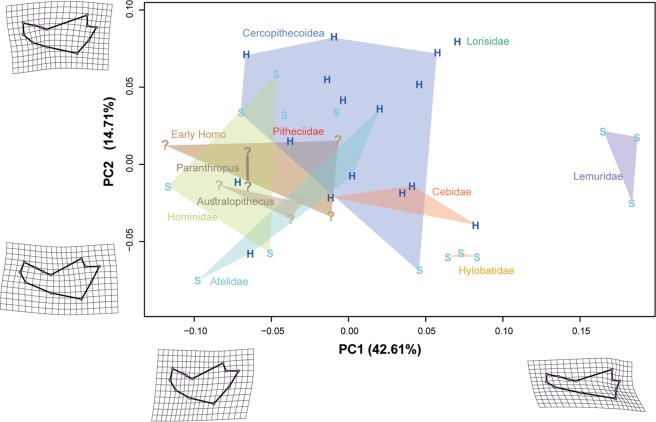
An on-going debate concerning the dietary adaptations of archaic hominins and early Homo has been fuelled by contradictory inferences obtained using different methodologies. This work presents an extensive comparative sample of 30 extant primate species that was assembled to perform a morpho-functional comparison of these taxa with 12 models corresponding to eight fossil hominin species. Finite Element Analysis and Geometric Morphometrics were employed to analyse chewing biomechanics and mandible morphology to, firstly, establish the variation of this clade, secondly, relate stress and shape variables, and finally, to classify fossil individuals into broad ingesta related hardness categories using a support vector machine algorithm. Our results suggest that some hominins previously assigned as hard food consumers (e.g. the members of the Paranthropus clade) in fact seem to rely more strongly on soft foods, which is consistent with most recent studies using either microwear or stable isotope analyses. By analysing morphometric and stress results in the context of the comparative framework, we conclude that in the hominin clade there were probably no hard-food specialists. Nonetheless, the biomechanical ability to comminute harder items, if required as fallback option, adds to their strategy of increased flexibility.
有关古人类和早期人类饮食适应的持续争论,由于使用不同方法得出的相互矛盾的推断而加剧。这项工作提供了一个广泛的比较样本,包括 30 种现存的灵长类物种,这些物种被组装在一起,以便对这些分类单元进行形态功能比较,同时还对应 8 种化石人类物种的 12 个模型进行了比较。有限元分析和几何形态测量学被用来分析咀嚼生物力学和下颌骨形态,首先确定这个分支的变异,其次,将应力和形状变量联系起来,最后,使用支持向量机算法将化石个体分类为广泛的与食团硬度相关的类别。我们的研究结果表明,一些以前被认为是硬食消费者的人类(例如,南方古猿属的成员)实际上似乎更依赖于软食,这与最近使用微观磨损或稳定同位素分析的大多数研究结果一致。通过在比较框架内分析形态计量和应力结果,我们得出结论,在人类分支中,可能没有专门的硬食消费者。尽管如此,如果需要作为备用选项来粉碎更硬的食物,那么这种生物力学能力增加了他们的灵活性策略。