Centrum für Naturkunde, University of Hamburg, Martin-Luter-King-Platz, 3 20146, Hamburg, Germany.
School of Earth and Environmental Sciences, University of Manchester, Oxford Road, M13 9PL, Manchester, UK.
Sci Rep. 2017 Aug 21;7(1):8364. doi: 10.1038/s41598-017-08161-0.
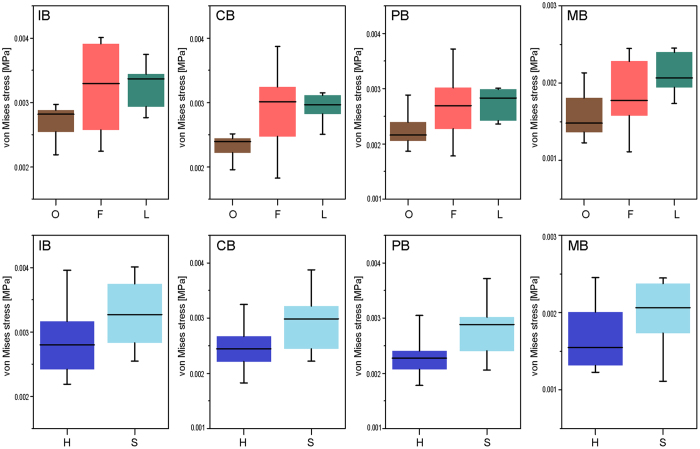
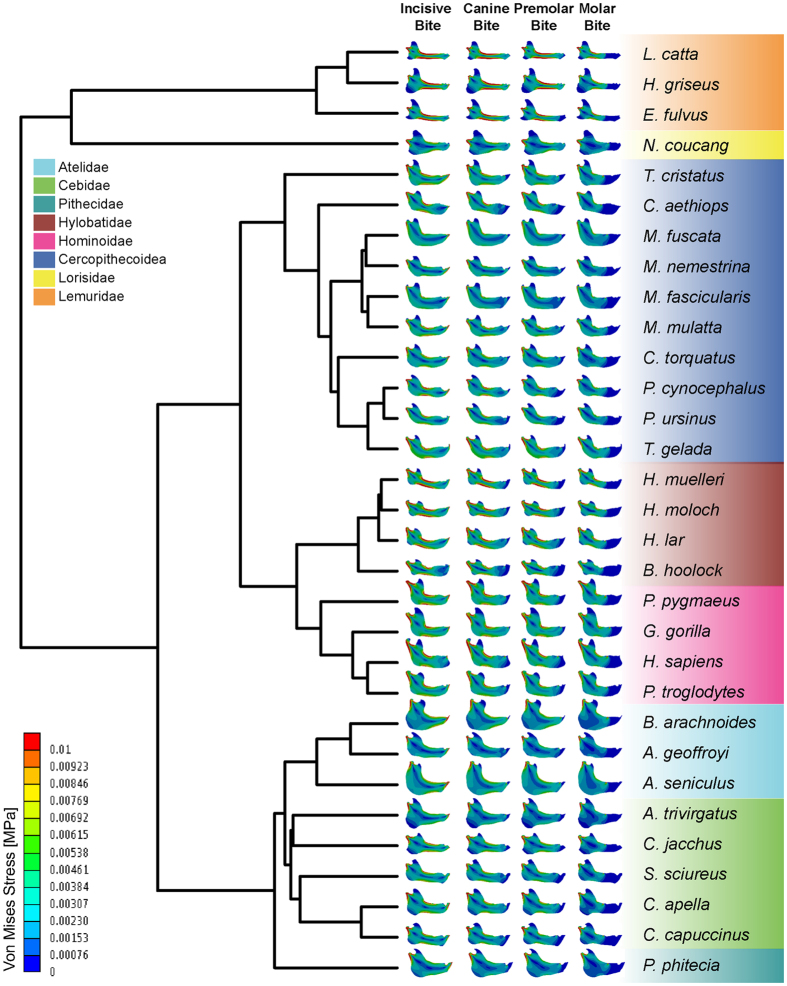
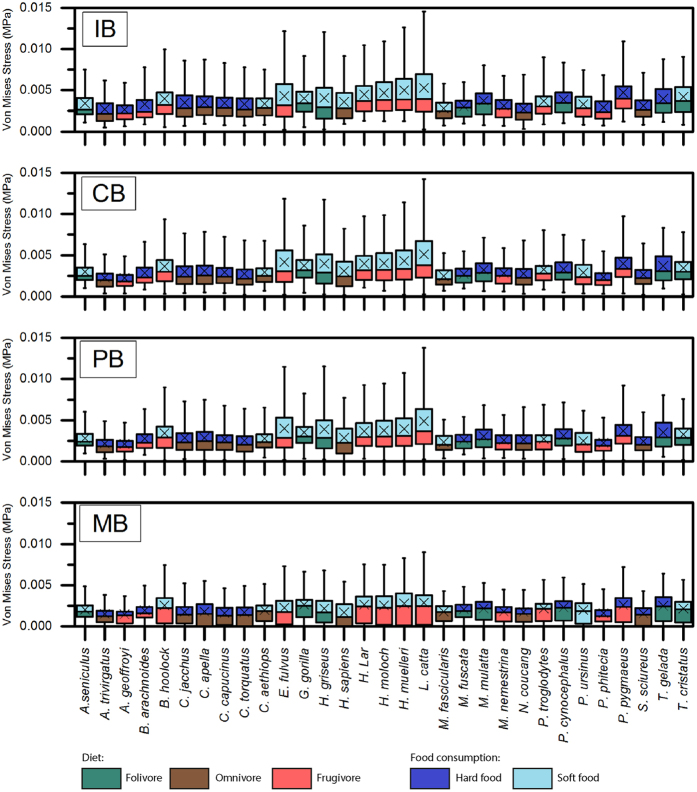
The relationship between primate mandibular form and diet has been previously analysed by applying a wide array of techniques and approaches. Nonetheless, most of these studies compared few species and/or infrequently aimed to elucidate function based on an explicit biomechanical framework. In this study, we generated and analysed 31 Finite Element planar models of different primate jaws under different loading scenarios (incisive, canine, premolar and molar bites) to test the hypothesis that there are significant differences in mandibular biomechanical performance due to food categories and/or food hardness. The obtained stress values show that in primates, hard food eaters have stiffer mandibles when compared to those that rely on softer diets. In addition, we find that folivores species have the weakest jaws, whilst omnivores have the strongest mandibles within the order Primates. These results are highly relevant because they show that there is a strong association between mandibular biomechanical performance, mandibular form, food hardness and diet categories and that these associations can be studied using biomechanical techniques rather than focusing solely on morphology.
灵长类动物下颌形态与饮食之间的关系此前已经通过应用广泛的技术和方法进行了分析。然而,这些研究大多只比较了少数几种物种,并且/或者通常并不旨在根据明确的生物力学框架来阐明功能。在这项研究中,我们生成并分析了 31 种不同灵长类动物下颌的有限元平面模型,这些模型在不同的加载情况下(切牙、犬齿、前臼齿和臼齿咬合),以检验以下假设:由于食物种类和/或食物硬度的不同,下颌的生物力学性能会存在显著差异。所得的应力值表明,在灵长类动物中,与依赖软食的动物相比,食用硬食的动物的下颌骨更硬。此外,我们发现,食叶动物的下颚最为脆弱,而在灵长目动物中,杂食动物的下颚最为强壮。这些结果非常重要,因为它们表明下颌的生物力学性能、下颌形态、食物硬度和饮食类别之间存在着很强的关联,并且这些关联可以通过生物力学技术来研究,而不仅仅是专注于形态。