Department of Nutritional Sciences, The Pennsylvania State University, University Park, PA, USA.
Department of Biobehavioral Health, The Pennsylvania State University, University Park, PA, USA.
Physiol Rep. 2020 Apr;8(8):e14418. doi: 10.14814/phy2.14418.
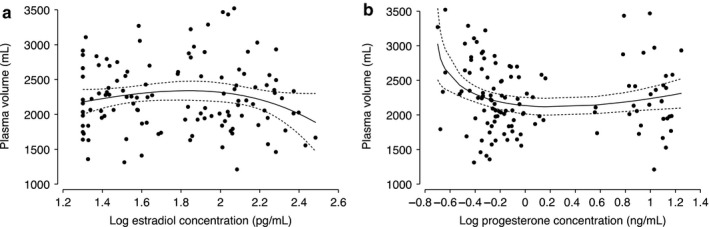
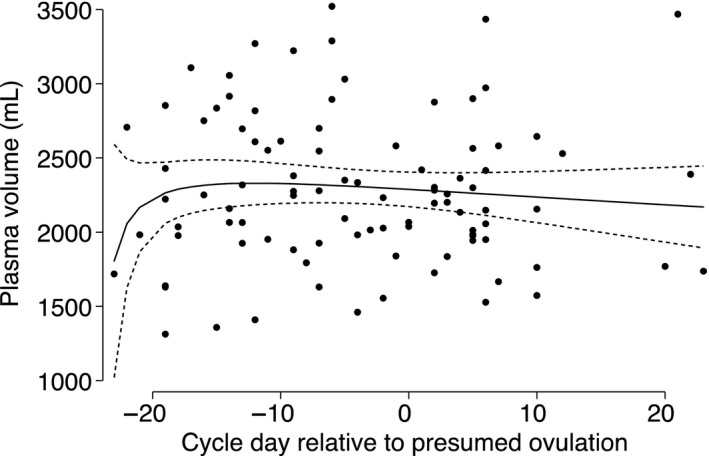
Increases in reproductive hormones like estrogen, play an important role in the remarkable increases in plasma volume observed in pregnancy. Accurate estimates of plasma volume expansion during pregnancy depend on correctly timing and measuring plasma volume in nonpregnant women. However, to date, there is no consensus on the pattern of plasma volume across the menstrual cycle. We prospectively measured plasma volume in 45 women across a single menstrual cycle. A urine-based fertility monitor was used to time three clinic visits to distinct points in the menstrual cycle: the early follicular phase (day 2), periovulation (day 12), and the mid-point of the luteal phase (~day 21)-based on a 28-day cycle length. Healthy women aged 18-41 years with regular menstrual cycles and a healthy body weight were enrolled in the study. At each visit, blood samples were collected before and after injection of 0.25 mg/kg body weight of indocyanine green dye (ICG). Pre- and post-ICG injection plasma samples were used to measure plasma volume. Preinjection samples were used to measure ovarian hormones and plasma osmolality. Mean plasma volume was highest during the early follicular phase (2,276 ± 478 ml); it declined to 2,232 ± 509 ml by the late follicular phase and to 2,228 ± 502 ml by the midluteal phase. This study found that overall variations in plasma volume are small across the menstrual cycle. Therefore, in clinical practice and research, the menstrual cycle phase may not be an important consideration when evaluating plasma volume among women of reproductive age.
生殖激素(如雌激素)的增加在怀孕期间观察到的血浆容量显著增加中起着重要作用。准确估计怀孕期间血浆容量的扩张取决于在非孕妇中正确地定时和测量血浆容量。然而,迄今为止,对于整个月经周期中血浆容量的模式尚未达成共识。我们前瞻性地测量了 45 名女性在单个月经周期中的血浆容量。使用基于尿液的生育监测器来定时三次就诊,以达到月经周期中的三个不同点:早期卵泡期(约第 2 天),排卵期(约第 12 天)和黄体中期(约第 21 天)-基于 28 天的周期长度。招募了年龄在 18-41 岁之间、月经周期规律且体重健康的健康女性参与研究。在每次就诊时,在注射 0.25mg/kg 体重的吲哚菁绿染料(ICG)前后采集血液样本。使用注射前后的 ICG 血浆样本测量血浆容量。使用预注射样本测量卵巢激素和血浆渗透压。早期卵泡期的平均血浆容量最高(2,276±478ml);在晚期卵泡期降至 2,232±509ml,在黄体中期降至 2,228±502ml。这项研究发现,整个月经周期中血浆容量的总体变化很小。因此,在临床实践和研究中,评估育龄妇女的血浆容量时,月经周期阶段可能不是一个重要的考虑因素。