Di Stefano Vita, Schillaci Domenico, Cusimano Maria Grazia, Rishan Mohammed, Rashan Luay
Department of Science and Technology Biological, Chemical and Pharmaceutical (STEBICEF) Università degli Studi di Palermo, Via Archirafi, 32, 90123 Palermo, Italy.
Frankincense and Biodiversity Lab, Dhofar University, 2509 Salalah, Oman.
Antibiotics (Basel). 2020 Apr 20;9(4):195. doi: 10.3390/antibiotics9040195.
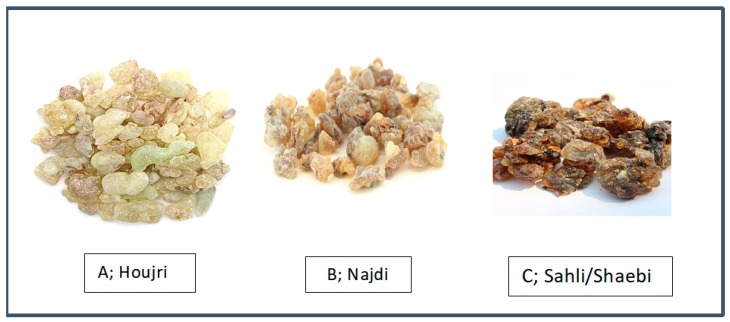
Frankincense essential oils from have been commonly used to treat microbial infections from as early as the 11th century. The main feature of the plant is its gum resin, from which it is possible to obtain essential oils. In the present study, we focused on the comparative study of the oils extracted from the resins of three different cultivars (Najdi, Sahli and Houjri). From each of frankincense resin three successive essential oil samples (Grade 1, Grade 2, Grade 3) were obtained. Houjri gum resin gave the lowest percentage (5%) of total essential oil content but showed the maximum number of volatile components in all three grades. Najdi Grade 2 essential oil showed a minimum inhibitory concentration (MIC) of 52 mg/mL toward relevant pathogens and , and samples from Grade 2 of Sahily and Houjiri were particularly active against a dermatological strain , displaying MIC values of 0.264 and 0.66 mg/mL, respectively. Data obtained from in vitro studies showed that all essential oils had a significant antifungal effect against and , showing MIC values ranging from 54.56 to 0.246 mg/mL. This work aims to increase the number of substances available in the fight against pathogens and to combat the phenomenon of antibiotic resistance, encouraging the use of alternative resources, especially in non-clinical settings (farms, food processing, etc.).
早在11世纪,乳香精油就已被广泛用于治疗微生物感染。该植物的主要特征是其树胶树脂,从中可以提取精油。在本研究中,我们重点对从三种不同乳香品种(Najdi、Sahli和Houjri)的树脂中提取的精油进行了比较研究。从每种乳香树脂中获得了三个连续的精油样品(1级、2级、3级)。Houjri树胶树脂的总精油含量最低(5%),但在所有三个等级中挥发性成分数量最多。Najdi 2级精油对相关病原体和的最低抑菌浓度(MIC)为52毫克/毫升,Sahily和Houjiri 2级样品对一种皮肤病菌株特别有效,MIC值分别为0.264和0.66毫克/毫升。体外研究获得的数据表明,所有精油对和都有显著的抗真菌作用,MIC值范围为54.56至0.246毫克/毫升。这项工作旨在增加对抗病原体可用物质的数量,并对抗抗生素耐药现象,鼓励使用替代资源,特别是在非临床环境(农场、食品加工等)中。