Regel Ivonne, Mayerle Julia, Mahajan Ujjwal Mukund
Department of Medicine II, University Hospital, LMU Munich, 81377 Munich, Germany.
Cancers (Basel). 2020 Apr 21;12(4):1024. doi: 10.3390/cancers12041024.
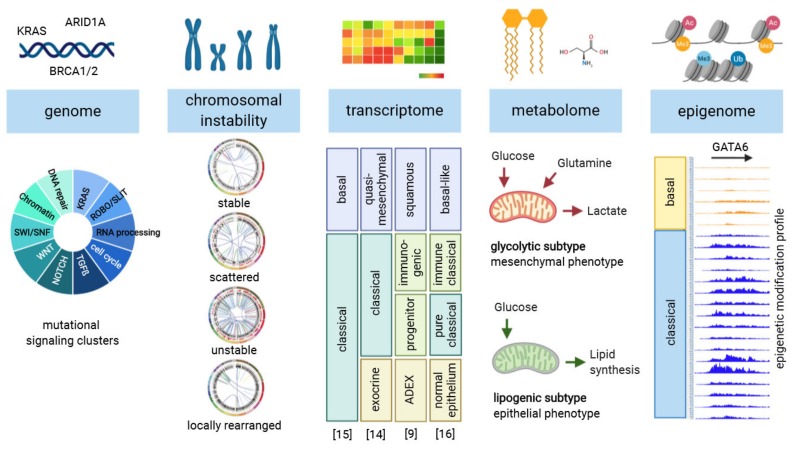
Current standard-of-care for patients with pancreatic ductal adenocarcinoma (PDAC) focusses on chemotherapeutic regimens and pancreatic cancer surgery. However, limited treatment options, late diagnosis in advanced tumor stages and the aggressive behavior of PDAC contribute to the high mortality of the disease. Consequently, there is an urgent need of precision medicine for pancreatic cancer patients. All over the world, numerous initiatives started in recent years to translate novel scientific discoveries into prospective clinical trials. One major approach pursues the stratification of PDAC patients according the tumor transcriptome to predict treatment response. Other strategies concentrate on genomic alterations and the identification of individualized targeted therapies. Further experimental studies are ongoing to detect novel biomarkers for cancer diagnosis, subtyping, treatment response prediction or clinical outcome. However, the challenge remains to transfer the knowledge into clinical practice. In this review, we summarize current literature and knowledge and highlight novel concepts of basic and clinical research uncovering suitable biomarkers and targeted therapies. Thus, we provide an overview of preclinical and clinical efforts of precision medicine in pancreatic cancer.
胰腺导管腺癌(PDAC)患者目前的标准治疗方案主要集中在化疗方案和胰腺癌手术上。然而,治疗选择有限、肿瘤晚期诊断较晚以及PDAC的侵袭性导致了该疾病的高死亡率。因此,胰腺癌患者迫切需要精准医疗。近年来,世界各地启动了许多计划,将新的科学发现转化为前瞻性临床试验。一种主要方法是根据肿瘤转录组对PDAC患者进行分层,以预测治疗反应。其他策略则集中在基因组改变和个体化靶向治疗的识别上。正在进行进一步的实验研究,以检测用于癌症诊断、亚型分类、治疗反应预测或临床结果的新型生物标志物。然而,将这些知识转化为临床实践仍然是一个挑战。在这篇综述中,我们总结了当前的文献和知识,并强调了基础和临床研究中发现合适生物标志物和靶向治疗的新概念。因此,我们概述了胰腺癌精准医疗的临床前和临床研究成果。