Department of Water Resources, Faculty of Geo-Information Science and Earth Observation, University of Twente, Hengelosestraat 99, 7514 AE Enschede, The Netherlands.
Int J Environ Res Public Health. 2020 Apr 15;17(8):2727. doi: 10.3390/ijerph17082727.
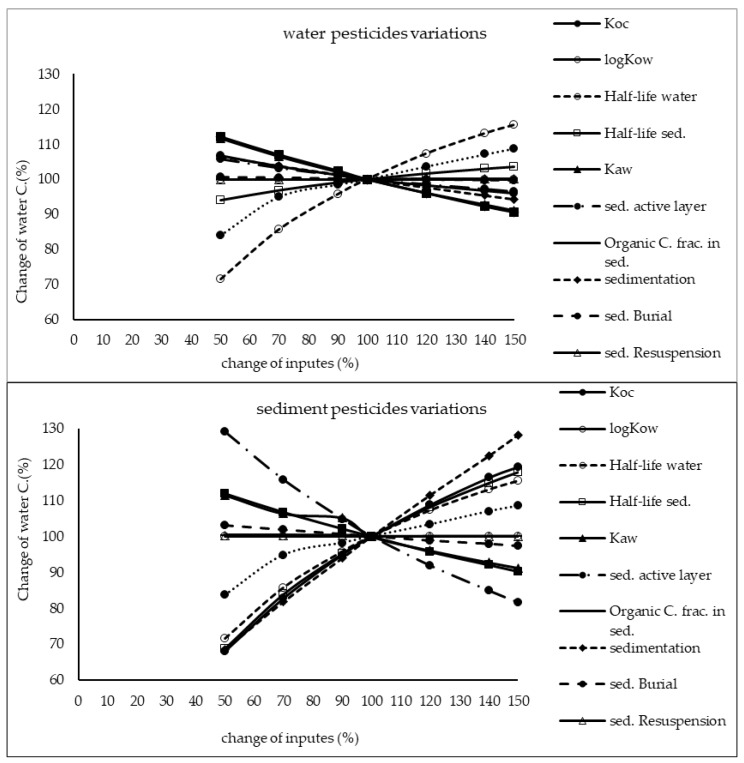
Distribution of pesticide residues in the environment and their transport to surface water bodies is one of the most important environmental challenges. Fate of pesticides in the complex environments, especially in aquatic phases such as lakes and rivers, is governed by the main properties of the contaminants and the environmental properties. In this study, a multimedia mass modeling approach using the Quantitative Water Air Sediment Interaction (QWASI) model was applied to explore the fate of organochlorine pesticide residues of methoxychlor, α-HCH and endosulfan-sulfate in the lake Naivasha (Kenya). The required physicochemical data of the pesticides such as molar mass, vapor pressure, air-water partitioning coefficient (K), solubility, and the Henry's law constant were provided as the inputs of the model. The environment data also were collected using field measurements and taken from the literature. The sensitivity analysis of the model was applied using One At a Time (OAT) approach and calibrated using measured pesticide residues by passive sampling method. Finally, the calibrated model was used to estimate the fate and distribution of the pesticide residues in different media of the lake. The result of sensitivity analysis showed that the five most sensitive parameters were K, logKow, half-life of the pollutants in water, half-life of the pollutants in sediment, and K. The variations of outputs for the three studied pesticide residues against inputs were noticeably different. For example, the range of changes in the concentration of α-HCH residue was between 96% to 102%, while for methoxychlor and endosulfan-sulfate it was between 65% to 125%. The results of calibration demonstrated that the model was calibrated reasonably with the R of 0.65 and RMSE of 16.4. It was found that methoxychlor had a mass fraction of almost 70% in water column and almost 30% of mass fraction in the sediment. In contrast, endosulfan-sulfate had highest most fraction in the water column (>99%) and just a negligible percentage in the sediment compartment. α-HCH also had the same situation like endosulfan-sulfate (e.g., 99% and 1% in water and sediment, respectively). Finally, it was concluded that the application of QWASI in combination with passive sampling technique allowed an insight to the fate process of the studied OCPs and helped actual concentration predictions. Therefore, the results of this study can also be used to perform risk assessment and investigate the environmental exposure of pesticide residues.
农药在环境中的分布及其向地表水的迁移是最重要的环境挑战之一。农药在复杂环境中的归宿,特别是在湖泊和河流等水相,主要取决于污染物的主要特性和环境特性。本研究应用基于定量水-气-泥沙相互作用(QWASI)模型的多介质质量模拟方法,探讨了肯尼亚奈瓦沙湖中甲氧基氯、α-六氯环己烷和硫丹硫酸盐等有机氯农药残留的归宿。模型的输入包括农药的摩尔质量、蒸气压、气-水分配系数(K)、溶解度和亨利定律常数等所需的理化数据。环境数据也通过现场测量和文献收集获得。采用逐个参数(OAT)法对模型进行了敏感性分析,并采用被动采样法测量的农药残留对模型进行了校准。最后,利用校准后的模型估计了农药在湖泊不同介质中的归宿和分布。敏感性分析的结果表明,K、logKow、污染物在水中的半衰期、污染物在沉积物中的半衰期和 K 是最敏感的五个参数。三种研究农药残留的输出随输入的变化明显不同。例如,α-六氯环己烷残留浓度的变化范围在 96%到 102%之间,而甲氧氯和硫丹硫酸盐的变化范围在 65%到 125%之间。校准结果表明,模型的 R 为 0.65,RMSE 为 16.4,校准效果合理。结果表明,甲氧氯在水柱中的质量分数接近 70%,在沉积物中的质量分数接近 30%。相比之下,硫丹硫酸盐在水柱中的质量分数最高(>99%),在沉积物中的质量分数可忽略不计。α-六氯环己烷的情况与硫丹硫酸盐相似(分别为 99%和 1%在水和沉积物中)。最后得出结论,QWASI 与被动采样技术的结合应用可以深入了解研究的 OCP 的归宿过程,并有助于实际浓度预测。因此,本研究的结果也可用于进行风险评估和研究农药残留的环境暴露。