Duke Clinical Research Institute Durham NC.
Center for Observational Research Amgen Inc Thousand Oaks CA.
J Am Heart Assoc. 2020 May 5;9(9):e014347. doi: 10.1161/JAHA.119.014347. Epub 2020 Apr 24.
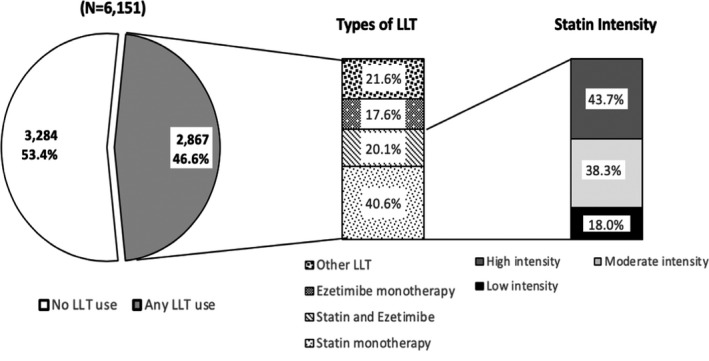
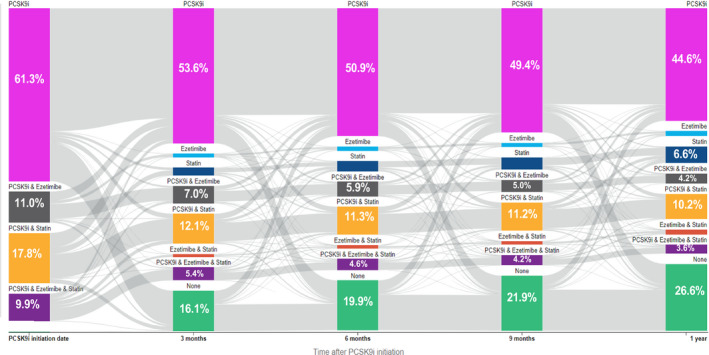
Background Proprotein convertase subtilisin/kexin type 9 inhibitors (PCSK9i) are used to reduce low-density lipoprotein (LDL) cholesterol. PCSK9i use after initiation, as well as persistence with or alterations to other LDL-lowering therapy after PCSK9i initiation, is not well understood. Methods and Results We conducted a retrospective study of alirocumab or evolocumab (PCSK9i) new users from July 2015 to December 2017 in the MarketScan Early View database of US commercial insurance beneficiaries. We determined the prevalence of PCSK9i interruption (≥30-day gap in supply) and LDL-lowering therapy use in the year after PCSK9i initiation. The average age of 6151 patients initiating PCSK9i therapy was 63 years, 44.4% were women, and 76.8% had atherosclerotic cardiovascular disease. Overall, 52.2% (95% CI, 50.8%-53.7%) of patients had an interruption in PCSK9i therapy in the first year after treatment initiation and 62.5% remained on PCSK9i therapy at 1-year postinitiation. Also, 27.7% of patients were taking a statin at the time of PCSK9i initiation, with only 22.4% on statin therapy at 1 year after PCSK9i initiation. Ezetimibe use decreased from 20.9% at the time of PCSK9i initiation to 12.0% a year later. By 1 year after PCSK9i initiation, 44.0% of patients had experienced an interruption in all LDL-lowering therapies, and 26.6% were no longer on any LDL-lowering therapies. Conclusions After PCSK9i initiation, statins were often discontinued, whereas more than half of patients experienced an interruption in PCSK9i therapy. These results suggest that many new PCSK9i users may remain at high risk for cardiovascular events because of interruptions in LDL-lowering therapy.
背景 前蛋白转化酶枯草溶菌素 9 抑制剂(PCSK9i)用于降低低密度脂蛋白(LDL)胆固醇。PCSK9i 在起始后的使用情况,以及在起始 PCSK9i 后对其他 LDL 降低疗法的持续使用或改变情况,尚不清楚。
方法和结果 我们对 2015 年 7 月至 2017 年 12 月美国商业保险受益人的 MarketScan Early View 数据库中接受阿利西尤单抗或依洛尤单抗(PCSK9i)治疗的新患者进行了回顾性研究。我们确定了起始 PCSK9i 治疗后 1 年内 PCSK9i 中断(≥30 天的供应中断)和 LDL 降低疗法使用的发生率。6151 例起始 PCSK9i 治疗的患者平均年龄为 63 岁,44.4%为女性,76.8%患有动脉粥样硬化性心血管疾病。总体而言,52.2%(95%CI,50.8%-53.7%)的患者在起始治疗后 1 年内中断了 PCSK9i 治疗,62.5%的患者在起始治疗后 1 年仍在使用 PCSK9i 治疗。此外,27.7%的患者在起始 PCSK9i 治疗时正在服用他汀类药物,而在起始 PCSK9i 治疗后 1 年仅有 22.4%的患者在服用他汀类药物。依折麦布的使用率从起始 PCSK9i 治疗时的 20.9%下降到 1 年后的 12.0%。在起始 PCSK9i 治疗后 1 年,44.0%的患者所有 LDL 降低疗法均中断,26.6%的患者不再使用任何 LDL 降低疗法。
结论 在起始 PCSK9i 后,他汀类药物常被停用,而超过一半的患者 PCSK9i 治疗中断。这些结果表明,由于 LDL 降低疗法中断,许多新的 PCSK9i 使用者可能仍处于心血管事件的高风险中。