Biotechnology Research Institute, Chinese Academy of Agricultural Sciences, 100081, Beijing, China.
Graduate School of Chinese Academy of Agricultural Sciences, 100081, Beijing, China.
Nat Commun. 2020 Apr 23;11(1):1955. doi: 10.1038/s41467-020-15893-7.
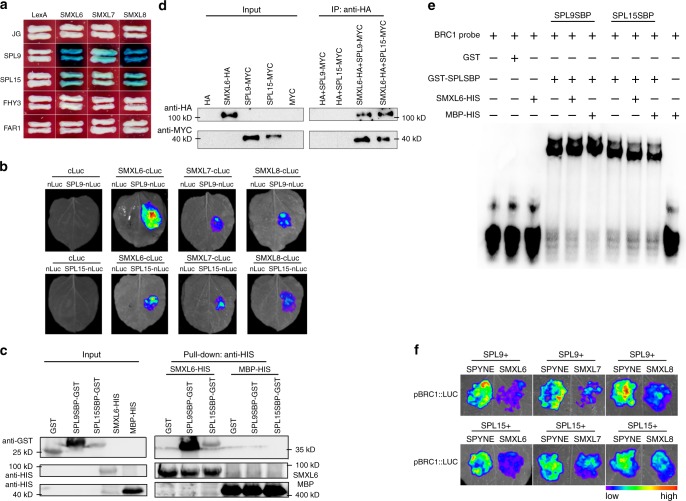
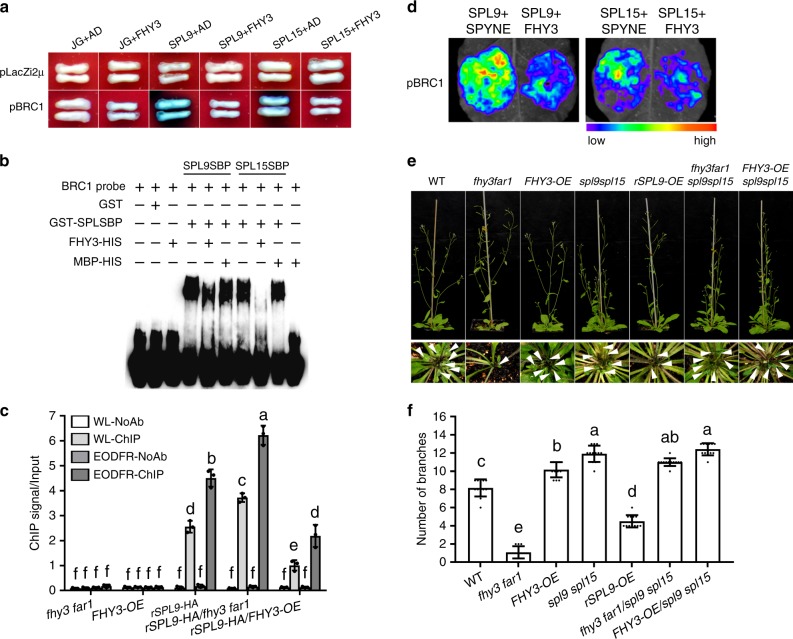
Branching/tillering is an important parameter of plant architecture and is tightly regulated by both internal factors (such as plant hormones) and external factors (such as light conditions). How the various signaling pathways converge to coordinately regulate branching is not well understood. Here, we report that in Arabidopsis, FHY3 and FAR1, two homologous transcription factors essential for phytochrome A-mediated light signaling, and SMXL6/SMXL7/SMXL8, three key repressors of the strigolactone (SL) signaling pathway, directly interact with SPL9 and SPL15 and suppress their transcriptional activation of BRC1, a key repressor of branching, thus promoting branching. In addition, FHY3 and FAR1 also directly up-regulate the expression of SMXL6 and SMXL7 to promote branching. Simulated shade treatment reduces the accumulation of FHY3 protein, leading to increased expression of BRC1 and reduced branching. Our results establish an integrated model of light and SL coordinately regulating BRC1 expression and branching through converging at the BRC1 promoter.
分枝/分蘖是植物结构的一个重要参数,由内部因素(如植物激素)和外部因素(如光照条件)共同调控。各种信号通路如何协同调控分枝还不是很清楚。在这里,我们报告在拟南芥中,FHY3 和 FAR1,这两个同源转录因子对于光信号转导中的光敏色素 A 是必需的,以及 SMXL6/SMXL7/SMXL8,SL 信号通路的三个关键抑制因子,直接与 SPL9 和 SPL15 相互作用,并抑制它们对 BRC1 的转录激活,BRC1 是分枝的关键抑制剂,从而促进分枝。此外,FHY3 和 FAR1 还直接上调 SMXL6 和 SMXL7 的表达以促进分枝。模拟遮荫处理会降低 FHY3 蛋白的积累,导致 BRC1 的表达增加和分枝减少。我们的研究结果建立了一个整合模型,表明光和 SL 通过在 BRC1 启动子处汇聚来协调调节 BRC1 表达和分枝。