Zhao Yuwan, Luo Qiuming, Mo Jierong, Li Jianwei, Ye Dongcai, Ao Zhixian, Chen Lixin, Liu Jianjun
Laboratory of Urology, Affiliated Hospital of Guangdong Medical University, Zhanjiang, Guangdong 524001, China.
J Cancer. 2020 Mar 31;11(13):3701-3712. doi: 10.7150/jca.36372. eCollection 2020.
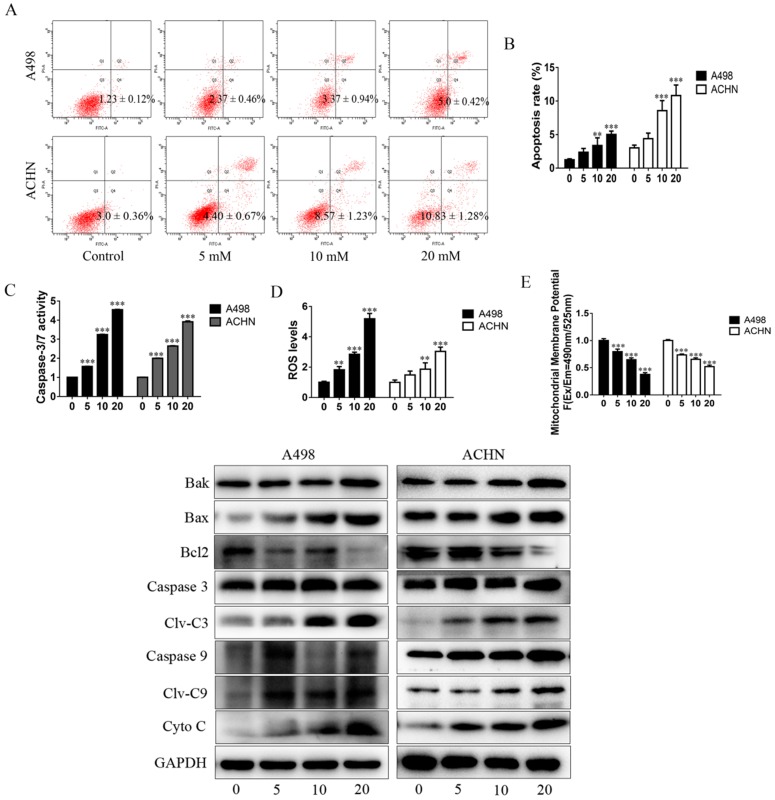
Metformin (MET) is taken as a principal medication for remedying Type 2 diabetes mellitus. Its anti-tumor effect has been reported increasingly, but the precise mechanism of it remains unclear. This study aims to explore the efficacy of MET and MET combined with nitric oxide donor prodrug JS-K on the proliferation, apoptosis, and DNA damage in human renal cell carcinoma (RCC) cells, and investigate the possible molecular mechanism involved. The cell proliferation was tested through methyl-tetrazolium assay and cell apoptosis was ascertained by flow cytometry. The dihydroethidium and JC-1 fluorescent methods were used to detect Reactive oxygen species (ROS) and mitochondrial transmembrane potential (Δψm), respectively. Proteins associated with apoptosis and DNA damage were evaluated by Western blotting. Results showed that MET and JS-K could suppress cell growth, and the inhibition concentration 50 of treatment with MET combined with JS-K (MET + JS-K) showed more toxicity than individual agents on RCC cells. This augmented toxicity was associated with intracellular reactive oxygen species (ROS) level, mitochondrial membrane potential alteration, and induced DNA breaks. The results of Western blotting showed that the expression level of pro-apoptotic proteins, such as Bax, Bak, caspase-3, and caspase-9, was up-regulated, and the anti-apoptotic protein Bcl-2 was down-regulated after treatment using MET alone and MET + JS-K, correspondingly. Moreover, MET + JS-K inhibited the expression of cellular PCNA and Rad51, and immunofluorescence analysis of γH2AX proved that MET + JS-K enhanced DNA damage. In summary, the results of this research indicated that MET and JS-K inhibited RCC cell growth by activating ROS, targeting mitochondria-dependent apoptotic pathways, and inducing DNA breaks.
二甲双胍(MET)被用作治疗2型糖尿病的主要药物。其抗肿瘤作用的报道日益增多,但其确切机制仍不清楚。本研究旨在探讨MET以及MET与一氧化氮供体前药JS-K联合使用对人肾细胞癌(RCC)细胞增殖、凋亡和DNA损伤的影响,并研究其中可能涉及的分子机制。通过甲基四氮唑法检测细胞增殖,采用流式细胞术确定细胞凋亡情况。分别使用二氢乙锭和JC-1荧光法检测活性氧(ROS)和线粒体跨膜电位(Δψm)。通过蛋白质印迹法评估与凋亡和DNA损伤相关的蛋白质。结果表明,MET和JS-K均可抑制细胞生长,MET与JS-K联合治疗(MET+JS-K)的半数抑制浓度对RCC细胞的毒性比单独用药更大。这种增强的毒性与细胞内活性氧(ROS)水平、线粒体膜电位改变以及诱导的DNA断裂有关。蛋白质印迹法结果显示,单独使用MET和MET+JS-K处理后,促凋亡蛋白如Bax、Bak、半胱天冬酶-3和半胱天冬酶-9的表达水平上调,抗凋亡蛋白Bcl-2的表达水平相应下调。此外,MET+JS-K抑制细胞增殖细胞核抗原(PCNA)和Rad51的表达,γH2AX的免疫荧光分析证明MET+JS-K增强了DNA损伤。综上所述,本研究结果表明,MET和JS-K通过激活ROS、靶向线粒体依赖性凋亡途径以及诱导DNA断裂来抑制RCC细胞生长。