Zhang Shuiting, He Yanjuan, Liu Chao, Li Guo, Lu Shanhong, Jing Qiancheng, Chen Xiyu, Ma Huiling, Zhang Diekuo, Wang Yunyun, Huang Donghai, Tan Pingqing, Chen Jie, Zhang Xin, Liu Yong, Qiu Yuanzheng
Department of Otolaryngology Head and Neck Surgery, Xiangya Hospital, Central South University, 87 Xiangya Road, Changsha, Hunan 410008, People's Republic of China.
Otolaryngology Major Disease Research Key Laboratory of Hunan Province, 87 Xiangya Road, Changsha, Hunan 410008, People's Republic of China.
J Cancer. 2020 Apr 6;11(13):3871-3881. doi: 10.7150/jca.43854. eCollection 2020.
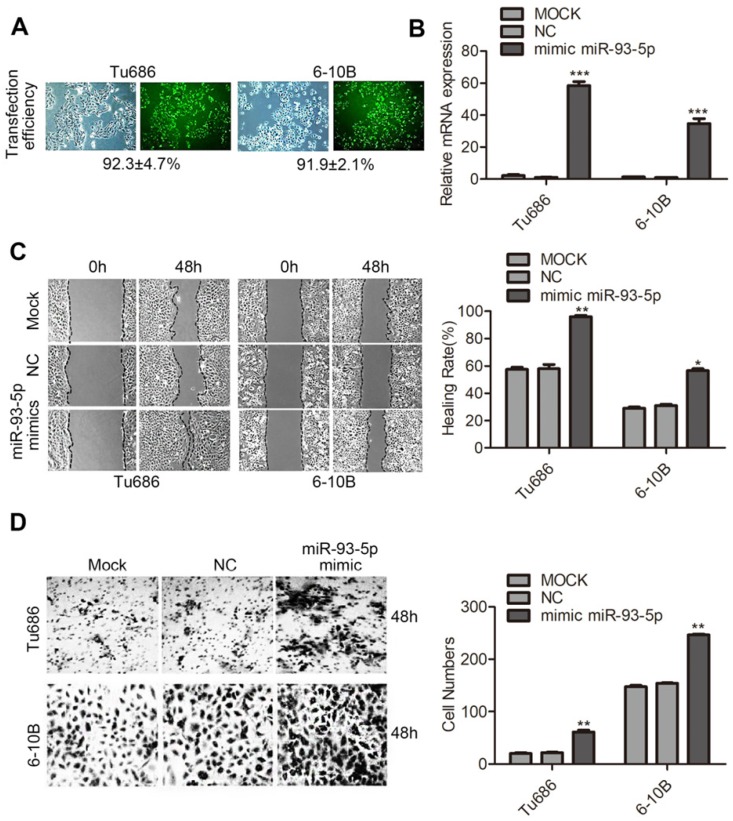
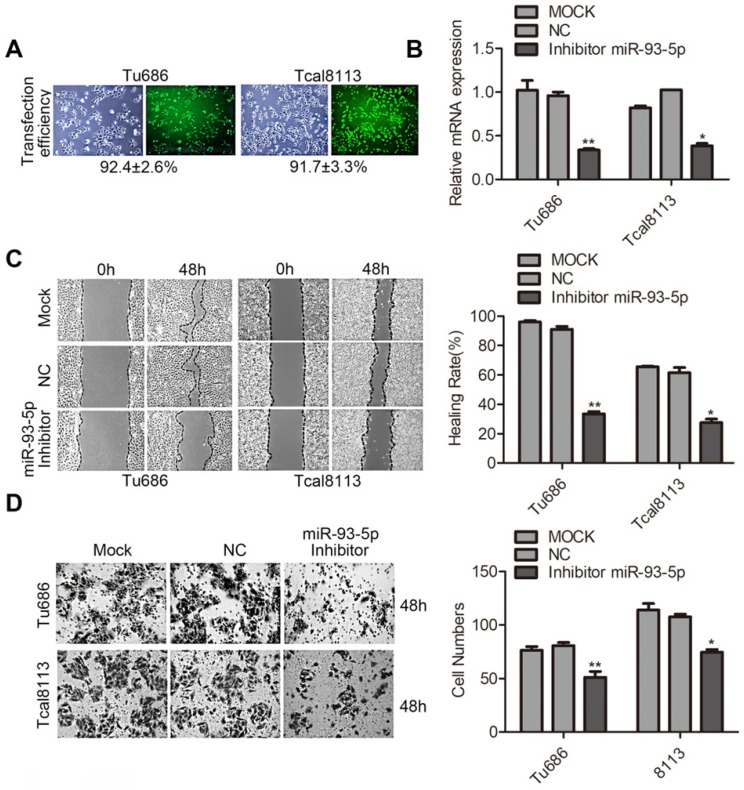
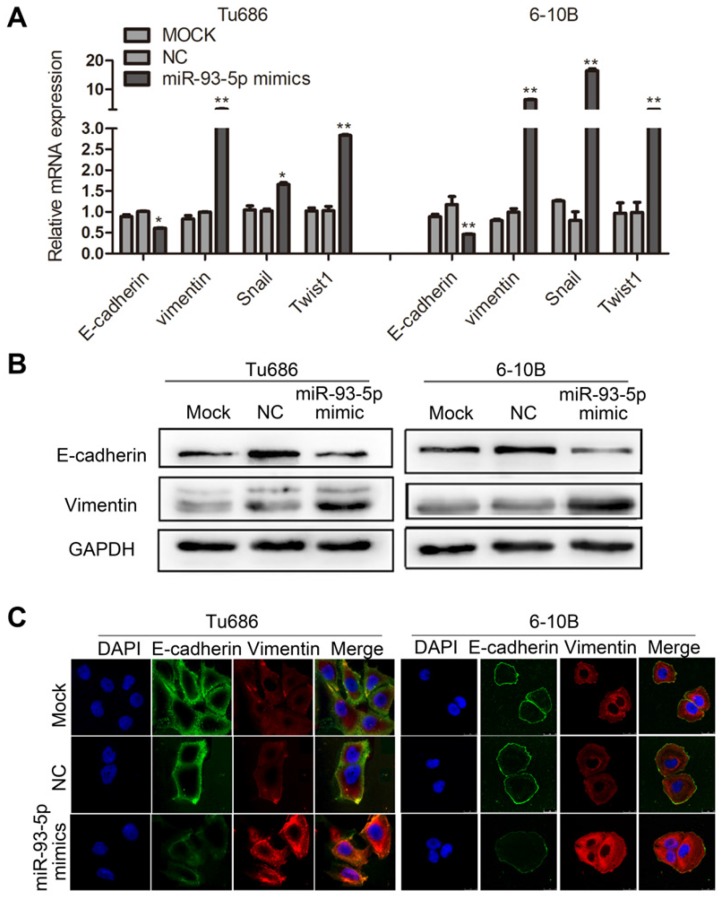
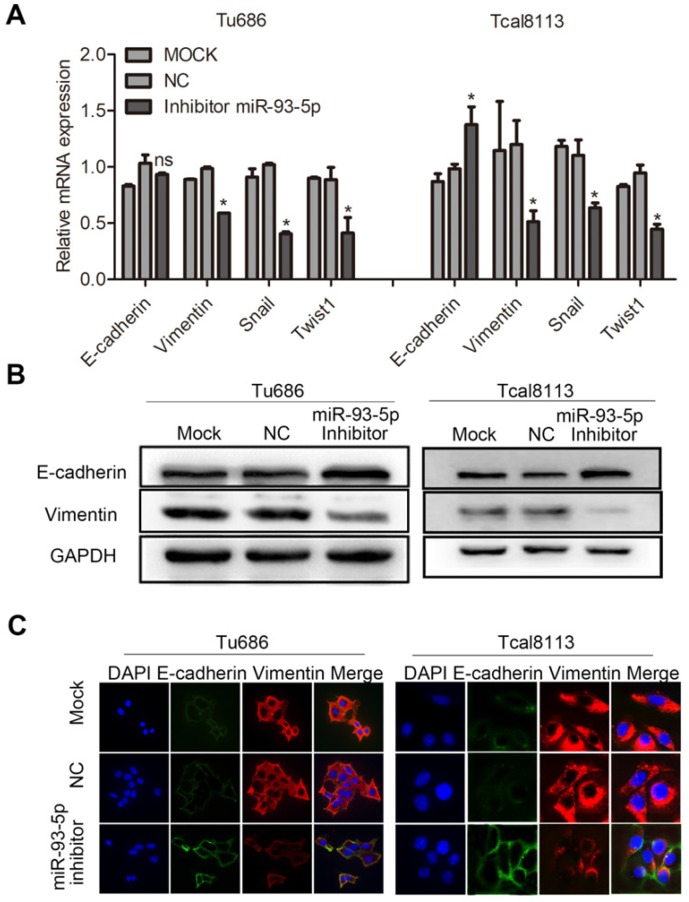
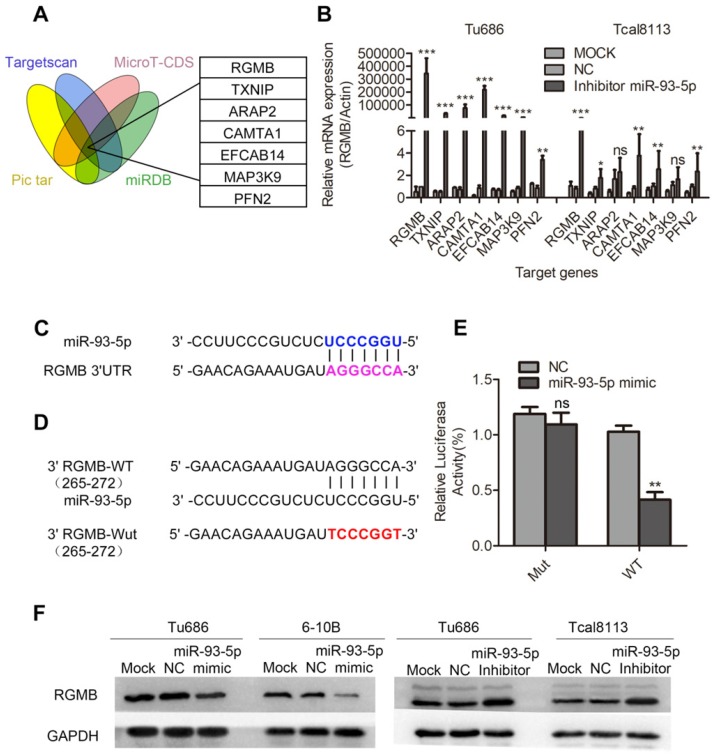
Invasion and metastasis represent the primary causes of therapeutic failure in patients diagnosed with squamous cell carcinoma of the head and neck (SCCHN). Therefore, disease prediction and inhibition of invasion and metastasis are critical for enhancing the survival of patients with SCCHN. Our previous study revealed that increased expression of miR-93-5p is associated with poor prognosis in SCCHN; however, the mechanism underlying the oncogenic functions of miR-93-5p in SCCHN migration and invasion remains unclear. Using qPCR analyses, transwell assays, and scratch tests, we demonstrated that expression of ectopic miR-93-5p induced the migration and invasion of SCCHN, and this was accompanied by corresponding alterations in biomarkers and transcription factors specific for epithelial-mesenchymal transition (EMT). Luciferase reporter assays were used to demonstrate that miR-93-5p directly targeted the 3' UTR of RGMB, and we further found that the tumor-promoting functions of miR-93-5p were partly mediated by targeting RGMB, whose downregulation also promoted the migration and invasion of SCCHN. Overall, our results indicate that miR-93-5p acts as an oncogene in the regulation of migration and invasion by suppressing RGMB in SCCHN. These findings provide novel evidence that miR-93-5p may serve as a valuable predictive biomarker and potential intervention target in patients with SCCHN.
侵袭和转移是头颈部鳞状细胞癌(SCCHN)患者治疗失败的主要原因。因此,疾病预测以及侵袭和转移的抑制对于提高SCCHN患者的生存率至关重要。我们之前的研究表明,miR-93-5p表达增加与SCCHN的不良预后相关;然而,miR-93-5p在SCCHN迁移和侵袭中的致癌功能背后的机制仍不清楚。通过定量聚合酶链反应(qPCR)分析、Transwell实验和划痕实验,我们证明异位表达miR-93-5p可诱导SCCHN的迁移和侵袭,并且这伴随着上皮-间质转化(EMT)特异性生物标志物和转录因子的相应改变。荧光素酶报告基因实验用于证明miR-93-5p直接靶向RGMB的3'非翻译区(UTR),并且我们进一步发现miR-93-5p的促肿瘤功能部分是通过靶向RGMB介导的,RGMB的下调也促进了SCCHN的迁移和侵袭。总体而言,我们的结果表明,miR-93-5p在SCCHN中通过抑制RGMB在迁移和侵袭的调节中起癌基因作用。这些发现提供了新的证据,表明miR-93-5p可能作为SCCHN患者有价值的预测生物标志物和潜在的干预靶点。