Aichinger Georg, Dellafiora Luca, Pantazi Foteini, Del Favero Giorgia, Galaverna Gianni, Dall'Asta Chiara, Marko Doris
Department of Food Chemistry and Toxicology, Faculty of Chemistry, University of Vienna, Austria. Währinger Str. 42, 1090, Vienna, Austria.
Department of Food and Drug, University of Parma, Area Parco delle Scienze 27/A, 43124, Parma, Italy.
Arch Toxicol. 2020 Jun;94(6):2225-2237. doi: 10.1007/s00204-020-02746-x. Epub 2020 Apr 23.
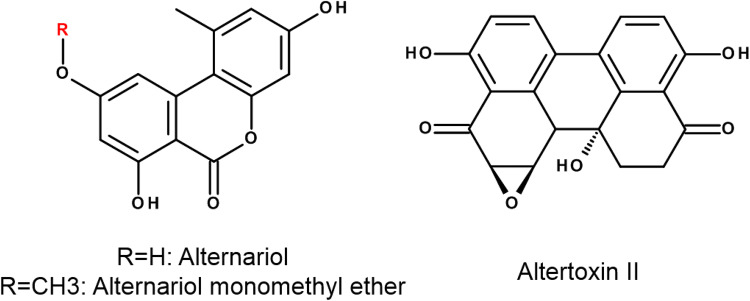
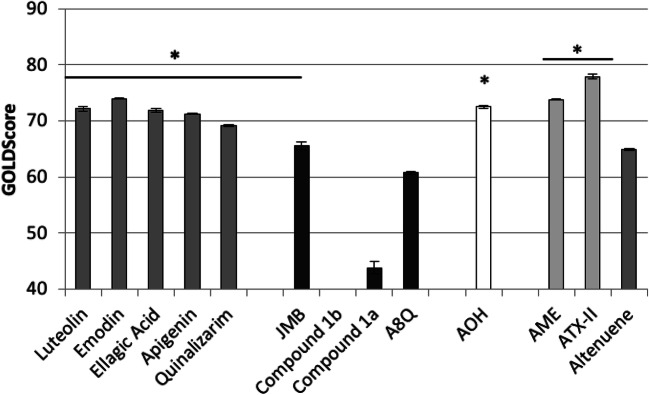
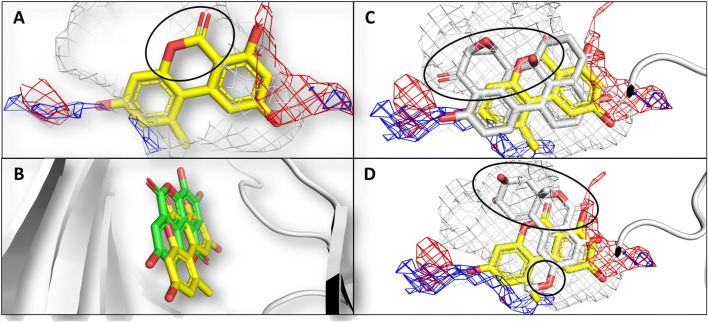
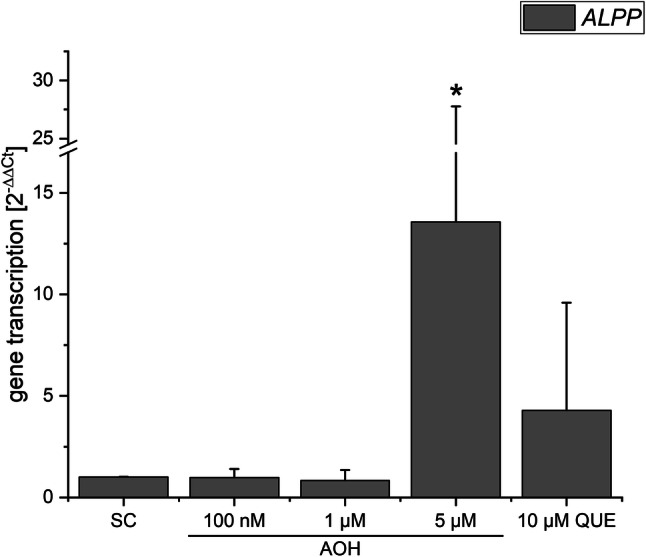
Emerging mycotoxins produced by Alternaria spp. were previously reported to exert cytotoxic, genotoxic, but also estrogenic effects in human cells. The involved mechanisms are very complex and not fully elucidated yet. Thus, we followed an in silico target fishing approach to extend knowledge on the possible biological targets underlying the activity of alternariol, taken as the signature compound of Alternaria toxins. Combining ligand-based screening and structure-based modeling, the ubiquitous casein kinase 2 (CK2) was identified as a potential target for the compound. This result was validated in a cell-free in vitro CK2 activity assay, where alternariol inhibited CK2 with an IC of 707 nM. As CK2 was recently discussed to influence estrogen receptor (ER) transcription and DNA-binding affinity, we assessed a potential impact on the mRNA levels of ERα or ERβ by qRT-PCR and on nuclear localization of the receptors by confocal microscopy, using estrogen-sensitive Ishikawa cells as a model. While AOH did not affect the transcription of ERα or ERβ, an increase in nuclear localization of ERα after incubation with 10 µM AOH was observed. However, this effect might be due to ER binding affinity and therefore estrogenicity of AOH. Furthermore, in silico docking simulation revealed not only AOH, but also a number of other Alternaria toxins as potential inhibitors of CK2, including alternariol monomethyl ether and the perylene quinone derivative altertoxin II (ATX-II). These findings were representatively confirmed in vitro for the perylene quinone derivative altertoxin II, which was found to inhibit the kinase with an IC of 5.1 µM. Taken together, we propose CK2 inhibition as an additional mechanism to consider in future studies for alternariol and several other Alternaria toxins.
链格孢属产生的新兴霉菌毒素此前被报道在人体细胞中具有细胞毒性、遗传毒性以及雌激素效应。其中涉及的机制非常复杂,尚未完全阐明。因此,我们采用了一种计算机辅助的靶点筛选方法,以扩展对作为链格孢毒素标志性化合物的交链孢酚活性潜在生物学靶点的认识。结合基于配体的筛选和基于结构的建模,发现普遍存在的酪蛋白激酶2(CK2)是该化合物的潜在靶点。这一结果在无细胞体外CK2活性测定中得到验证,其中交链孢酚以707 nM的半数抑制浓度(IC)抑制CK2。由于最近有人讨论CK2会影响雌激素受体(ER)的转录和DNA结合亲和力,我们以雌激素敏感的石川细胞为模型,通过qRT-PCR评估其对ERα或ERβ mRNA水平的潜在影响,并通过共聚焦显微镜评估其对受体核定位的影响。虽然AOH不影响ERα或ERβ的转录,但观察到用10 μM AOH孵育后ERα的核定位增加。然而,这种效应可能是由于AOH的ER结合亲和力以及因此产生的雌激素性。此外,计算机对接模拟显示,不仅AOH,还有许多其他链格孢毒素是CK2的潜在抑制剂,包括交链孢酚单甲醚和苝醌衍生物变应毒素II(ATX-II)。这些发现代表性地在体外对苝醌衍生物变应毒素II进行了验证,发现其以5.1 μM的IC抑制该激酶。综上所述,我们提出CK2抑制是未来研究交链孢酚和其他几种链格孢毒素时应考虑的另一种机制。