Dermatology and Laser Surgery Center of New York, Yale University School of Medicine, New York, New York.
Lasers Surg Med. 2021 Feb;53(2):185-198. doi: 10.1002/lsm.23247. Epub 2020 Apr 23.
More studies are needed to assess the long-term safety profile and clinical outcomes of lasers and energy-based devices to treat the symptoms associated with vulvovaginal atrophy. This study evaluated a series of three fractional CO laser treatments to the vulva and vagina with a 1-year follow-up in a postmenopausal population.
STUDY DESIGN/MATERIALS AND METHODS: In this prospective, self-controlled, open-label clinical study, 18 postmenopausal females with atrophic vaginitis received 3 monthly treatments to the vulva and vagina with a fractional CO laser system and 1-, 3-, 6-, and 12-month follow-up. Investigators used the Vaginal Health Index (VHI) to assess changes in vaginal elasticity, fluid volume, vaginal pH, epithelial integrity, and moisture. Sexual function at each timepoint was subject-reported, using the validated Female Sexual Function Index (FSFI).
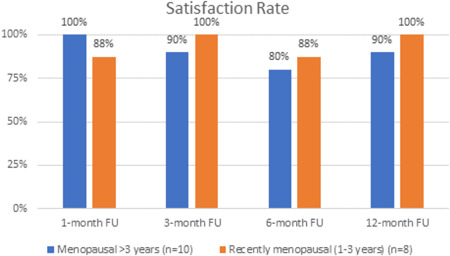
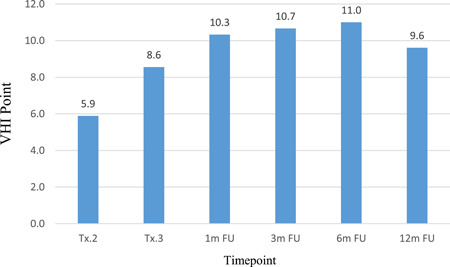
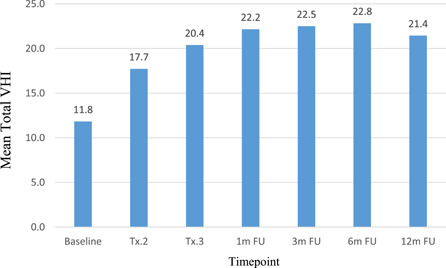
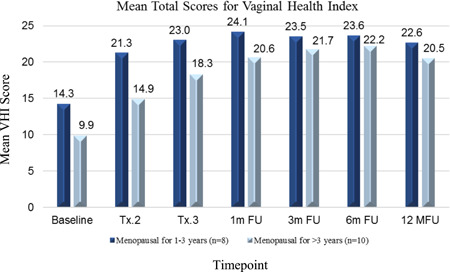
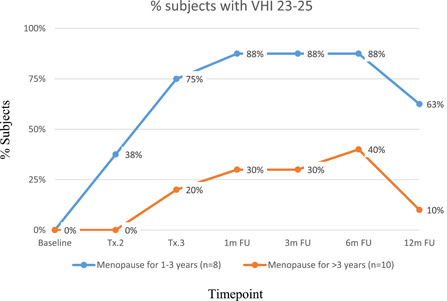
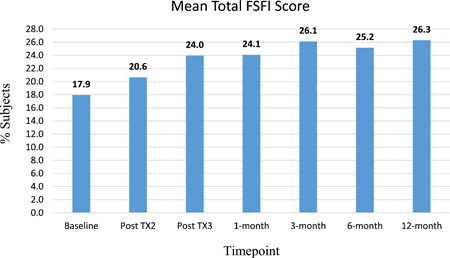
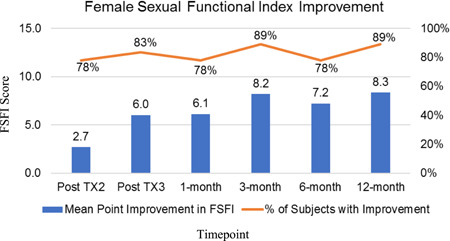
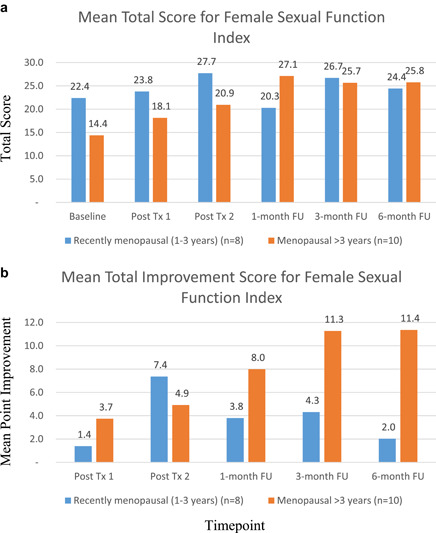
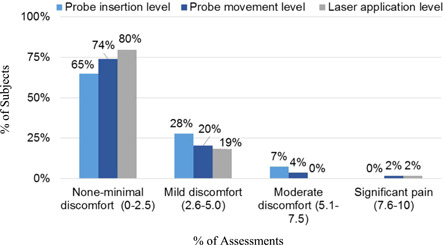
Treatment of the vulva and vagina in postmenopausal women with fractional CO laser resurfacing resulted in statistically significant improvements as compared with baseline at all post-treatment and follow-up intervals to 12 months in VHI and FSFI (P ≤ 0.003 and P ≤ 0.03, respectively). Mean total VHI score increased from a baseline of 11.8-22.8 (93.2% improved) at 6-month follow-up (P = 0.0002) slightly decreasing to 21.4 (81.4% improved) at 12-month follow-up post-treatment (P = 0.0003). Mean FSFI Scores increased from a baseline of 17.9-26.3 (46.9% improvement) at 12-month follow-up post-treatment (P ≤ 0.0048). Cohort analysis revealed restoration of normal or near-normal (23-25) VHI following laser treatment in the recently menopausal (1-3 years) greatly exceeded that of the >3 years postmenopausal population and the difference was statistically significant (P ≤ 0.05). Normal/near-normal VHI at 3-, 6-, and 12-month post-treatment was 88%, 88%, and 63% in the recently postmenopausal cohort, as compared with 30%, 40%, and 10% of the >3 years postmenopausal group (P ≤ 0.05). Patient satisfaction following treatment was rated as high at 94% at 12-month follow-up. Safety findings demonstrated no-to-slight discomfort in the majority of subjects and transient erythema and edema, with no adverse events associated with treatment.
Fractional CO laser treatment of the vulva and vagina resulted in statistically significant improvements in VHI and FSFI compared with baseline in postmenopausal population that were sustained to 12-month follow-up. Restoration of normal VHI was observed in a statistically significant greater percentage in the recently postmenopausal cohort (1-3 years) as compared with postmenopausal cohort of >3 years, suggesting that early intervention is correlated with improved outcomes. Lasers Surg. Med. © 2020 Wiley Periodicals, Inc.
需要更多的研究来评估激光和基于能量的设备治疗与外阴阴道萎缩相关症状的长期安全性和临床结果。本研究评估了一系列对外阴和阴道进行三次分批次 CO2 激光治疗,并在绝经后人群中进行了为期 1 年的随访。
研究设计/材料和方法:在这项前瞻性、自我对照、开放标签的临床研究中,18 名绝经后患有萎缩性阴道炎的女性接受了 3 次每月一次的外阴和阴道分批次 CO2 激光治疗,并在 1、3、6 和 12 个月进行了随访。研究人员使用阴道健康指数(VHI)评估阴道弹性、液体量、阴道 pH 值、上皮完整性和水分的变化。在每个时间点,使用经过验证的女性性功能指数(FSFI)进行主观报告的性功能。
在外阴和阴道接受分批次 CO2 激光换肤治疗的绝经后女性中,与基线相比,所有治疗后和随访至 12 个月的 VHI 和 FSFI 均有统计学显著改善(P≤0.003 和 P≤0.03,分别)。VHI 的平均总分从基线的 11.8-22.8(改善 93.2%)增加到 6 个月随访时(P=0.0002),在 12 个月随访时(P=0.0003)略有下降至 21.4(改善 81.4%)。FSFI 评分从基线的 17.9-26.3(改善 46.9%)增加到 12 个月随访时(P≤0.0048)。
队列分析显示,在最近绝经(1-3 年)的患者中,激光治疗后 VHI 恢复正常或接近正常(23-25)的比例大大超过绝经后>3 年的患者,差异具有统计学意义(P≤0.05)。最近绝经组在治疗后 3、6 和 12 个月的正常/接近正常 VHI 分别为 88%、88%和 63%,而绝经后>3 年组分别为 30%、40%和 10%(P≤0.05)。治疗后 12 个月的患者满意度评价为 94%。安全性发现,大多数患者仅有轻度不适和短暂的红斑和水肿,与治疗相关的不良反应。
分批次 CO2 激光治疗外阴和阴道与基线相比,在外阴阴道萎缩的绝经后人群中显著改善了 VHI 和 FSFI,并且在 12 个月的随访中持续改善。在最近绝经(1-3 年)的患者中,正常 VHI 的恢复比例明显高于绝经后>3 年的患者,这表明早期干预与改善结果相关。激光外科医学。2020 年威利父子公司。