Department of Obstetrics and Gynecology, Peking University People's Hospital, Xizhimen, South Street, Beijing, Beijing, 100044, China.
Department of Obstetrics and Gynecology, Peking University Shenzhen Hospital, Lianhua Road, Shenzhen, Guangdong, 518036, China.
Lasers Surg Med. 2021 Jul;53(5):647-653. doi: 10.1002/lsm.23346. Epub 2020 Nov 19.
Genitourinary syndrome of menopause (GSM) is a common condition affecting of most postmenopausal women, which greatly impacks the quality of life,and need to treat. This prospective multicenter cohort study aimed to compare the efficacy and safety of the fractional carbon dioxide (CO ) laser with that of topical estrogen for vaginal treatment and relieving symptoms of genitourinary syndrome of menopause (GSM).
STUDY DESIGN/MATERIALS AND METHODS: This study included 162 postmenopausal patients who received vaginal laser or topical Estriol cream therapy between January 2017 and May 2019 at eight study centers in China. The degree of GSM-related symptoms (vaginal burning, dryness, and dyspareunia) was evaluated using the Vaginal Health Index score (VHIS) and Visual Analog Scale (VAS) at baseline, 1, 3, 6, and 12 months posttreatment. The primary endpoint was the improvement in vaginal burning, dryness, and dyspareunia at 6 months after treatment. Multivariate logistic regression was used to compare the rate of improvement in the two groups.
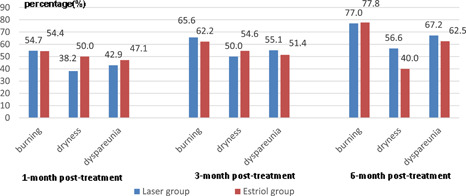
At baseline, the laser and control groups showed no significant difference in the mean age, time after menopause, and the VHIS (all P > 0.05). In the laser group, compared with baseline, significant differences were seen in the VHIS after the first or second treatment session and at 1, 3, 6, and 12 months posttreatment (P < 0.01). In the control group, compared with baseline, the VHIS showed significant differences after 1, 3, and 6 months of treatment (P < 0.05). However, there was no significant difference after 3 and 6 months of follow-up between the two groups (P > 0.05). The VHIS scores were significantly higher after 1 month (16.63 ± 2.79 vs. 15.57 ± 2.43) and 12 months (15.72 ± 2.59 vs. 12.12 ± 4.08) of treatment in both the groups (P < 0.05). At 6 months after treatment, both groups showed improvement in vaginal burning, vaginal dryness, and dyspareunia (P > 0.05). The VAS findings at 6 months posttreatment were significantly different when compared with the pretreatment findings (P < 0.001). There were no significant adverse effects in the two groups.
Fractional CO laser vaginal treatment could be a safe and effective option for treating symptoms of GSM, including vaginal burning, dryness, and dyspareunia. The improvement in symptoms was comparable with that seen with topical estrogen therapy and lasted for at least 6-12 months posttreatment. Lasers Surg. Med. © 2020 Wiley Periodicals LLC.
绝经后泌尿生殖系统综合征(GSM)是一种常见的影响大多数绝经后女性的疾病,极大地影响了生活质量,需要治疗。本前瞻性多中心队列研究旨在比较二氧化碳(CO )激光与局部雌激素阴道治疗和缓解绝经后泌尿生殖系统综合征(GSM)症状的疗效和安全性。
研究设计/材料和方法:本研究纳入了 2017 年 1 月至 2019 年 5 月期间在中国 8 个研究中心接受阴道激光或局部雌三醇乳膏治疗的 162 例绝经后患者。GSM 相关症状(阴道烧灼感、干燥和性交困难)的严重程度采用阴道健康指数评分(VHIS)和视觉模拟评分(VAS)在治疗前、治疗后 1、3、6 和 12 个月进行评估。主要终点是治疗后 6 个月阴道烧灼感、干燥和性交困难的改善情况。采用多变量逻辑回归比较两组的改善率。
治疗前,激光组和对照组在平均年龄、绝经后时间和 VHIS 方面均无显著差异(均 P > 0.05)。在激光组中,与基线相比,第一次或第二次治疗后以及治疗后 1、3、6 和 12 个月时 VHIS 有显著差异(P < 0.01)。在对照组中,与基线相比,VHIS 在治疗后 1、3 和 6 个月有显著差异(P < 0.05)。然而,两组在治疗后 3 和 6 个月的随访中无显著差异(P > 0.05)。两组治疗后 1 个月(16.63 ± 2.79 比 15.57 ± 2.43)和 12 个月(15.72 ± 2.59 比 12.12 ± 4.08)VHIS 评分均显著升高(P < 0.05)。治疗后 6 个月,两组阴道烧灼感、阴道干燥和性交困难均有改善(P > 0.05)。治疗后 6 个月时的 VAS 结果与治疗前相比有显著差异(P < 0.001)。两组均无明显不良反应。
CO 激光阴道治疗可作为治疗 GSM 症状(包括阴道烧灼感、干燥和性交困难)的安全有效方法。症状的改善与局部雌激素治疗相当,至少持续 6-12 个月。激光外科医学。2020 年 Wiley 期刊 LLC。