Alcaide-Aldeano Alex, Garay Alberto, Alcoberro Lídia, Jiménez-Marrero Santiago, Yun Sergi, Tajes Marta, García-Romero Elena, Díez-López Carles, González-Costello José, Mateus-Porta Gemma, Cainzos-Achirica Miguel, Enjuanes Cristina, Comín-Colet Josep, Moliner Pedro
University of Barcelona, School of Medicine, 08036 Barcelona, Spain.
Community Heart Failure Unit, Department of Cardiology, Bellvitge University Hospital, L'Hospitalet de Llobregat, 08907 Barcelona, Spain.
J Clin Med. 2020 Apr 22;9(4):1199. doi: 10.3390/jcm9041199.
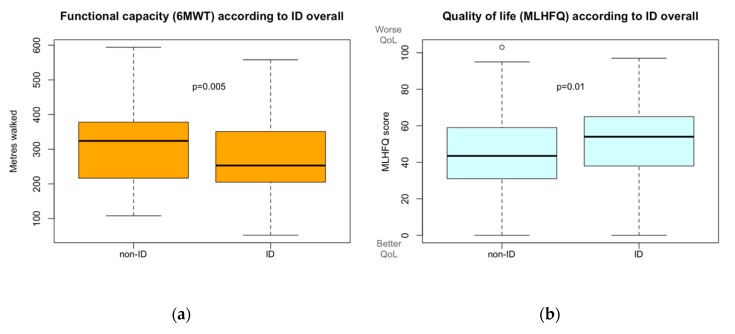
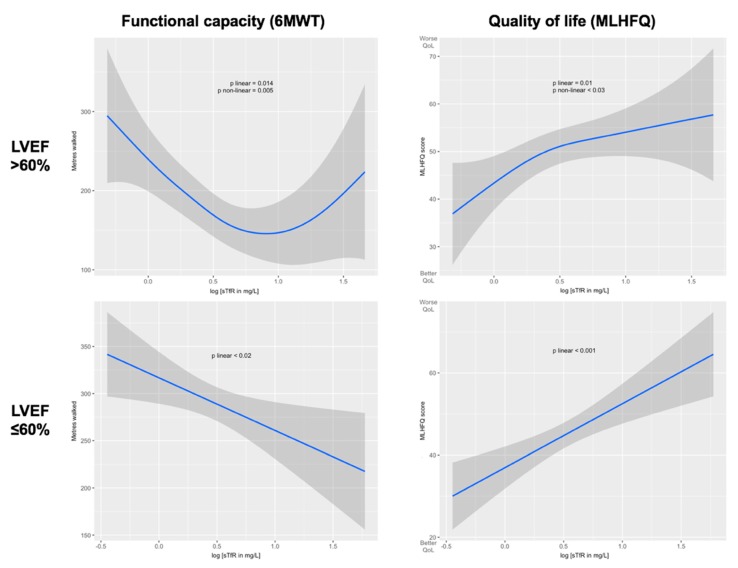
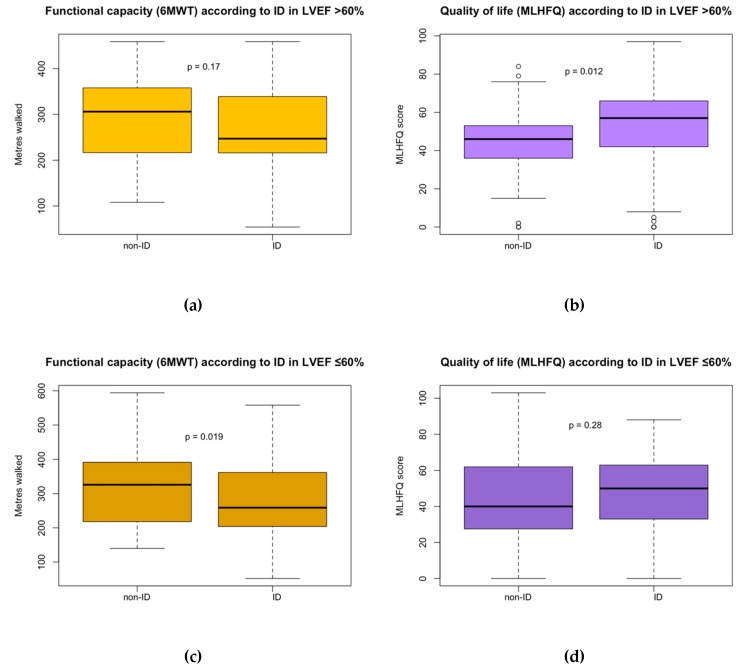
The effects of iron deficiency (ID) have been widely studied in heart failure (HF) with reduced ejection fraction. On the other hand, studies in HF with preserved ejection fraction (HFpEF) are few and have included small numbers of participants. The aim of this study was to assess the role that ID plays in functional capacity and quality of life (QoL) in HFpEF while comparing several iron-related biomarkers to be used as potential predictors. ID was defined as ferritin <100 ng/mL or transferrin saturation <20%. Submaximal exercise capacity, measured by the 6-min walking test (6MWT), and QoL, assessed by the Minnesotta Living with Heart Failure Questionnaire (MLHFQ), were compared between iron deficient patients and patients with normal iron status. A total of 447 HFpEF patients were included in the present cross-sectional study, and ID prevalence was 73%. Patients with ID performed worse in the 6MWT compared to patients with normal iron status (ID 271 ± 94 m vs. non-ID 310 ± 108 m, < 0.01). They also scored higher in the MLHFQ, denoting worse QoL (ID 49 ± 22 vs. non-ID 43 ± 23, = 0.01). Regarding iron metabolism biomarkers, serum soluble transferrin receptor (sTfR) was the strongest independent predictor of functional capacity (β = -63, < 0.0001, R 0.39) and QoL (β = 7.95, < 0.0001, R 0.14) in multivariate models. This study postulates that ID is associated with worse functional capacity and QoL in HFpEF as well, and that sTfR is the best iron-related biomarker to predict both. Our study also suggests that the effects of ID could differ among HFpEF patients by left ventricular ejection fraction.
缺铁(ID)对射血分数降低的心力衰竭(HF)的影响已得到广泛研究。另一方面,关于射血分数保留的心力衰竭(HFpEF)的研究较少,且纳入的参与者数量不多。本研究的目的是评估ID在HFpEF患者的功能能力和生活质量(QoL)中所起的作用,同时比较几种与铁相关的生物标志物作为潜在预测指标。ID定义为铁蛋白<100 ng/mL或转铁蛋白饱和度<20%。通过6分钟步行试验(6MWT)测量的次极量运动能力和通过明尼苏达心力衰竭生活问卷(MLHFQ)评估的QoL,在缺铁患者和铁状态正常的患者之间进行了比较。本横断面研究共纳入447例HFpEF患者,ID患病率为73%。与铁状态正常的患者相比,ID患者在6MWT中的表现更差(ID组为271±94米,非ID组为310±108米,<0.01)。他们在MLHFQ中的得分也更高,表明QoL更差(ID组为49±22,非ID组为43±23,=0.01)。关于铁代谢生物标志物,在多变量模型中,血清可溶性转铁蛋白受体(sTfR)是功能能力(β=-63,<0.0001,R 0.39)和QoL(β=7.95,<0.0001,R 0.14)的最强独立预测指标。本研究推测,ID在HFpEF中也与更差的功能能力和QoL相关,并且sTfR是预测两者的最佳铁相关生物标志物。我们的研究还表明,ID的影响在HFpEF患者中可能因左心室射血分数而异。