Clinica Medica 3, Department of Medicine - DIMED, University of Padova, 35128 Padova, Italy.
Department of Medicine, Klinikum Rheine, 48431 Rheine, Germany.
Cells. 2020 Apr 22;9(4):1047. doi: 10.3390/cells9041047.
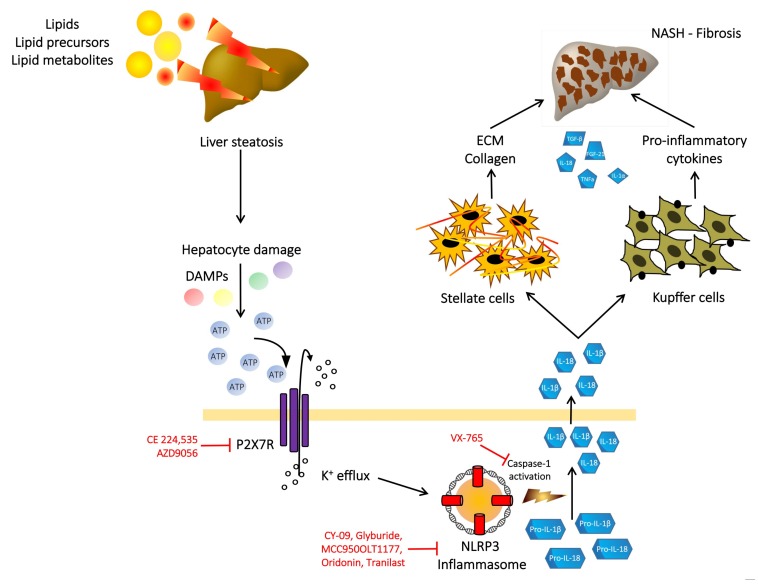
Non-alcoholic fatty liver disease (NAFLD) is the most common liver disease worldwide, and its prevalence is reaching epidemic characteristics both in adults and in children. The increase of NAFLD prevalence parallels that of obesity, now representing the major cause of liver inflammation, increasing the risk of cirrhosis and hepatocarcinoma. Furthermore, NAFLD is a risk factor for cardiovascular diseases and type 2 diabetes, two of the major leading causes of morbidity and mortality in western countries. Thus a significant amount of studies have dealt with the evaluation of the possible molecular mechanisms leading to NAFLD and its inflammatory consequences within the liver, the non-alcoholic steatohepatitis, and cirrhosis. The inflammasome is a key player in the inflammation and fibrogenic responses in many different tissues, including the liver. The activation of the NLRP3 inflammasome requires the activation by extracellular adenosine tri-phosphate (ATP) of a specific purinergic receptor named P2X7 located in the target cells, although other pathways have been described. To this regard, extracellular ATP acts as an internal danger signal coming from damaged cells participating in the activation of the inflammatory process, a signaling pathway common to many different tissues. Here, we briefly review the involvement of the P2X7 receptor/inflammasome NLRP3 axis in the pathophysiological events leading to NAFLD and its inflammatory and fibrotic evolutions, reporting the possible therapeutical strategies targeting the P2X7 receptor/NLRP3 inflammasome.
非酒精性脂肪性肝病(NAFLD)是全球最常见的肝脏疾病,其患病率在成人和儿童中均呈流行趋势。NAFLD 患病率的增加与肥胖症的增加是平行的,肥胖症现在是肝脏炎症的主要原因,增加了肝硬化和肝癌的风险。此外,NAFLD 也是心血管疾病和 2 型糖尿病的一个危险因素,这两种疾病是西方国家发病率和死亡率的主要原因。因此,大量研究致力于评估导致 NAFLD 及其在肝脏中的炎症后果(非酒精性脂肪性肝炎和肝硬化)的可能分子机制。炎症小体是许多不同组织(包括肝脏)炎症和纤维化反应的关键参与者。NLRP3 炎症小体的激活需要细胞外三磷酸腺苷(ATP)激活位于靶细胞中的特定嘌呤能受体 P2X7,尽管已经描述了其他途径。在这方面,细胞外 ATP 作为来自受损细胞的内部危险信号,参与激活炎症过程,这是许多不同组织共有的信号通路。在这里,我们简要回顾了 P2X7 受体/炎症小体 NLRP3 轴在导致 NAFLD 及其炎症和纤维化演变的病理生理事件中的作用,并报告了针对 P2X7 受体/NLRP3 炎症小体的可能治疗策略。