Song Qi, Zhang Jie, Wu Qibiao, Li Guoping, Leung Elaine Lai-Han
State Key Laboratory of Quality Research in Chinese Medicine, Macau University of Science and Technology, Taipa, Macau (SAR).
Department of Cardiothoracic Surgery, The Affiliated Hospital, Southwest Medical University, No. 25, Taiping St., Luzhou, Sichuan, China.
Medicine (Baltimore). 2020 Apr;99(17):e19480. doi: 10.1097/MD.0000000000019480.
The digestive tract malignancies are a series of malignant tumor with high morbidity and mortality. Traditional Chinese medicine (TCM) combined with chemotherapy drugs interventions have been applied for the treatment of malignant tumors in Asian countries for dacades. This study aimed to assess the effectiveness and safety on the combination of Kanglaite injection and fluorouracil-based chemotherapy for treating digestive tract malignancies.
To assess the effectiveness and safety on the combination of Kanglaite injection and fluorouracil-based chemotherapy for digestive tract malignancies.
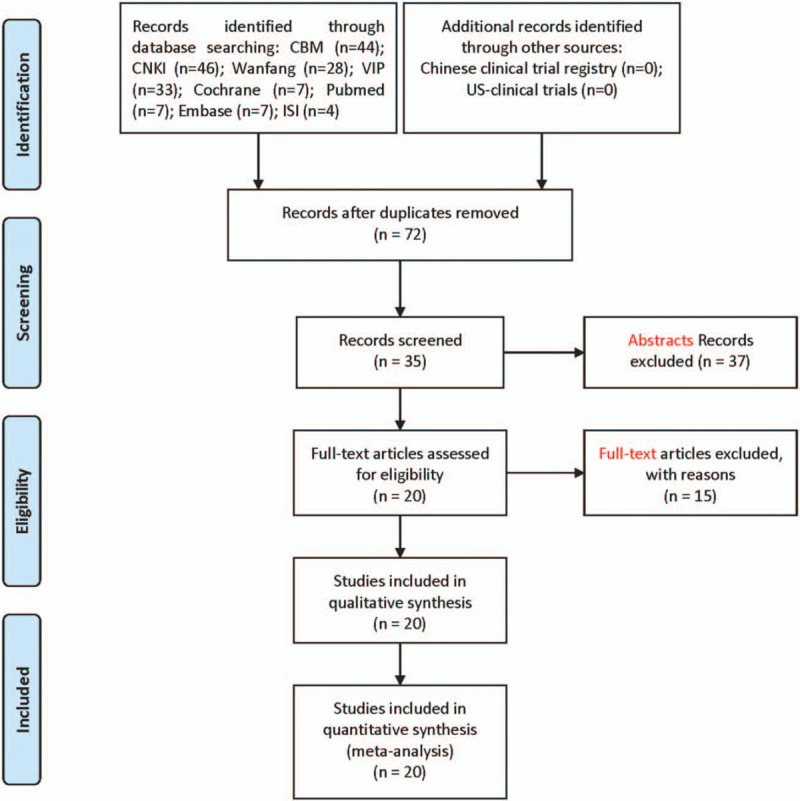
The Preferred Reporting Items for Systematic Reviews and Meta-Analyses (PRISMA) guidelines were followed when conducting the meta-analysis. Randomized controlled trials (RCTs) of Kanglaite injection combined with fluorouracil-based chemotherapy in the treatment of digestive tract malignant tumors were selected and assessed for inclusion. RevMan 5.3 software (Cochrane Collaboration, Oxford, UK) was used for meta-analysis. The objective response rate (ORR) was defined as the primary endpoint, and the disease control rate (DCR), quality of life (QoL), and toxicities were the secondary outcomes.
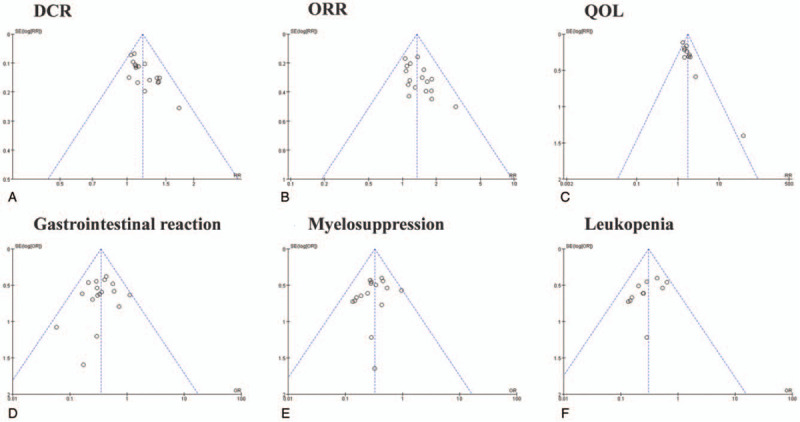
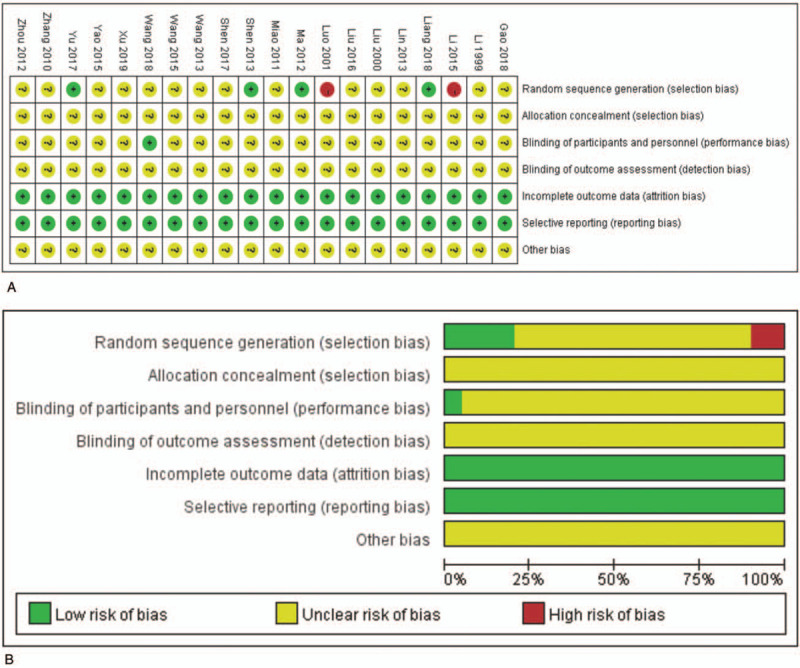
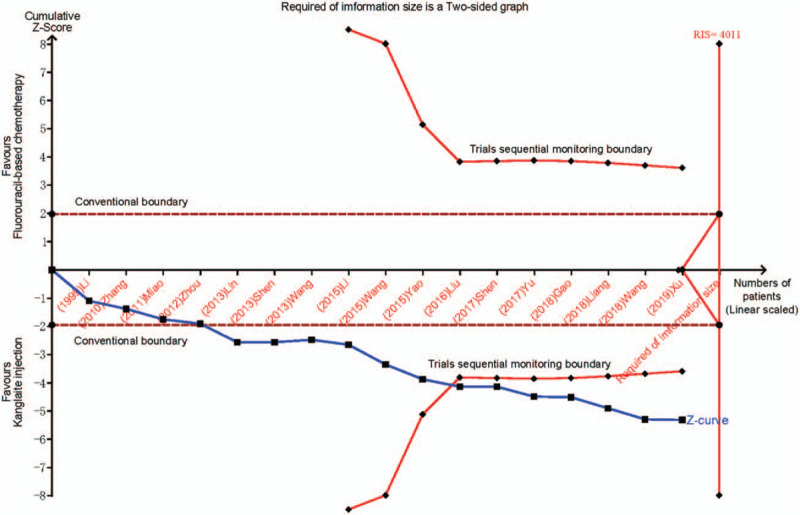
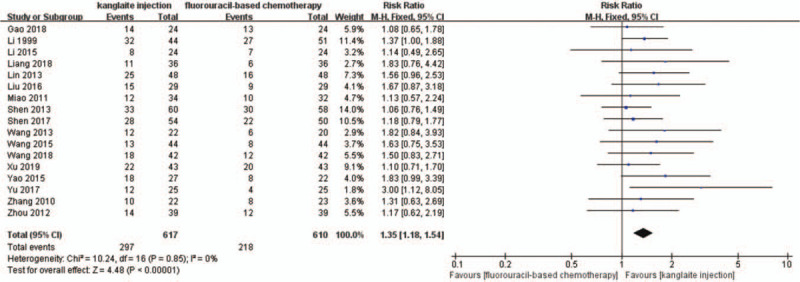
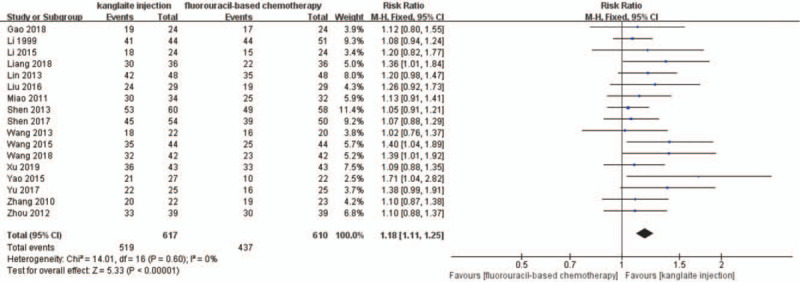
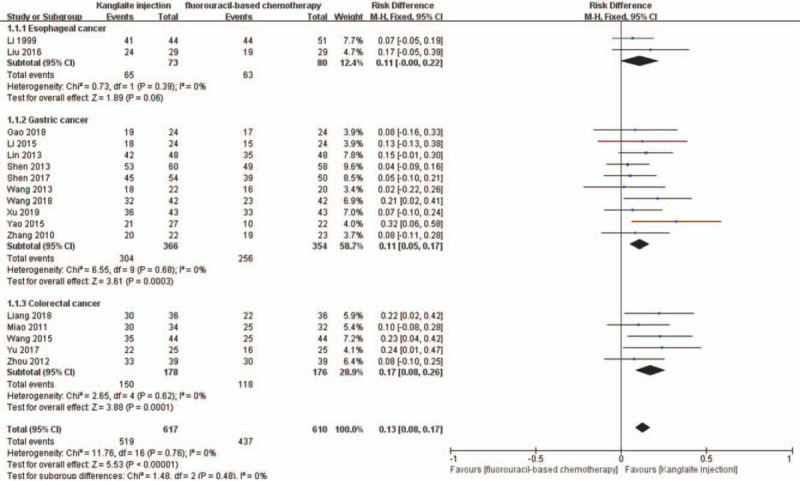
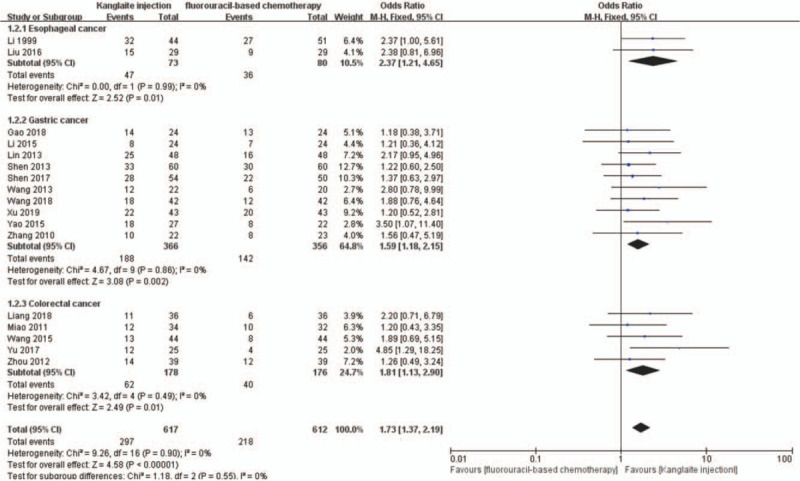
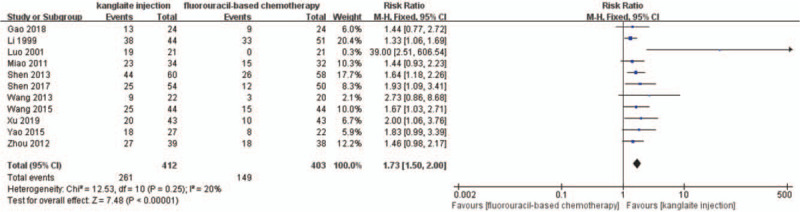
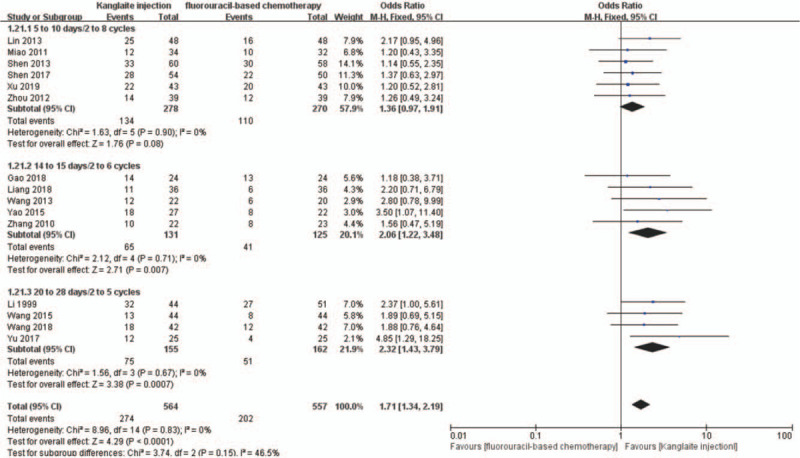
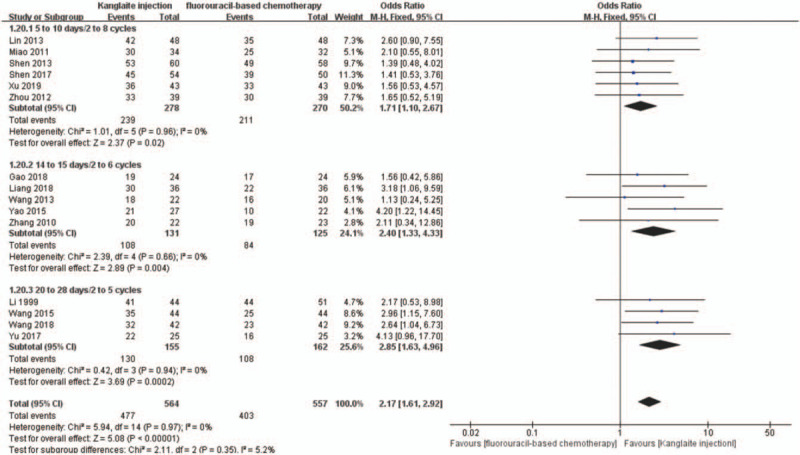
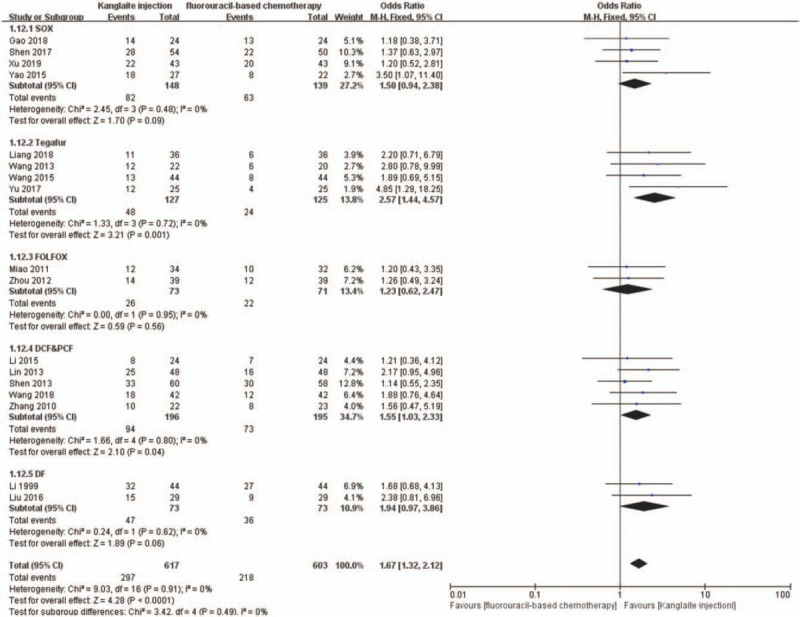
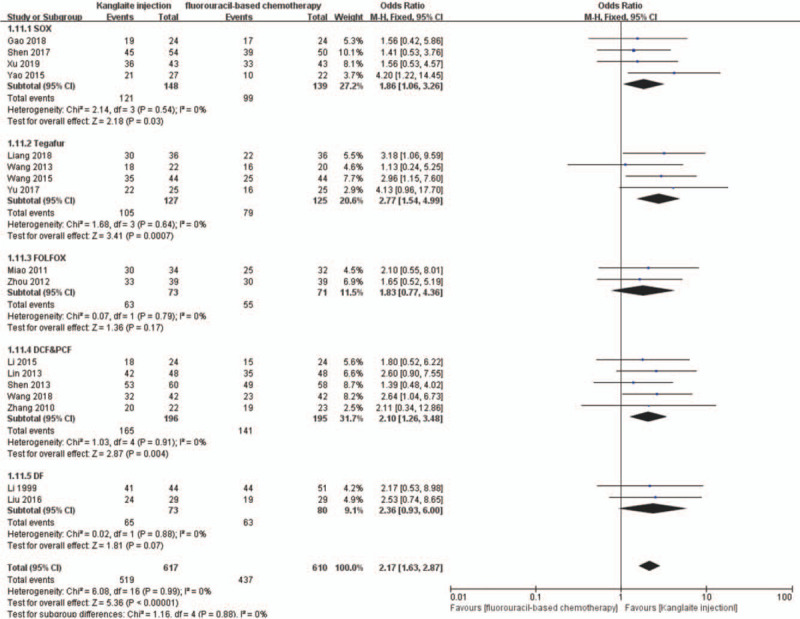
20 RCTs enrolling 1339 patients with advanced digestive tract malignancies were included. The methodological quality of most included trials was low to moderate. Compared with fluorouracil-based chemotherapy alone, Kanglaite injection plus fluorouracil-based chemotherapy can improve DCR (risk ratio (RR) = 1.18, 95% confidence interval (CI) 1.11-1.25, P < .00001), ORR (RR = 1.35, 95% CI 1.18-1.54, P < .00001), QoL (RR = 1.58, 95% CI 1.35-1.85, P < .00001), and can reduce adverse drug reactions (ADRs) such as myelosuppression (RR = 0.33, 95% CI 0.25-0.43, P < .00001), leukopenia (RR = 0.31, 95% CI 0.22-0.43, P < .00001), thrombocytopenia (RR = 0.6, 95% CI 0.38-0.49, P = .03), neutropenia (RR = 0.26, 95% CI 0.12-0.55, P = .0005), anemia (RR = 0.41, 95% CI 0.23-0.75, P = .004), gastrointestinal reaction (RR = 0.35, 95% CI 0.27-0.46, P < .00001), nausea/vomiting (RR = 0.41, 95% CI 0.28-0.61, P < .00001), diarrhea (RR = 0.34, 95% CI 0.18-0.62, P = .0004), hepatotoxicity (RR = 0.28, 95% CI 0.17-0.47, P < .00001), neurotoxicity (RR = 0.58, 95% CI 0.41-0.82, P = .002), mucositis (RR = 0.59, 95% CI 0.29-1.21, P = .15).
Kanglaite injection combined with fluorouracil-based chemotherapy could remarkably improve the clinical effectiveness and reduce the adverse effects in patients with advanced malignant tumors of the digestive tract which may provide evidence to judge whether TCM is an effective and safe intervention for the digestive tract malignancies.
消化道恶性肿瘤是一类发病率和死亡率都很高的恶性肿瘤。在亚洲国家,中药联合化疗药物干预已应用于恶性肿瘤治疗数十年。本研究旨在评估康莱特注射液联合氟尿嘧啶类化疗治疗消化道恶性肿瘤的有效性和安全性。
评估康莱特注射液联合氟尿嘧啶类化疗治疗消化道恶性肿瘤的有效性和安全性。
进行荟萃分析时遵循系统评价和荟萃分析的首选报告项目(PRISMA)指南。选取康莱特注射液联合氟尿嘧啶类化疗治疗消化道恶性肿瘤的随机对照试验(RCT)并评估纳入情况。使用RevMan 5.3软件(英国牛津Cochrane协作网)进行荟萃分析。客观缓解率(ORR)被定义为主要终点,疾病控制率(DCR)、生活质量(QoL)和毒性为次要结局。
纳入20项RCT,共1339例晚期消化道恶性肿瘤患者。大多数纳入试验的方法学质量为低到中等。与单纯氟尿嘧啶类化疗相比,康莱特注射液联合氟尿嘧啶类化疗可提高DCR(风险比(RR)=1.18,95%置信区间(CI)1.11 - 1.25,P <.00001)、ORR(RR = 1.35,95% CI 1.18 - 1.54,P <.00001)、QoL(RR = 1.58,95% CI 1.35 - 1.85,P <.00001),并可减少骨髓抑制(RR = 0.33,95% CI 0.25 - 0.43,P <.00001)、白细胞减少(RR = 0.31,95% CI 0.22 - 0.43,P <.00001)、血小板减少(RR = 0.6,95% CI 0.38 - 0.49,P =.03)、中性粒细胞减少(RR = 0.26,95% CI 0.12 - 0.55,P =.0005)、贫血(RR = 0.41,95% CI 0.23 - 0.75,P =.004)、胃肠道反应(RR = 0.35,95% CI 0.27 - 0.46,P <.00001)、恶心/呕吐(RR = 0.41,95% CI 0.28 - 0.61,P <.00001)、腹泻(RR = 0.34,95% CI 0.18 - 0.62,P =.0004)、肝毒性(RR = 0.28,95% CI 0.17 - 0.47,P <.00001)、神经毒性(RR = 0.58,95% CI 0.41 - 0.82,P =.002)、口腔黏膜炎(RR = 0.59,95% CI 0.29 - 1.21,P =.15)等药物不良反应。
康莱特注射液联合氟尿嘧啶类化疗可显著提高晚期消化道恶性肿瘤患者的临床疗效并减少不良反应,这可能为判断中药对消化道恶性肿瘤是否为有效且安全的干预措施提供依据。