Han Xuke, Gao Yang, Wang Shengju, Chen Qiu
Hospital of Chengdu University of Traditional Chinese Medicine.
Chengdu University of Traditional Chinese Medicine, Chengdu, Sichuan Province, China.
Medicine (Baltimore). 2020 Apr;99(17):e19843. doi: 10.1097/MD.0000000000019843.
The most common and bothersome lower urinary tract complication of diabetes mellitus is diabetic neurogenic bladder (DNB). Acupuncture has certain advantages in treating bladder dysfunction including urinary retention and incontinence. Therefore, we think that electroacupuncture (EA) may be beneficial to DNB patients. However, it is not clear whether EA combined with basic western medicine could optimize the therapeutic effect for DNB.
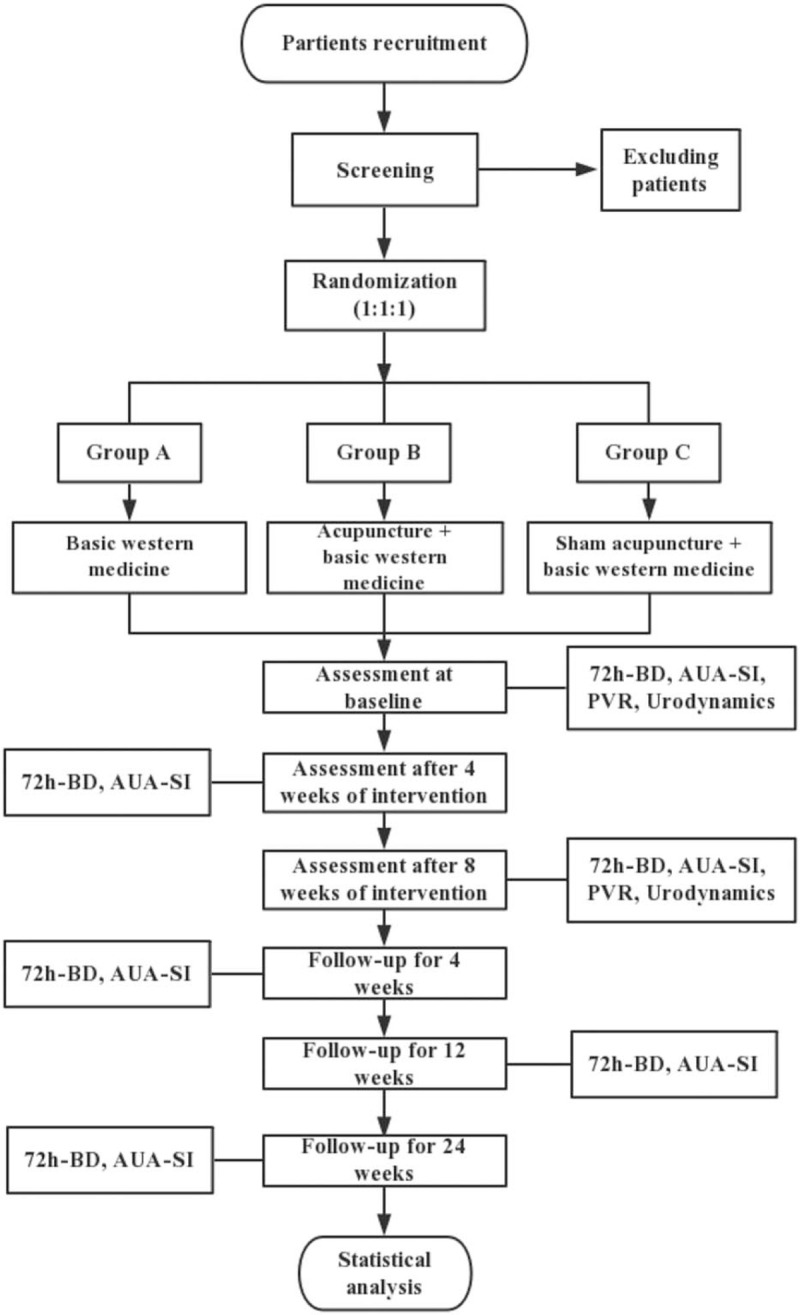
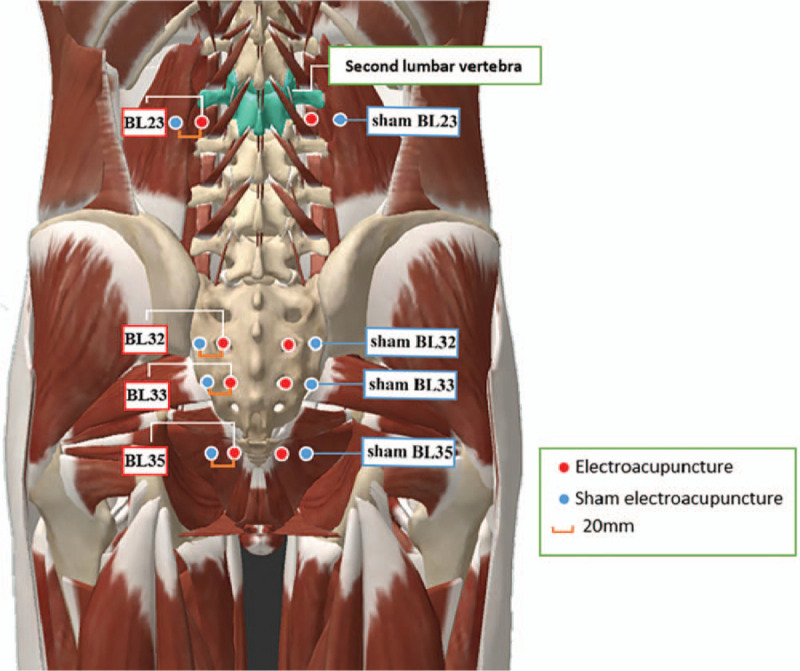
METHOD/DESIGN: This is a sham-controlled, patient-blinded, pioneer randomized controlled trial (RCT). One hundred fifty eligible patients will be randomly divided into 3 groups: A. basic western medicine (BWC), B. EA with BWC, C. sham EA with BWC. EA treatment will be given twice a week for 12 weeks at bilateral BL23, BL32, BL33, and BL35. The BWC group will received Alpha-lipoic acid (ALA) and methylcobalamin (MC) treatment for 12 weeks, 2 treatment sessions per week. The primary outcome is scored by the 72-hour bladder diary (72h-BD). The secondary outcomes will be scored by the American Urological Association symptom index (AUA-SI), Post-void residual urine volume (PVR) and urodynamic tests. All the assessments will be conducted at baseline and the 12th weeks after the intervention starts. The follow-up assessments will be performed with 72h-BD and AUA-SI in the 4th, 12th, and 24th weeks after intervention ends.
This trial protocol provides an example of the clinical application acupuncture treatment in the management of DNB. This RCT will provide us information on the effect of treating DNB patients with only acupuncture, western medicine therapy (ALA + MC) as well as the combination of both. The additive effect or synergistic effect of acupuncture and basic western medicine will then be analyzed.
Chinese Clinical Trial Registry, ChiCTR2000030421.
糖尿病最常见且令人困扰的下尿路并发症是糖尿病神经源性膀胱(DNB)。针刺在治疗膀胱功能障碍(包括尿潴留和尿失禁)方面具有一定优势。因此,我们认为电针(EA)可能对DNB患者有益。然而,EA联合基础西医治疗是否能优化DNB的治疗效果尚不清楚。
方法/设计:这是一项假针刺对照、患者盲法的前瞻性随机对照试验(RCT)。150例符合条件的患者将被随机分为3组:A.基础西医治疗组(BWC),B. EA联合BWC组,C.假EA联合BWC组。电针治疗将在双侧膀胱俞(BL23)、次髎(BL32)、中髎(BL33)和下髎(BL35)进行,每周2次,共12周。BWC组将接受α-硫辛酸(ALA)和甲钴胺(MC)治疗12周,每周2次。主要结局通过72小时膀胱日记(72h-BD)评分。次要结局将通过美国泌尿外科学会症状指数(AUA-SI)、排尿后残余尿量(PVR)和尿动力学检查评分。所有评估将在基线以及干预开始后的第12周进行。随访评估将在干预结束后的第4、12和24周用72h-BD和AUA-SI进行。
本试验方案提供了针刺治疗在DNB管理中的临床应用实例。这项RCT将为我们提供仅用针刺、西医治疗(ALA + MC)以及两者联合治疗DNB患者的效果信息。然后将分析针刺与基础西医的相加作用或协同作用。
中国临床试验注册中心,ChiCTR2000030421。