Chang Mineok, Lee Hea-Yeon, Seo Suk Min, Koh Yoon-Seok, Park Hun-Jun, Kim Pum-Joon, Seung Ki-Bae
Division of Cardiology, Seoul National University Hospital.
Health promotion center, Seoul St. Mary's Hospital.
Medicine (Baltimore). 2020 Apr;99(17):e19865. doi: 10.1097/MD.0000000000019865.
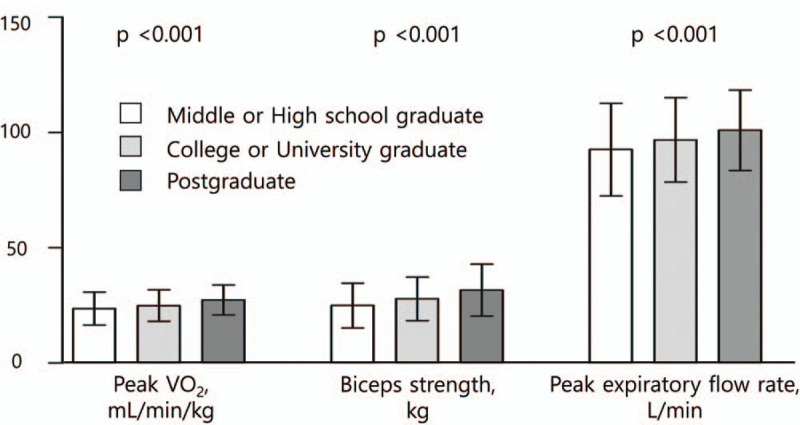
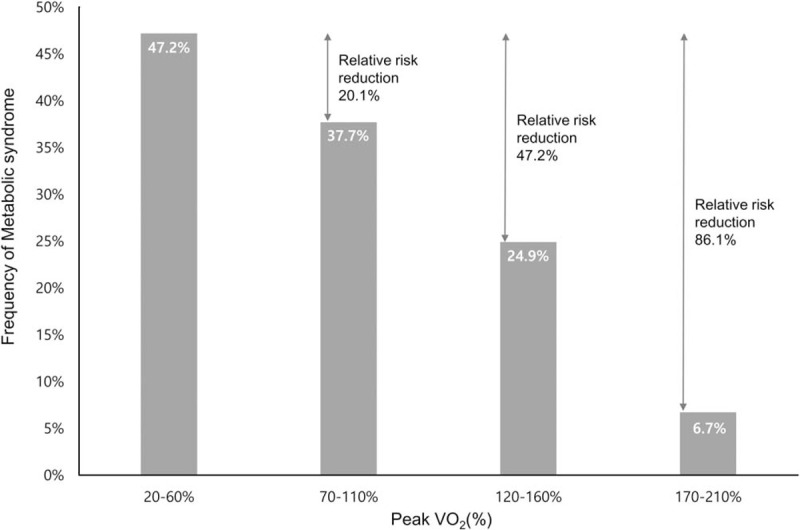
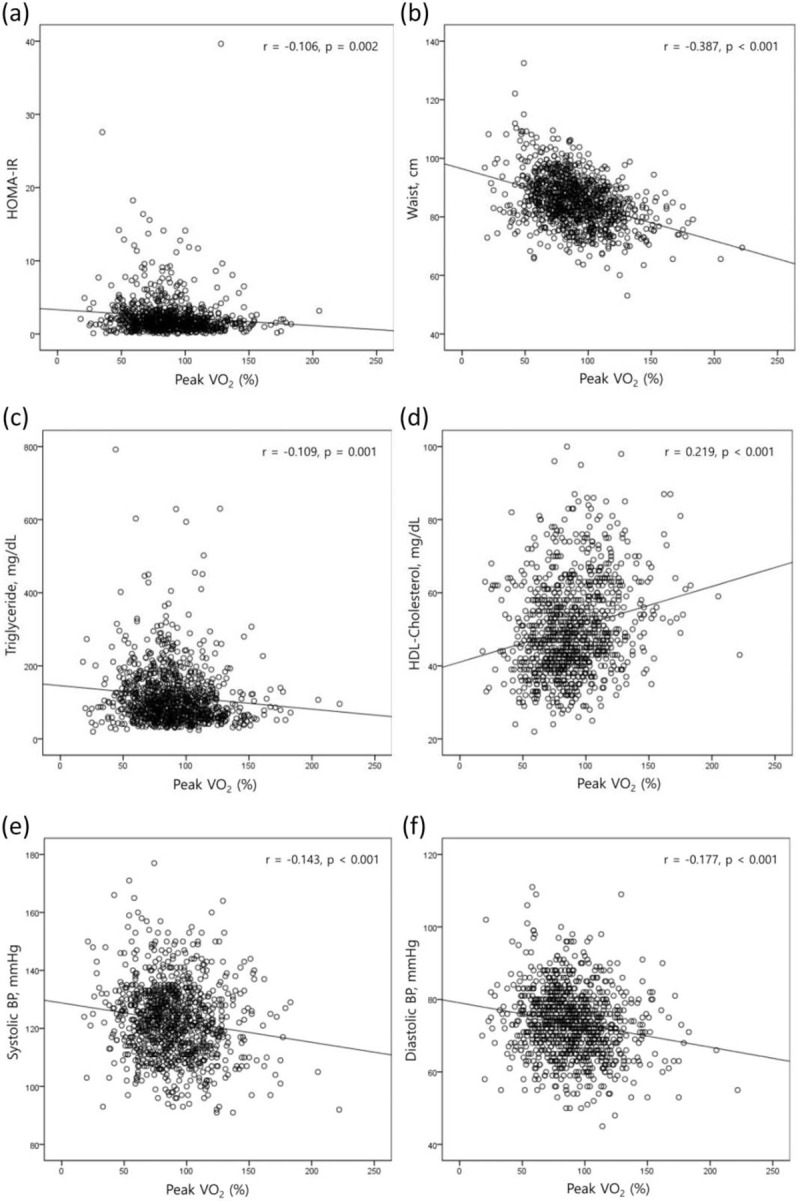
The aim of this study was to evaluate the relationship between educational attainment and cardiorespiratory fitness (CRF) as a predictor of metabolic syndrome in a Korean population.In this single-center, retrospective cross-sectional study, 988 healthy adults (601 men and 387 women) who underwent regular health check-up in Seoul St. Mary's Hospital were analyzed. Educational attainment was categorized into 3 groups according to their final grade of educational course: middle or high school (≤12 years of education), college or university (12-16 years of education), and postgraduate (≥16 years of education). CRF was assessed by cardiopulmonary exercise testing, biceps strength, hand grip strength, bioelectrical impedance analysis, and echocardiography. Metabolic syndrome was diagnosed according to the 3rd report of the National Cholesterol Education Program.Among the subjects, 357 (36.1%) had metabolic syndrome. The postgraduate group had significantly higher peak oxygen consumption (VO2), biceps strength, hand grip strength, and peak expiratory flow than other groups (all P < .001). This group showed better left ventricular diastolic function, in terms of deceleration time of mitral inflow, maximal tricuspid valve regurgitation velocity, and left atrial volume index than other groups. Peak VO2 (%) was significantly correlated with all the parameters of metabolic syndrome, including insulin resistance (r = -0.106, P = .002), waist circumference (r = -0.387, P < .001), triglyceride (r = -0.109, P = .001), high density lipoprotein-cholesterol (r = 0.219, P < .001), systolic blood pressure (r = -0.143, P < .001), and diastolic blood pressure (r = -0.177, P < .001). And Peak VO2 (%) was found to be a predictor of metabolic syndrome (adjusted β = .988, P < .001). However, the level of education was not able to predict metabolic syndrome (postgraduate group; β = .955, P = .801).Although the postgraduate group had better CRF than other groups, the educational attainment could not exclusively predict metabolic syndrome in this study. Further research is needed to reveal the socioeconomic mechanism of developing metabolic syndrome.
本研究旨在评估韩国人群中教育程度与心肺适能(CRF)之间的关系,将其作为代谢综合征的预测指标。在这项单中心回顾性横断面研究中,分析了在首尔圣玛丽医院接受定期健康检查的988名健康成年人(601名男性和387名女性)。根据教育课程的最终年级,将教育程度分为3组:初中或高中(教育年限≤12年)、大专或本科(教育年限12 - 16年)以及研究生(教育年限≥16年)。通过心肺运动测试、二头肌力量、握力、生物电阻抗分析和超声心动图评估CRF。根据美国国家胆固醇教育计划第三次报告诊断代谢综合征。在研究对象中,357人(36.1%)患有代谢综合征。研究生组的峰值耗氧量(VO2)、二头肌力量、握力和呼气峰值流速显著高于其他组(所有P<0.001)。就二尖瓣流入减速时间、最大三尖瓣反流速度和左心房容积指数而言,该组的左心室舒张功能优于其他组。峰值VO2(%)与代谢综合征的所有参数显著相关,包括胰岛素抵抗(r=-0.106,P=0.002)、腰围(r=-0.387,P<0.001)、甘油三酯(r=-0.109,P=0.001)、高密度脂蛋白胆固醇(r=0.219,P<0.001)、收缩压(r=-0.143,P<0.001)和舒张压(r=-0.177,P<0.001)。并且发现峰值VO2(%)是代谢综合征的一个预测指标(调整后β=0.988,P<0.001)。然而,教育程度并不能预测代谢综合征(研究生组;β=0.955,P=0.801)。尽管研究生组的CRF优于其他组,但在本研究中教育程度并不能单独预测代谢综合征。需要进一步研究以揭示代谢综合征发生发展的社会经济机制。