Gannar Fadoua, Cabrera de León Antonio, Brito Díaz Buenaventura, Del Cristo Rodríguez Pérez María, Marcelino Rodríguez Itahisa, Ben Dahmen Fatma, Sakly Mohsen, Attia Nabil
Research Unit 'Integrated Physiology', Laboratory of Biochemistry-Human Nutrition, Faculty of Sciences of Bizerte, UR11ES33, Carthage University, Tunis, Tunisia.
Research Unit, Nuestra Señora de la Candelaria University Hospital, University of La Laguna, Santa Cruz de Tenerife, Spain.
Diabetol Metab Syndr. 2015 Oct 13;7:88. doi: 10.1186/s13098-015-0084-6. eCollection 2015.
There is an increasing prevalence of obesity and metabolic syndrome (MS) in developing countries. It has been shown the relationship between social class and MS in developed countries. The objective of our study was to compare the association of social class with the prevalence of MS in a developing country (Tunisia, region of Cap-Bon) and a developed one (Spain, Canary Islands).
Cross-sectional study of 6729 Canarian and 393 Tunisian individuals. Social class was measured with the income, crowding and education (ICE) model, which includes family income, household crowding and education level. Logistic regression models adjusted by age estimated the risk by odds ratio (OR) and confidence interval (CI 95 %) of MS according to social class.
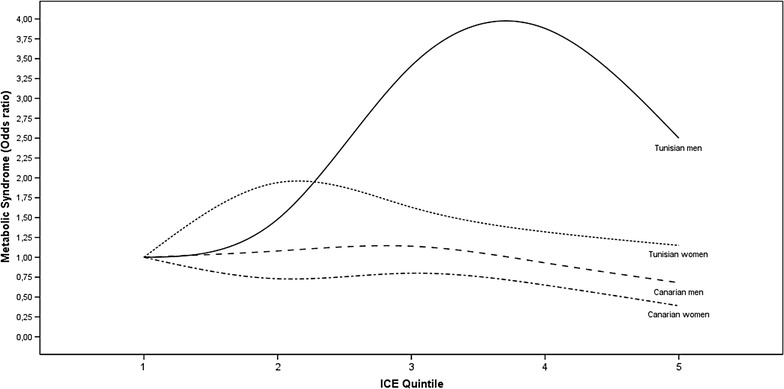
MS prevalence was higher in Tunisian (50 %) than in Canarian women (29 %; p = 0.002), with no significant differences between men. For Canarian women, being in the highest social class was a protective factor against MS (OR = 0.39; CI 95 % 0.29-0.53) and all its components. The Canarian population and the Tunisian women, showed a significant linear trend (p < 0.001) of MS to decrease when social class increased.
High social class is a protective factor from MS and its components within the Canarian population and the Tunisian women. Our results suggest that the socioeconomic transition in a developing country like Tunisia can improve the population health in a sex-specific manner.
在发展中国家,肥胖和代谢综合征(MS)的患病率日益上升。在发达国家,社会阶层与MS之间的关系已得到证实。我们研究的目的是比较一个发展中国家(突尼斯,邦角地区)和一个发达国家(西班牙,加那利群岛)中社会阶层与MS患病率之间的关联。
对6729名加那利群岛人和393名突尼斯人进行横断面研究。社会阶层采用收入、拥挤程度和教育程度(ICE)模型进行衡量,该模型包括家庭收入、家庭拥挤程度和教育水平。根据年龄调整的逻辑回归模型通过比值比(OR)和95%置信区间(CI)估计了不同社会阶层患MS的风险。
突尼斯女性的MS患病率(50%)高于加那利群岛女性(29%;p = 0.002),男性之间无显著差异。对于加那利群岛女性,处于最高社会阶层是预防MS(OR = 0.39;95%CI 0.29 - 0.53)及其所有组成部分的保护因素。加那利群岛人群和突尼斯女性中,社会阶层升高时,MS患病率呈显著线性下降趋势(p < 0.001)。
在加那利群岛人群和突尼斯女性中,高社会阶层是预防MS及其组成部分的保护因素。我们的结果表明,像突尼斯这样的发展中国家的社会经济转型可以以性别特异性方式改善人群健康。