Department of Biohybrid and Medical Textiles (BioTex), AME - Institute of Applied Medical Engineering, Helmholtz Institute, RWTH Aachen University, Forckenbeckstraße 55, 52074, Aachen, Germany.
Aachen-Maastricht Institute for Biobased Materials, Faculty of Science and Engineering, Maastricht University, Brightlands Chemelot Campus, 6167 RD, Geleen, The Netherlands.
Sci Rep. 2020 Apr 24;10(1):6963. doi: 10.1038/s41598-020-63922-8.
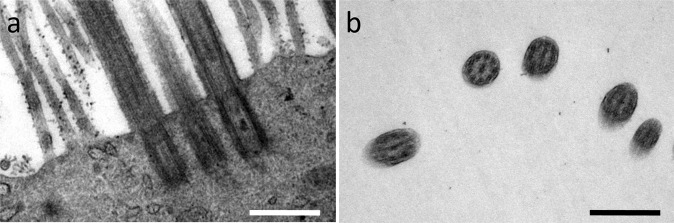
In vitro differentiation of airway epithelium is of interest for respiratory tissue engineering and studying airway diseases. Both applications benefit from the use of primary cells to maintain a mucociliated phenotype and thus physiological functionality. Complex differentiation procedures often lack standardization and reproducibility. To alleviate these shortfalls, we compared differentiation behavior of human nasal epithelial cells in four differentiation media. Cells were differentiated at the air-liquid interface (ALI) on collagen-coated inserts. Mucociliary differentiation status after five weeks was analyzed by electron microscopy, histology and immunohistochemistry. The amount of ciliation was estimated and growth factor concentrations were evaluated using ELISA. We found that retinoic-acid-supplemented mixture of DMEM and Airway Epithelial Cell Growth Medium gave most promising results to obtain ciliated and mucus producing nasal epithelium in vitro. We discovered the balance between retinoic acid (RA), vascular endothelial growth factor (VEGF), epidermal growth factor (EGF) and fibroblast growth factor β (FGF-β) to be relevant for differentiation. We could show that low VEGF, EGF and FGF-β concentrations in medium correspond to absent ciliation in specific donors. Therefore, our results may in future facilitate donor selection and non-invasive monitoring of ALI cultures and by this contribute to improved standardization of epithelial in vitro culture.
气道上皮细胞的体外分化对于呼吸组织工程和气道疾病的研究具有重要意义。这两种应用都受益于使用原代细胞来维持黏液纤毛表型和生理功能。复杂的分化程序往往缺乏标准化和可重复性。为了缓解这些不足,我们比较了人鼻上皮细胞在四种分化培养基中的分化行为。细胞在胶原包被的插片上进行气液界面(ALI)分化。五周后,通过电子显微镜、组织学和免疫组织化学分析黏液纤毛分化状态。通过 ELISA 评估纤毛数量和生长因子浓度。我们发现,补充有视黄酸的 DMEM 和气道上皮细胞生长培养基混合物最有希望获得体外具有纤毛和分泌黏液的鼻上皮细胞。我们发现,RA、血管内皮生长因子(VEGF)、表皮生长因子(EGF)和纤维母细胞生长因子β(FGF-β)之间的平衡对于分化很重要。我们能够证明,培养基中低浓度的 VEGF、EGF 和 FGF-β 对应于特定供体中不存在纤毛。因此,我们的结果将来可能有助于 ALI 培养物的供体选择和非侵入性监测,并通过这种方式促进上皮细胞体外培养的标准化。