Departments of Obstetrics and Gynecology, The Edith Wolfson Medical Center, Holon, and Sackler School of Medicine, Tel Aviv University, P.O. Box 5, 58100, Holon, Israel.
BMC Pregnancy Childbirth. 2020 Apr 25;20(1):246. doi: 10.1186/s12884-020-02925-9.
The association between the number of vaginal examinations (VEs) performed during labor and the risk of infection is unclear. The literature regarding this issue is not consensual, and the available studies are relatively small. Therefore, we aimed to study the association between the number of VEs during labor, and maternal febrile morbidity, in a very large cohort.
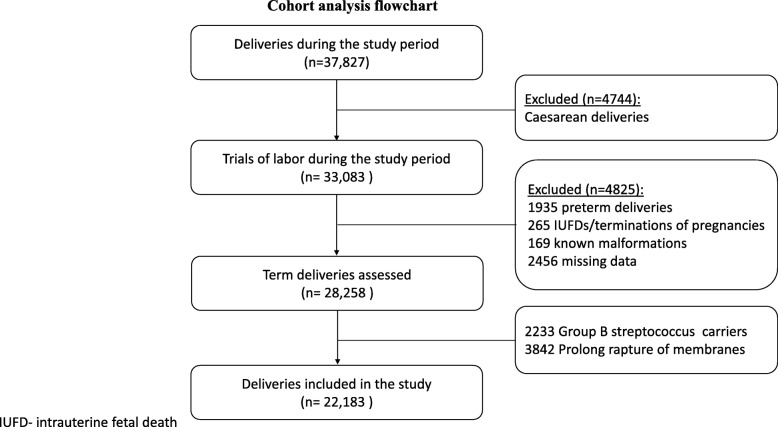
This is a retrospective cohort study. All women who delivered vaginally ≥37 weeks, at our institute, between 2008 and 2017 were included. Patients who underwent cesarean delivery or who were treated with prophylactic antibiotics, or had a fever ≥38.0 °C prior to the first VE were excluded. Cases of intrauterine fetal death, known malformations, or missing data were excluded as well. The cohort was divided according to the number of VEs performed: up to 4 VEs (n = 9716), 5-6 VEs (n = 4624), 7-8 VEs (n = 2999), and 9 or more VEs (n = 4844). The rates of intrapartum febrile morbidity (intrapartum fever and chorioamnionitis), postpartum febrile morbidity (postpartum fever and endometritis), and peripartum febrile morbidity (any of the mentioned complications) were compared.
Overall, 22,183 women were included in the study. On multivariate analysis, we found that performing 5 VEs or more during labor was independently associated with intrapartum febrile morbidity (5-6 VEs: aOR = 1.83, 95% CI (1.29-2.61), 7-8 VEs: aOR = 2.65 95% CI (1.87-3.76), 9 or more VEs aOR = 3.47 95% CI (2.44-4.92)), postpartum febrile morbidity (5-6 VEs: aOR = 1.29, 95% CI (1.09-1.86), 7-8 VEs: aOR = 1.94 95% CI (1.33-2.83), 9 or more VEs aOR = 1.91 95% CI (1.28-2.82)), and peripartum morbidity (5-6 VEs: aOR = 1.48, 95% CI (1.15-1.91), 7-8 VEs: aOR = 2.15 95% CI (1.66-2.78), 9 or more VEs: aOR = 2.57 95% CI (1.97-3.34)).
The number of VEs performed during labor is directly correlated with febrile morbidity. Performing five or more VEs during labor is independently associated with febrile morbidity; For intrapartum and peripartum febrile morbidity the risk rises as more VEs are performed.
在分娩期间进行的阴道检查(VE)次数与感染风险之间的关系尚不清楚。关于这个问题的文献并不一致,而且可用的研究相对较少。因此,我们旨在研究大量队列中分娩期间 VE 次数与产妇发热发病率之间的关系。
这是一项回顾性队列研究。纳入了 2008 年至 2017 年期间在我院分娩且胎龄≥37 周的所有阴道分娩患者。排除行剖宫产或接受预防性抗生素治疗的患者,以及在首次 VE 前发热≥38.0°C 的患者。还排除了宫内胎儿死亡、已知畸形或数据缺失的病例。根据进行的 VE 次数将队列分为以下几组:≤4 次(n=9716)、5-6 次(n=4624)、7-8 次(n=2999)和≥9 次(n=4844)。比较产时发热发病率(产时发热和绒毛膜羊膜炎)、产后发热发病率(产后发热和子宫内膜炎)和围产期发热发病率(上述任何一种并发症)。
共有 22183 名妇女纳入研究。多变量分析显示,分娩时进行 5 次或更多 VE 与产时发热发病率独立相关(5-6 次 VE:比值比[aOR]为 1.83,95%置信区间[CI]为 1.29-2.61),7-8 次 VE:aOR 为 2.65,95% CI 为 1.87-3.76),9 次或更多 VE:aOR 为 3.47,95% CI 为 2.44-4.92))、产后发热发病率(5-6 次 VE:aOR 为 1.29,95% CI 为 1.09-1.86)、7-8 次 VE:aOR 为 1.94,95% CI 为 1.33-2.83)、9 次或更多 VE:aOR 为 1.91,95% CI 为 1.28-2.82)和围产期发病率(5-6 次 VE:aOR 为 1.48,95% CI 为 1.15-1.91)、7-8 次 VE:aOR 为 2.15,95% CI 为 1.66-2.78)、9 次或更多 VE:aOR 为 2.57,95% CI 为 1.97-3.34)。
分娩期间进行的 VE 次数与发热发病率直接相关。分娩时进行 5 次或更多 VE 与发热发病率独立相关;对于产时和围产期发热发病率,进行的 VE 次数越多,风险越高。