Hogh-Poulsen Sidsel, Carlsen Sif Emilie, Bendix Jane M, Clausen Tine D, Lokkegaard Ellen C L, Axelsson Paul Vignir Bryde
Department of Gynecology and Obstetrics, Copenhagen University Hospital-North Zealand, Denmark.
Department of Clinical Research, Copenhagen University Hospital-North Zealand, Hillerod, Denmark.
Acta Obstet Gynecol Scand. 2025 Feb;104(2):309-318. doi: 10.1111/aogs.15035. Epub 2024 Dec 31.
Induction of labor is a common procedure, and in Denmark, approximately one in four vaginal deliveries are induced. The association between induction and maternal postpartum infections such as endometritis, surgical site infection after cesarean section, urinary tract infection, and sepsis has been sparsely investigated. Our objective was to investigate the association between induction of labor and risk of maternal postpartum infection and to identify potential risk factors for infection.
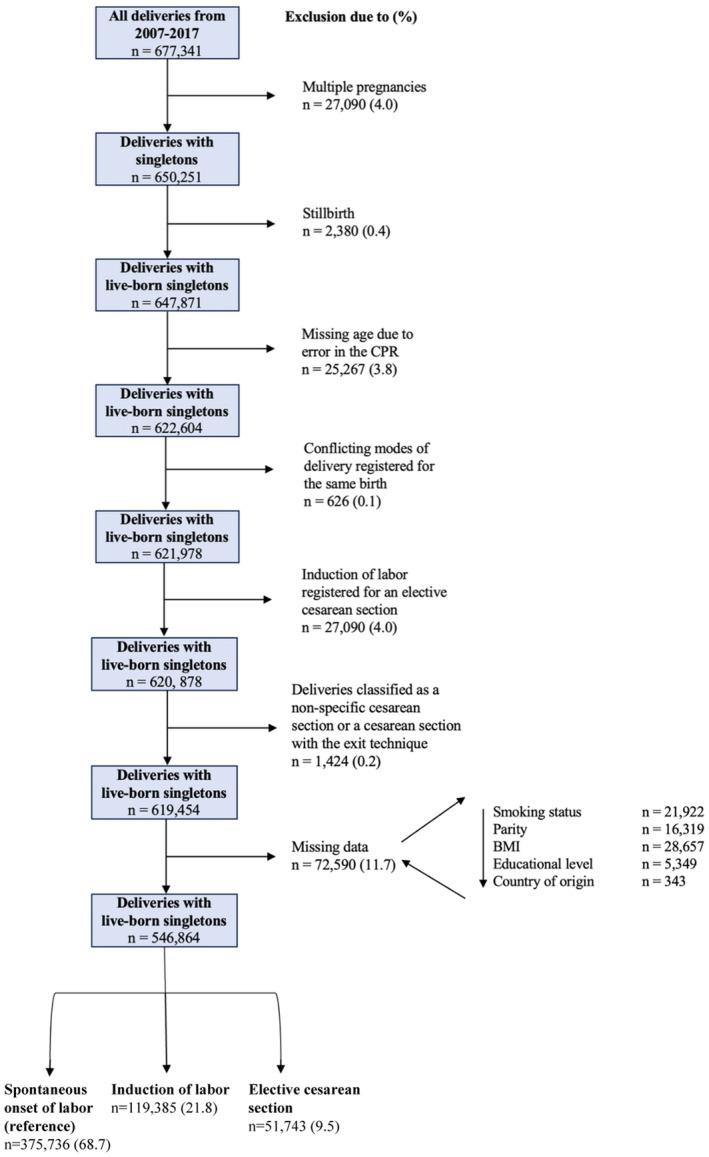
In a nationwide cohort study, all deliveries with live-born singletons from January 1, 2007, to December 31, 2017 (n = 546 864) were included. Deliveries were grouped into categories of spontaneous onset of labor, induction of labor, and elective cesarean section. The primary outcome was any infection within 30 days postpartum based on discharge diagnosis codes and redeemed antibiotic prescriptions for endometritis, surgical site infection, urinary tract infection, and sepsis. Analyses were done using logistic regression.
Infection within 30 days postpartum was found among 8.5% of the women undergoing induction of labor compared to 6.8% of the women with spontaneous onset of labor. In adjusted logistic regression analyses, the risk of postpartum infection was significantly increased after induction of labor compared to spontaneous onset of labor (adjusted ORs [aOR], 1.24; 95% confidence interval [CI], 1.21-1.27). Women with rupture of membranes were not at increased risk of postpartum infection (aOR 1.01; 95%CI 0.94-1.09). The risk of postpartum maternal sepsis was not significantly associated with induction of labor. Antibiotic treatment during pregnancy, pre-eclampsia, and long education were all associated with increased risk of maternal postpartum infection, while either a low or high body mass index and previous deliveries were associated with decreased risk.
Induction of labor was associated with an increased risk of maternal postpartum infection. However, the absolute risk was 1.7% higher for the women with induced labor compared to spontaneous onset of labor, which we believe should not be a cause for concern. Unexpectedly, low and high body mass index was associated with decreased risk of infection, and rupture of membranes was not associated with increased risk after induction of labor, which might reflect actual clinical management.
引产是一种常见的操作,在丹麦,约四分之一的阴道分娩是引产。引产与产妇产后感染(如子宫内膜炎、剖宫产术后手术部位感染、尿路感染和败血症)之间的关联研究较少。我们的目的是研究引产与产妇产后感染风险之间的关联,并确定感染的潜在风险因素。
在一项全国性队列研究中,纳入了2007年1月1日至2017年12月31日期间所有单胎活产分娩(n = 546864)。分娩分为自然发动分娩、引产和择期剖宫产几类。主要结局是根据出院诊断编码和子宫内膜炎、手术部位感染、尿路感染和败血症的抗生素处方赎回情况,确定产后30天内的任何感染。采用逻辑回归进行分析。
引产的女性中8.5%在产后30天内发生感染,而自然发动分娩的女性中这一比例为6.8%。在调整后的逻辑回归分析中,与自然发动分娩相比,引产后宫内感染的风险显著增加(调整后的比值比[aOR],1.24;95%置信区间[CI],1.21 - 1.27)。胎膜早破的女性产后感染风险未增加(aOR 1.01;95%CI 0.94 - 1.09)。产妇产后败血症的风险与引产无显著关联。孕期抗生素治疗、子痫前期和高学历均与产妇产后感染风险增加有关,而低或高体重指数以及既往分娩史则与风险降低有关。
引产与产妇产后感染风险增加有关。然而,引产女性的绝对风险比自然发动分娩的女性高1.7%,我们认为这不应该引起担忧。出乎意料的是,低体重指数和高体重指数与感染风险降低有关,引产后宫内感染风险增加与胎膜早破无关,这可能反映了实际临床管理情况。