Department of Endocrinology, Beijing Hospital, National Center of Gerontology; Institute of Geriatric Medicine, Chinese Academy of Medical Sciences, Graduate School of Peking Union Medical College, No. 1 Dahua Road, Dong Dan, Beijing, 100730, P. R. China.
Department of Endocrinology, Beijing Hospital, National Center of Gerontology; Institute of Geriatric Medicine, Chinese Academy of Medical Sciences, No. 1 Dahua Road, Dong Dan, Beijing, 100730, P. R. China.
Cardiovasc Diabetol. 2020 Apr 25;19(1):48. doi: 10.1186/s12933-020-01014-7.
Exenatide, a glucagon like peptide 1 analog, has been suggested to reduce the cardiovascular disease risk factors, such as body weight, blood pressure and subclinical atherosclerosis in patients with type 2 diabetes mellitus (T2DM). This was the first randomized, open-label, controlled trial to compare the effects of exenatide versus insulin on subclinical atherosclerosis, as assessed by carotid-intima media thickness (CIMT), in patients with T2DM.
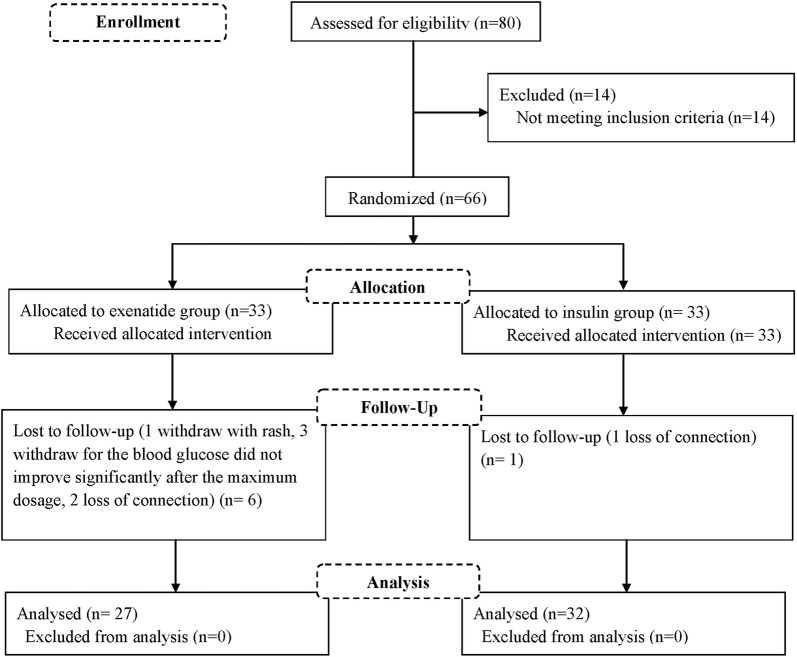
A total of 66 patients with T2DM admitted from March 10, 2015 to June 20, 2017 in the Department of Endocrinology, Beijing Hospital were randomized to receive twice-daily exenatide or aspartate 70/30 insulin for 52 weeks. The primary endpoint was change from baseline in CIMT, and secondary endpoints included changes at week 52 from baseline in body weight, glycemic markers, lipid metabolism markers, blood pressure, C-reactive protein, fibrinogen, 8-hydroxydeoxyguanosine, irisin, and brain natriuretic peptide.
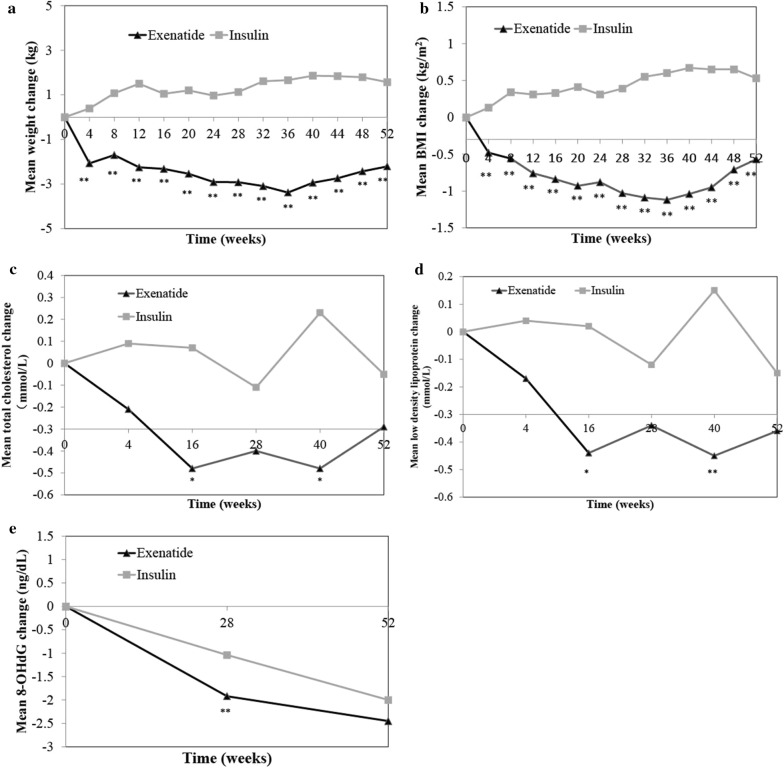
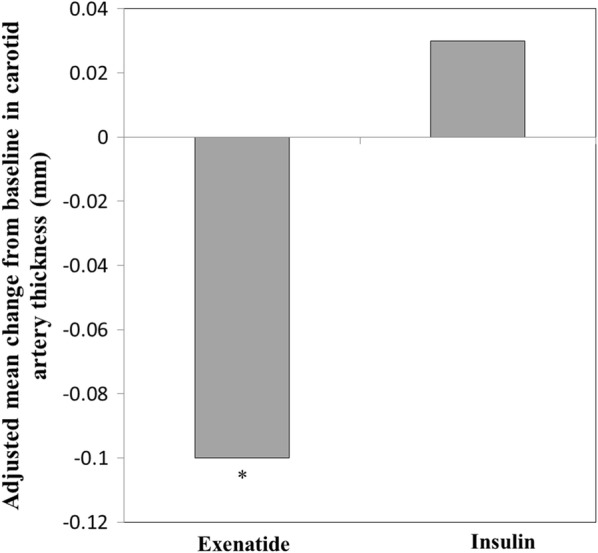
Exenatide more significantly reduced the CIMT from baseline compared with insulin after 52 weeks, with a mean difference of - 0.14 mm (95% interval confidence: - 0.25, - 0.02; P = 0.016). Weight and body mass index were both significantly reduced in the exenatide group over 52 weeks. Exenatide reduced total lipoprotein and low-density lipoprotein cholesterol levels more significantly than insulin at weeks 16 and 40. Correlation analyses showed that CIMT was positively correlated with low-density lipoprotein cholesterol.
Twice-daily exenatide could prevent atherosclerosis progression in patients with T2DM over a 52-week treatment period compared with insulin therapy. Trial registration Chinese Clinical Trial Registry ChiCTR-1800015658.
胰高血糖素样肽 1 类似物艾塞那肽可降低 2 型糖尿病(T2DM)患者的心血管疾病风险因素,如体重、血压和亚临床动脉粥样硬化。这是首例比较艾塞那肽与胰岛素对 T2DM 患者亚临床动脉粥样硬化影响的随机、开放标签、对照试验,采用颈动脉内膜中层厚度(CIMT)评估。
2015 年 3 月 10 日至 2017 年 6 月 20 日,北京医院内分泌科收治的 66 例 T2DM 患者被随机分为两组,分别接受每日 2 次艾塞那肽或门冬胰岛素 70/30 治疗 52 周。主要终点是 CIMT 自基线的变化,次要终点包括第 52 周体重、血糖标志物、血脂代谢标志物、血压、C 反应蛋白、纤维蛋白原、8-羟基脱氧鸟苷、鸢尾素和脑钠肽自基线的变化。
52 周后,与胰岛素相比,艾塞那肽更显著降低 CIMT 自基线的变化,平均差值为-0.14mm(95%置信区间:-0.25,-0.02;P=0.016)。52 周内,艾塞那肽组体重和体重指数均显著降低。艾塞那肽在第 16 周和第 40 周时更显著降低总脂蛋白和低密度脂蛋白胆固醇水平。相关性分析表明,CIMT 与低密度脂蛋白胆固醇呈正相关。
与胰岛素治疗相比,每日 2 次艾塞那肽可在 52 周治疗期间预防 T2DM 患者的动脉粥样硬化进展。临床试验注册 中国临床试验注册中心 ChiCTR-1800015658。