Shamasneh Ala O, Atieh Anwar S, Gharaibeh Kamel A, Hamadah Abdurrahman
Department of Internal Medicine, Faculty of Medicine, Al-Quds University, Jerusalem, Palestine.
Department of Medicine, Faculty of Medicine, Hashemite University, Zarqa, Jordan.
Ren Fail. 2020 Nov;42(1):343-349. doi: 10.1080/0886022X.2020.1748650.
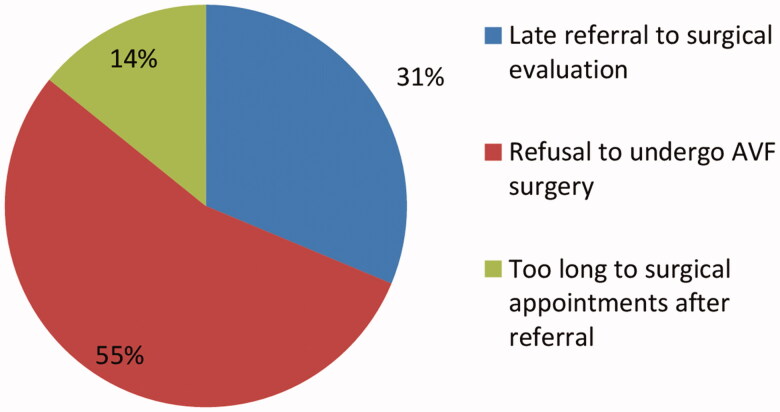
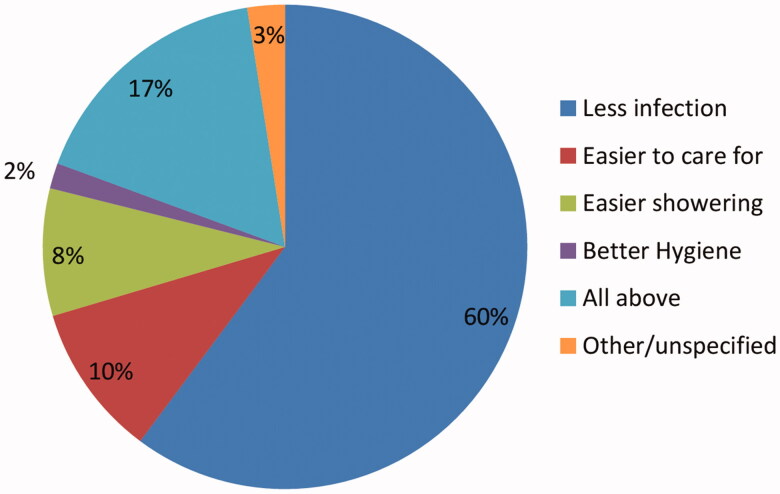
In the dialysis center in Ramallah, we investigated the attitudes and perceived barriers to having arteriovenous fistula (AVF) in 156 patients. The current method of HD access was AVF in 52% and central venous catheter in 47%. Perceived causes of no or delayed AVF were: patient's refusal of AVF in 54.5%, late referral to a surgical evaluation in 31.3% and too long to surgical appointments in 14.2%. Among those who refused AVF, reasons were: concern about the surgical procedure in 42.5%, poor understanding of disease/access in 23.3%, fear of needles in 15.1%, denial of disease or need for HD in 17.8%, and cosmetic reasons in 1.4%. Forty six percent of patients believed they received education about AVF prior to the creation of HD access, and 73.7% would recommend AVF as the method of access due to the lower risk of infection (96%), easier to care for (16%), easier showering (14%), and better-associated hygiene (3%). In conclusion, the majority would recommend an AVF as the mode of vascular access for HD. The most common barrier to having an AVF was patient's refusal to undergo AVF creation because of their concern about the surgical procedure. A systematic evaluation of the process that precedes the creation of AVF may allow for better utilization.
在拉马拉的透析中心,我们调查了156例患者对于动静脉内瘘(AVF)的态度及感知到的障碍。当前的血液透析(HD)通路建立方法中,52%为AVF,47%为中心静脉导管。感知到的未建立或延迟建立AVF的原因有:54.5%为患者拒绝AVF,31.3%为转诊至外科评估较晚,14.2%为等待手术预约时间过长。在拒绝AVF的患者中,原因如下:42.5%担心手术过程,23.3%对疾病/通路了解不足,15.1%害怕打针,17.8%否认疾病或需要HD,1.4%出于美观原因。46%的患者认为在建立HD通路之前接受了关于AVF的教育,73.7%的患者会推荐AVF作为通路方法,原因是感染风险较低(96%)、更容易护理(16%)、更容易淋浴(14%)以及卫生状况更好(3%)。总之,大多数人会推荐AVF作为HD的血管通路方式。建立AVF最常见的障碍是患者因担心手术过程而拒绝建立AVF。对建立AVF之前的流程进行系统评估可能会实现更好的利用。