Boffa Angelo, Previtali Davide, Altamura Sante Alessandro, Zaffagnini Stefano, Candrian Christian, Filardo Giuseppe
Clinica Ortopedica e Traumatologica 2, IRCCS Istituto Ortopedico Rizzoli, Bologna, Italy.
Orthopaedic and Traumatology Unit, Ospedale Regionale di Lugano, EOC, Lugano, Switzerland.
Orthop J Sports Med. 2020 Apr 21;8(4):2325967120910504. doi: 10.1177/2325967120910504. eCollection 2020 Apr.
Microfracture is the most common first-line option for the treatment of small chondral lesions, although increasing evidence shows that the clinical benefit of microfracture decreases over time. Platelet-rich plasma (PRP) has been suggested as an effective biological augmentation to improve clinical outcomes after microfracture.
To evaluate the clinical evidence regarding the application of PRP, documenting safety and efficacy of this augmentation technique to improve microfracture for the treatment of cartilage lesions.
Systematic review; Level of evidence, 3.
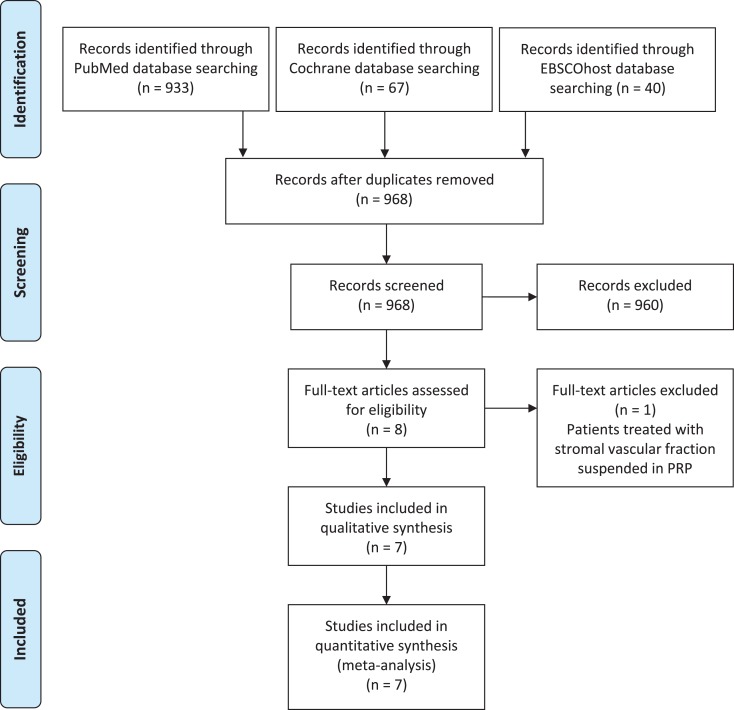
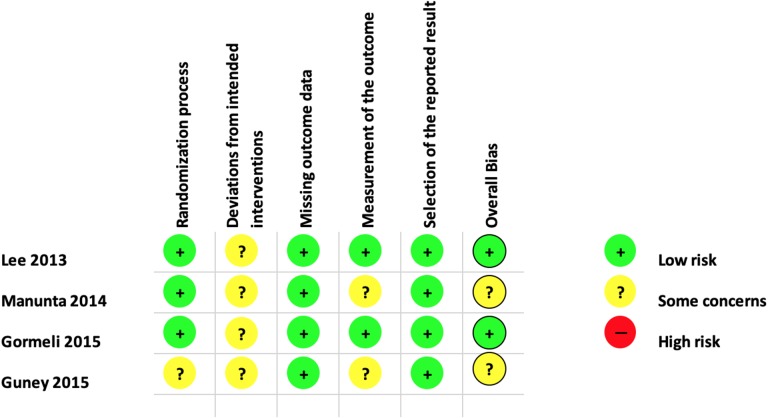
A systematic review was performed in PubMed, EBSCOhost database, and the Cochrane Library to identify comparative studies evaluating the clinical efficacy of PRP augmentation to microfracture. A meta-analysis was performed on articles that reported results for visual analog scale (VAS) for pain, International Knee Documentation Committee (IKDC), and American Orthopaedic Foot and Ankle Society (AOFAS) scores. Risk of bias was documented through use of the Cochrane Collaboration Risk of Bias 2.0 and Risk of Bias in Non-randomized Studies of Interventions assessment tools. The quality assessment was performed according to the Grading of Recommendations Assessment, Development and Evaluation guidelines.
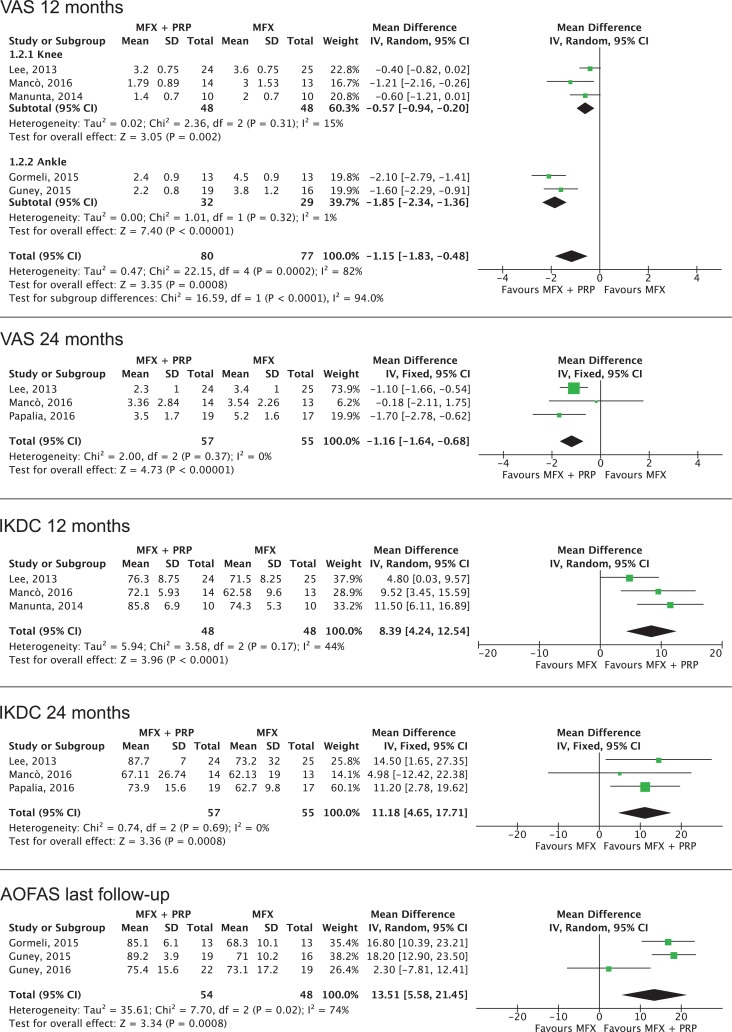
A total of 7 studies met the inclusion criteria and were included in the meta-analysis: 4 randomized controlled trials, 2 prospective comparative studies, and 1 retrospective comparative study, for a total of 234 patients. Of the 7 studies included, 4 studies evaluated the effects of PRP treatment in the knee, and 3 studies evaluated effects in the ankle. The analysis of all scores showed a difference favoring PRP treatment in knees (VAS, = .002 and < .001 at 12 and 24 months, respectively; IKDC, < .001 at both follow-up points) and ankles (both VAS and AOFAS, < .001 at 12 months). The improvement offered by PRP did not reach the minimal clinically important difference (MCID).
PRP provided an improvement to microfracture in knees and ankles at short-term follow-up. However, this improvement did not reach the MCID, and thus it was not clinically perceivable by the patients. Moreover, the overall low evidence and the paucity of high-level studies indicate further research is needed to confirm the potential of PRP augmentation to microfracture for the treatment of cartilage lesions.
微骨折术是治疗小面积软骨损伤最常用的一线治疗方法,尽管越来越多的证据表明微骨折术的临床疗效会随时间下降。富血小板血浆(PRP)被认为是一种有效的生物增强剂,可改善微骨折术后的临床效果。
评估关于PRP应用的临床证据,记录这种增强技术改善微骨折术治疗软骨损伤的安全性和有效性。
系统评价;证据等级,3级。
在PubMed、EBSCOhost数据库和Cochrane图书馆进行系统评价,以识别评估PRP增强微骨折术临床疗效的比较研究。对报告疼痛视觉模拟量表(VAS)、国际膝关节文献委员会(IKDC)和美国矫形足踝协会(AOFAS)评分结果的文章进行荟萃分析。通过使用Cochrane协作网偏倚风险2.0和干预非随机研究中的偏倚风险评估工具记录偏倚风险。根据推荐评估、制定和评价分级指南进行质量评估。
共有7项研究符合纳入标准并纳入荟萃分析:4项随机对照试验、2项前瞻性比较研究和1项回顾性比较研究,共234例患者。在纳入的7项研究中,4项研究评估了PRP治疗在膝关节中的效果,3项研究评估了在踝关节中的效果。对所有评分的分析表明,PRP治疗在膝关节(VAS,12个月和24个月时分别为P = 0.002和P < 0.001;IKDC,两个随访点均为P < 0.001)和踝关节(VAS和AOFAS,12个月时均为P < 0.001)中更具优势。PRP带来的改善未达到最小临床重要差异(MCID)。
在短期随访中,PRP改善了膝关节和踝关节的微骨折术效果。然而,这种改善未达到MCID,因此患者在临床上无法感知。此外,总体证据水平较低且高水平研究匮乏,表明需要进一步研究以证实PRP增强微骨折术治疗软骨损伤的潜力。