State Key Laboratory of Rice Biology and China National Center for Rice Improvement, China National Rice Research Institute, Hangzhou 310006, China.
Genes (Basel). 2020 Apr 24;11(4):466. doi: 10.3390/genes11040466.
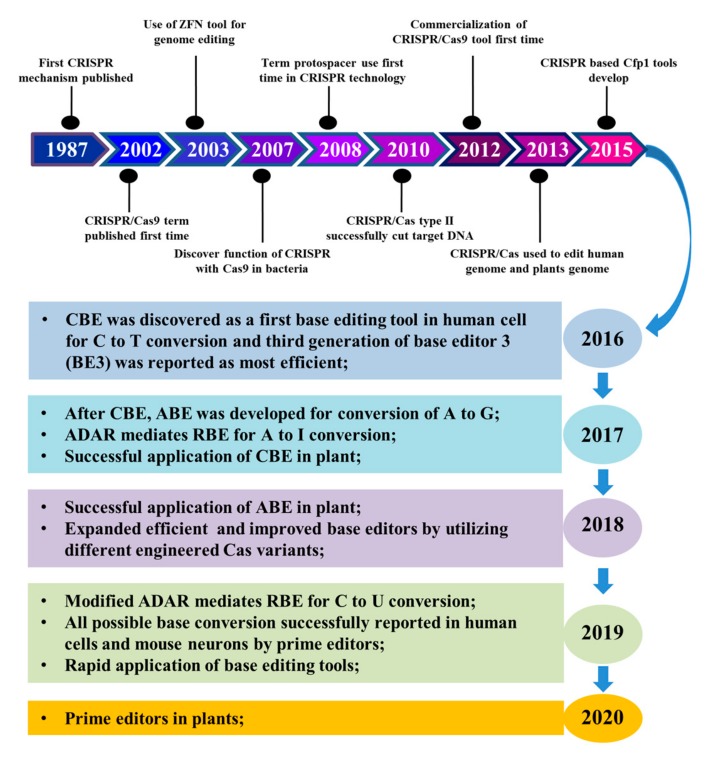
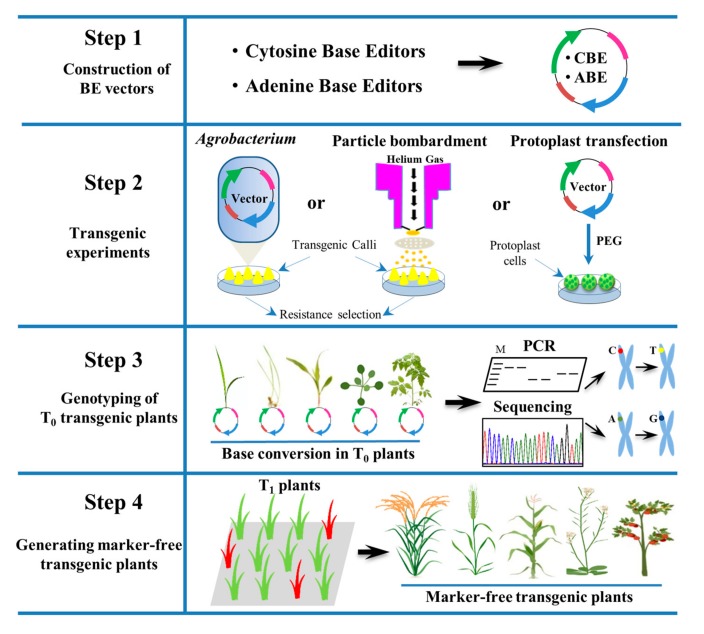
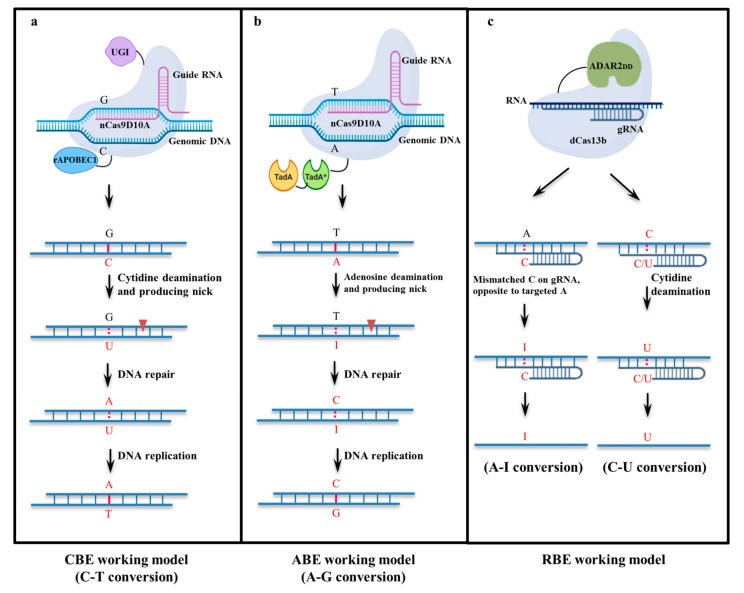
Clustered regularly interspaced short palindromic repeats (CRISPR)/CRISPR associated protein 9 (Cas9), a newly developed genome-editing tool, has revolutionized animal and plant genetics by facilitating modification of target genes. This simple, convenient base-editing technology was developed to improve the precision of genome editing. Base editors generate precise point mutations by permanent base conversion at a specific point, with very low levels of insertions and deletions. Different plant base editors have been established by fusing various nucleobase deaminases with Cas9, Cas13, or Cas12a (Cpf1), proteins. Adenine base editors can efficiently convert adenine (A) to guanine (G), whereas cytosine base editors can convert cytosine (C) to thymine (T) in the target region. RNA base editors can induce a base substitution of A to inosine (I) or C to uracil (U). In this review, we describe the precision of base editing systems and their revolutionary applications in plant science; we also discuss the limitations and future perspectives of this approach.
成簇规律间隔短回文重复序列(CRISPR)/CRISPR 相关蛋白 9(Cas9)是一种新开发的基因组编辑工具,通过促进靶基因的修饰,彻底改变了动植物遗传学。这种简单、方便的碱基编辑技术是为了提高基因组编辑的精度而开发的。碱基编辑器通过在特定点永久碱基转换产生精确的点突变,插入和缺失率非常低。通过将各种核碱基脱氨酶与 Cas9、Cas13 或 Cas12a(Cpf1)蛋白融合,已经建立了不同的植物碱基编辑器。腺嘌呤碱基编辑器可以有效地将腺嘌呤(A)转换为鸟嘌呤(G),而胞嘧啶碱基编辑器可以将靶区域中的胞嘧啶(C)转换为胸腺嘧啶(T)。RNA 碱基编辑器可以诱导 A 到肌苷(I)或 C 到尿嘧啶(U)的碱基替换。在这篇综述中,我们描述了碱基编辑系统的精度及其在植物科学中的革命性应用;我们还讨论了这种方法的局限性和未来前景。