Deutsch Thomas M, Stefanovic Stefan, Feisst Manuel, Fischer Chiara, Riedel Fabian, Fremd Carlo, Domschke Christoph, Pantel Klaus, Hartkopf Andreas D, Sutterlin Marc, Brucker Sara Y, Schneeweiss Andreas, Wallwiener Markus
Department of Gynecology and Obstetrics, University Hospital Heidelberg, Im Neuenheimer Feld 440, 69120 Heidelberg, Germany.
Department of Gynecology and Obstetrics, Mannheim University Hospital, University of Heidelberg, Theodor-Kutzer-Ufer 1-3, 68167 Mannheim, Germany.
Cancers (Basel). 2020 Apr 24;12(4):1055. doi: 10.3390/cancers12041055.
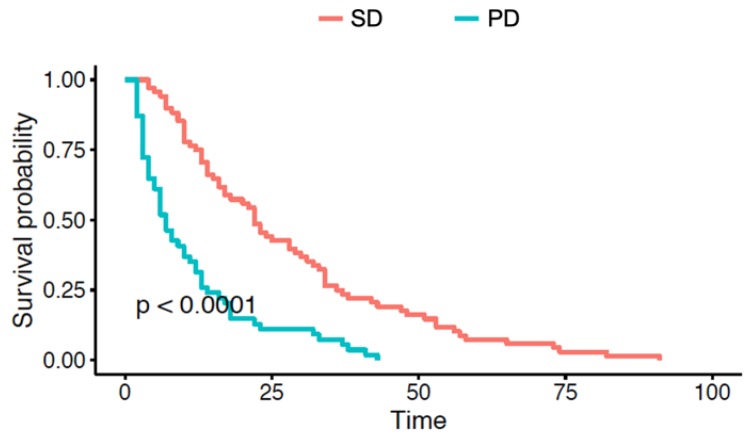
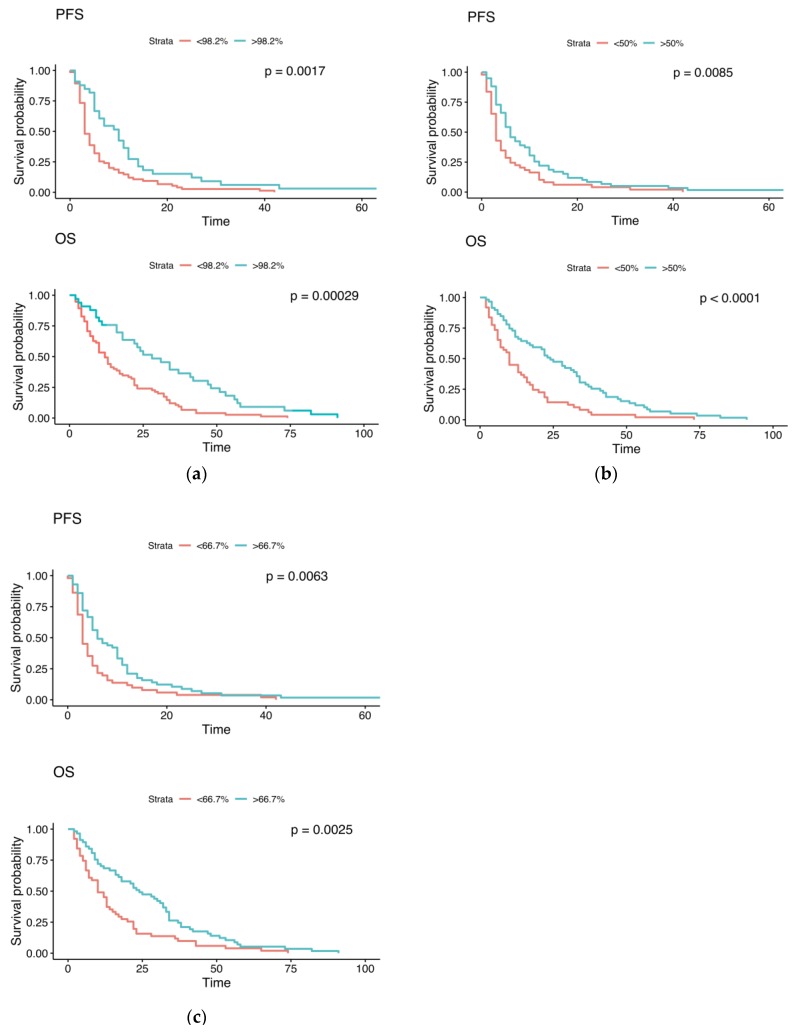
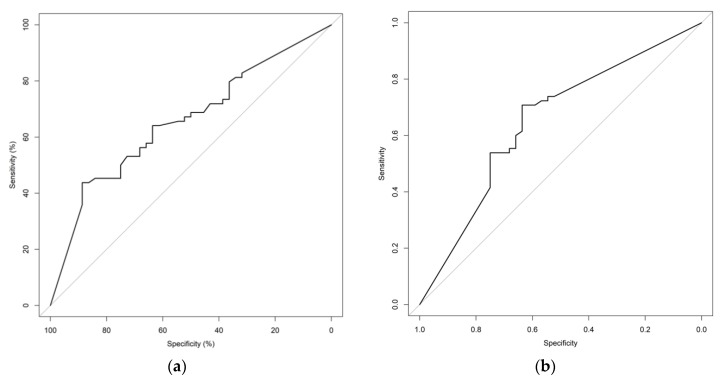
Detection of circulating tumor cells (CTC) can distinguish between aggressive and indolent metastatic disease in breast cancer patients and is thus considered an independent, negative prognostic factor. A clear decline in CTCs is observed in patients who respond to systemic therapy. Nevertheless, CTCs can decrease in patients experiencing disease progression during systemic therapy, too. This study aims to determine the differences between CTC decline in patients responding to therapy and those in whom disease is progressing. Therefore, CTC values were compared at the start and after one cycle of a new line of systemic therapy. In all, 108 initially CTC-positive patients (with ≥5 intact CTCs in 7.5 mL blood) were enrolled in this study and intact and apoptotic CTCs were measured via the CellSearch system. A cut-off analysis was performed using Youden's J statistics to differentiate between CTC change in the two groups. Here, 64 (59.3%) patients showed stable disease or partial response vs. 44 (40.7%) presenting disease progression. Median overall survival was 23 (range: 4-92) vs. 7 (2-43) months ( < 0.001). Median intact CTC count at enrollment was 15.0 (5-2760) vs. 30.5 (5-200000) cells ( = 0.39) and 2.5 (0-420) vs. 8.5 (0-15000) cells after one cycle of systemic therapy ( = 0.001). Median apoptotic CTC count at enrollment was 10.5 (0-1500) vs. 9 (0-800) cells ( = 0.475) and 1 (0-200) vs. 3 (0-250) cells after one cycle of systemic therapy ( = 0.01). A 50% reduction in baseline apoptotic CTC count represents the optimal cut-off to differentiate between therapy response and disease progression. An apoptotic CTC reduction of ≤10% is 74% specific for early disease progression.
循环肿瘤细胞(CTC)的检测可区分乳腺癌患者侵袭性和惰性转移性疾病,因此被视为一个独立的不良预后因素。对全身治疗有反应的患者中可观察到CTC明显下降。然而,在接受全身治疗期间疾病进展的患者中CTC也可能减少。本研究旨在确定对治疗有反应的患者与疾病进展患者之间CTC下降的差异。因此,在新的一线全身治疗开始时和一个周期后比较了CTC值。本研究共纳入108例初始CTC阳性患者(7.5 mL血液中≥5个完整CTC),并通过CellSearch系统测量完整和凋亡的CTC。使用尤登指数进行截断分析,以区分两组中的CTC变化。其中,64例(59.3%)患者疾病稳定或部分缓解,而44例(40.7%)患者疾病进展。中位总生存期分别为23个月(范围:4 - 92个月)和7个月(2 - 43个月)(P < 0.001)。入组时完整CTC计数中位数分别为15.0(5 - 2760)个细胞和30.5(5 - 200000)个细胞(P = 0.39),全身治疗一个周期后分别为2.5(0 - 420)个细胞和8.5(0 - 15000)个细胞(P = 0.001)。入组时凋亡CTC计数中位数分别为10.5(0 - 1500)个细胞和9(0 - 800)个细胞(P = 0.475),全身治疗一个周期后分别为1(0 - 200)个细胞和3(0 - 250)个细胞(P = 0.01)。基线凋亡CTC计数降低50%是区分治疗反应和疾病进展的最佳截断值。凋亡CTC减少≤10%对早期疾病进展的特异性为74%。