Prantl Lukas, Gerken Michael, Zeman Florian, Leitzmann Michael, Koller Michael, Klinkhammer-Schalke Monika, Evert Matthias, Kuehlmann Britta, Biermann Niklas
University Center of Plastic, Hand- and Reconstructive Surgery, University Hospital Regensburg, Franz-Josef-Strauß-Allee 11, 93053 Regensburg, Germany.
Tumor Center Regensburg, Institute for Quality Assurance and Health Services Research, University Hospital Regensburg, Franz-Josef-Strauß-Allee 11, 93053 Regensburg, Germany.
J Clin Med. 2020 Apr 25;9(5):1247. doi: 10.3390/jcm9051247.
Breast-implant-associated anaplastic large cell lymphoma (BI-ALCL) and primary breast ALCL are rare extranodal manifestations of non-Hodgkin lymphoma. The rarity of both diseases, along with unreleased sales data on breast implants and constant updates of classification systems impede the calculation of an exact incidence.
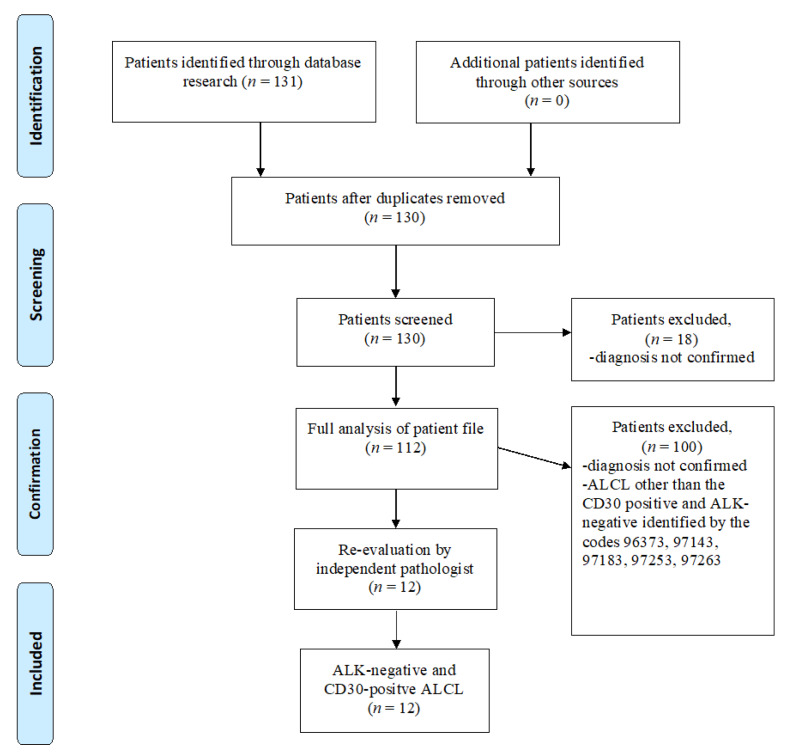
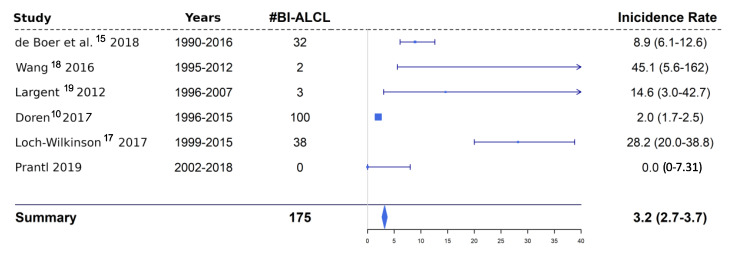
The database of the Tumor Center Regensburg in Bavaria was searched for patients with CD30-positive and ALK-negative anaplastic large cell lymphoma between 2002 and 2018. These lymphomas were identified by the ICD-O-3 morphology code "97023" and were cross-checked by searching the diagnosis by name the and ICD-10 code C84.7. Furthermore, we tried to calculate the incidence rates and corresponding 95% confidence intervals, standardized to 1,000,000 implant years of breast-implant-associated anaplastic large cell lymphoma and primary breast anaplastic large cell lymphoma.
Twelve ALK-negative and CD30-positive anaplastic large cell lymphomas were identified out of 170,405 malignancies. No case was found within the breast tissue and none of the patients had a previous history of breast implant placement. In five cases, lymph node involvement in close proximity to the breast was observed.
We found a low incidence of anaplastic large cell lymphoma and no association to breast implants in these patients. A review of the current literature revealed inconsistent use of classification systems for anaplastic large cell lymphomas and potential overestimation of cases.
乳腺植入物相关间变性大细胞淋巴瘤(BI-ALCL)和原发性乳腺间变性大细胞淋巴瘤是非霍奇金淋巴瘤罕见的结外表现。这两种疾病的罕见性,加上乳腺植入物未公开的销售数据以及分类系统的不断更新,阻碍了确切发病率的计算。
在巴伐利亚州雷根斯堡肿瘤中心的数据库中搜索2002年至2018年间患有CD30阳性和ALK阴性间变性大细胞淋巴瘤的患者。这些淋巴瘤通过ICD-O-3形态学编码“97023”进行识别,并通过按名称搜索诊断结果和ICD-10编码C84.7进行交叉核对。此外,我们试图计算乳腺植入物相关间变性大细胞淋巴瘤和原发性乳腺间变性大细胞淋巴瘤的发病率及相应的95%置信区间,标准化为每100万植入年。
在170405例恶性肿瘤中,共识别出12例ALK阴性和CD30阳性的间变性大细胞淋巴瘤。在乳腺组织内未发现病例,且所有患者既往均无乳腺植入史。5例患者观察到乳腺附近的淋巴结受累。
我们发现这些患者中间变性大细胞淋巴瘤的发病率较低,且与乳腺植入物无关。对当前文献的回顾显示,间变性大细胞淋巴瘤分类系统的使用不一致,且病例可能被高估。