Department of Preventive Health Care, China-Japan Friendship Hospital, No. 2, Yinghua East Street, Chaoyang district, Beijing, 100029, China.
Department of Pediatrics, China-Japan Friendship Hospital, No. 2, Yinghua East Street, Chaoyang district, Beijing, 100029, China.
BMC Pregnancy Childbirth. 2020 Apr 28;20(1):253. doi: 10.1186/s12884-020-02941-9.
Since the inception of newborn screening programs in China in the 1990s, pregnancy among patients with inherited, metabolic disorders has become more common. This study explores the management and outcomes of planned, full-term pregnancies in patients with phenylketonuria (PKU).
Married patients with PKU from 2012 to 2017 were enrolled to receive prenatal counseling and regular health assessments. Study-related assessments included the timing of Phe-restricted diets, maternal weight gain, gestational age, pregnancy complications, and blood Phe concentrations (both pre-conception and during pregnancy), obstetrical data, and offspring outcomes(e.g. anthropomorphic measurements and developmental quotients [DQs]).
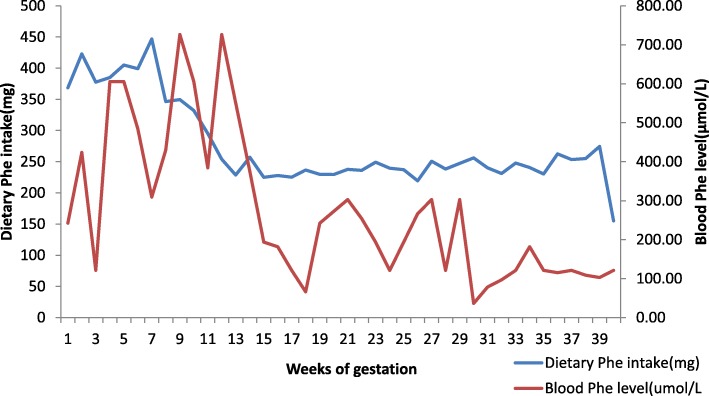
A total of six offspring were successfully delivered. The mean ± SD (range) age of the mother at delivery was 26.3 ± 4.7 (range: 21.1-32.5) years. The mean duration of Phe control before pregnancy was 5.5 ± 1.3(range: 3.1-6.5) months. During pregnancy, the proportion of blood Phe concentrations within the clinically-recommended target range (120-360 μmol/L) ranged from 63.2-83.5%. Low birth weight (< 2500 g) offspring occurred in two women who experienced suboptimal metabolic control. In addition, offspring DQ was related to the proportion of blood Phe levels per trimester that were within the recommended range (r = 0.886, p = 0.016).
This is the first report of women in China with PKU who successfully gave birth to clinically healthy babies. Infant outcomes were related to maternal blood Phe management prior to and during pregnancy. In maternal PKU patients with poor compliance to dietary treatment, sapropterin dihydrochloride (6R-BH) may be an option to improve the management of blood Phe levels.
自 20 世纪 90 年代中国开展新生儿筛查项目以来,遗传性、代谢性疾病患者的妊娠变得更加常见。本研究探讨了苯丙酮尿症(PKU)患者计划的足月妊娠的管理和结局。
纳入 2012 年至 2017 年期间患有 PKU 的已婚患者,接受产前咨询和定期健康评估。研究相关评估包括限制苯丙氨酸饮食的时间、孕妇体重增加、妊娠龄、妊娠并发症和血苯丙氨酸浓度(孕前和孕期)、产科数据和后代结局(如人体测量和发育商数 [DQ])。
共成功分娩 6 例后代。母亲分娩时的平均年龄为 26.3 ± 4.7(范围:21.1-32.5)岁。孕前苯丙氨酸控制的平均持续时间为 5.5 ± 1.3(范围:3.1-6.5)个月。孕期血苯丙氨酸浓度在临床推荐目标范围(120-360 μmol/L)内的比例为 63.2-83.5%。2 名代谢控制不佳的孕妇分娩低体重儿(<2500 g)。此外,后代 DQ 与各孕期血苯丙氨酸水平在推荐范围内的比例相关(r=0.886,p=0.016)。
这是中国首例 PKU 妇女成功分娩临床健康婴儿的报告。婴儿结局与母亲孕前和孕期血苯丙氨酸管理有关。对于饮食治疗依从性差的母体 PKU 患者,盐酸沙丙蝶呤(6R-BH)可能是改善血苯丙氨酸水平管理的一种选择。