
人工神经网络利用傅里叶相位空间解决音乐问题。
Artificial Neural Networks Solve Musical Problems With Fourier Phase Spaces.
机构信息
Biological Computation Project, Department of Psychology, University of Alberta, Edmonton, Alberta, Canada.
出版信息
Sci Rep. 2020 Apr 28;10(1):7151. doi: 10.1038/s41598-020-64229-4.
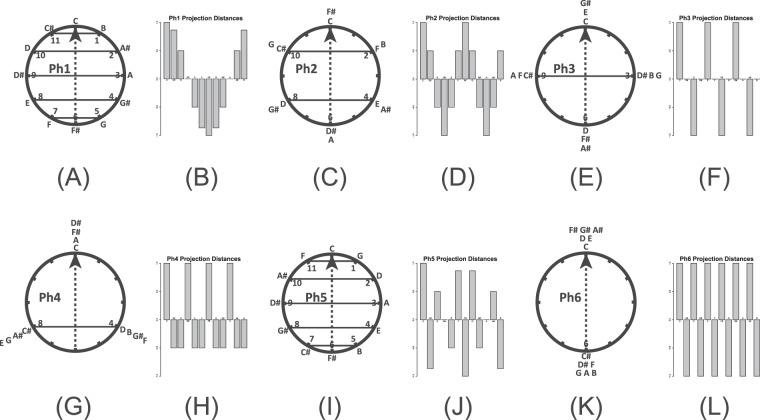
How does the brain represent musical properties? Even with our growing understanding of the cognitive neuroscience of music, the answer to this question remains unclear. One method for conceiving possible representations is to use artificial neural networks, which can provide biologically plausible models of cognition. One could train networks to solve musical problems, and then study how these networks encode musical properties. However, researchers rarely examine network structure in detail because networks are difficult to interpret, and because many assume that networks capture informal or subsymbolic properties. Here we report very high correlations between network connection weights and discrete Fourier phase spaces used to represent musical sets. This is remarkable because there is no clear mathematical relationship between network learning rules and discrete Fourier analysis. That networks discover Fourier phase spaces indicates that these spaces have an important role to play outside of formal music theory. Finding phase spaces in networks raises the strong possibility that Fourier components are possible codes for musical cognition.
大脑如何表现音乐特性?即使我们对音乐认知神经科学的理解不断加深,这个问题的答案仍然不清楚。一种构思可能的表现形式的方法是使用人工神经网络,它可以提供认知的生物学上合理的模型。人们可以训练网络来解决音乐问题,然后研究这些网络如何编码音乐特性。然而,研究人员很少详细检查网络结构,因为网络难以解释,并且许多人认为网络捕获的是非正式或亚符号性质。在这里,我们报告了网络连接权重与用于表示音乐集的离散傅里叶相位空间之间的非常高的相关性。这很了不起,因为网络学习规则和离散傅里叶分析之间没有明确的数学关系。网络发现傅里叶相位空间表明,这些空间在正式音乐理论之外具有重要作用。在网络中找到相位空间,强烈表明傅里叶分量可能是音乐认知的代码。



 Zotero 插件