Kübert Angelika, Paulus Sinikka, Dahlmann Adrian, Werner Christiane, Rothfuss Youri, Orlowski Natalie, Dubbert Maren
Ecosystem Physiology, University of Freiburg, Freiburg, Germany.
Department of Biogeochemical Integration, Max Planck Institute for Biogeochemistry, Jena, Germany.
Front Plant Sci. 2020 Apr 14;11:387. doi: 10.3389/fpls.2020.00387. eCollection 2020.
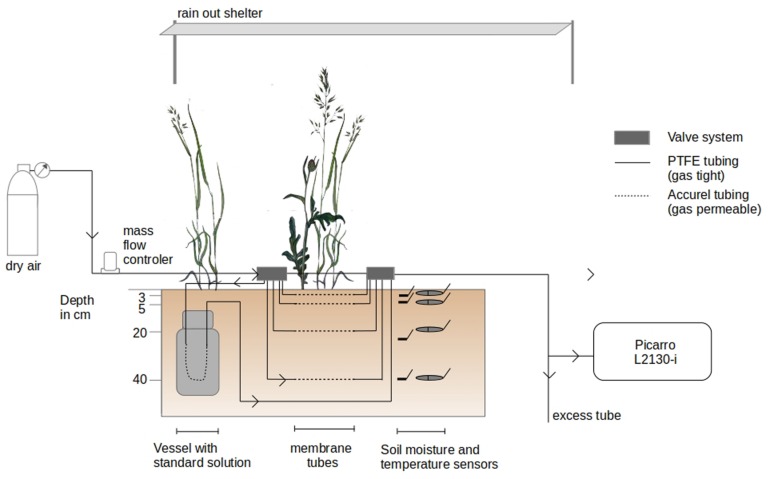
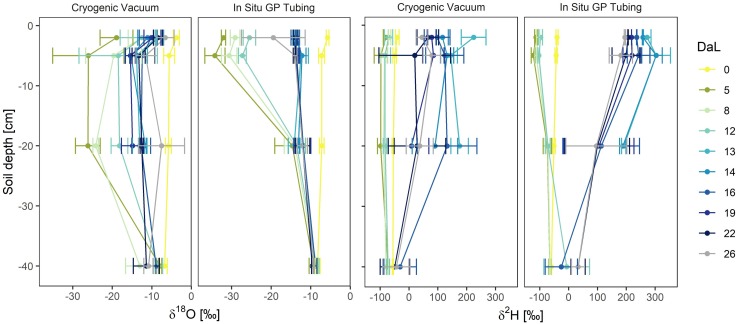
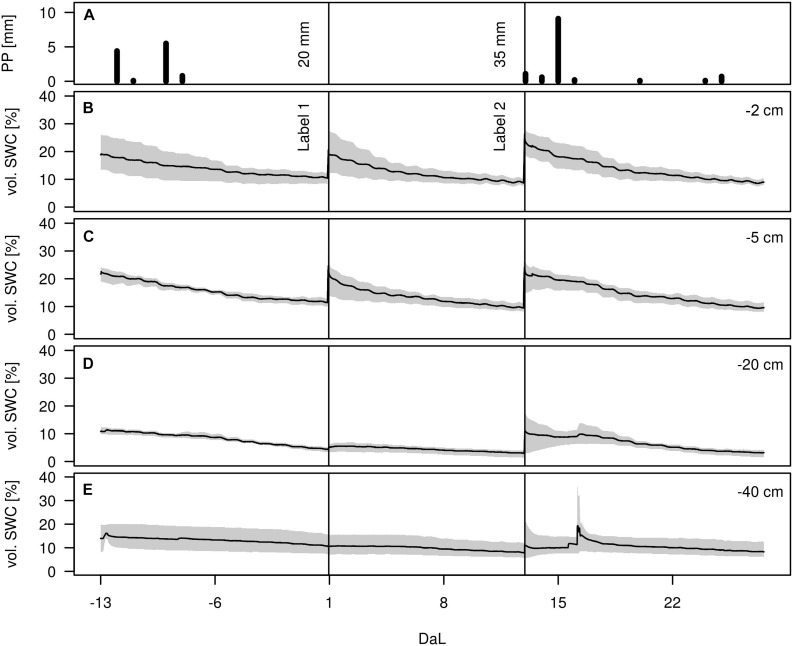
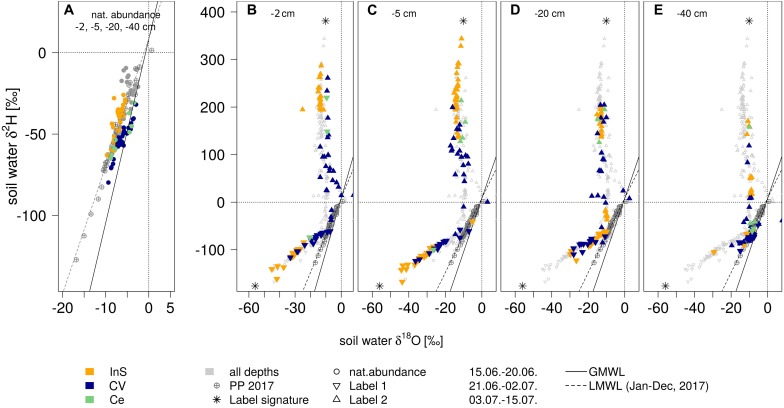
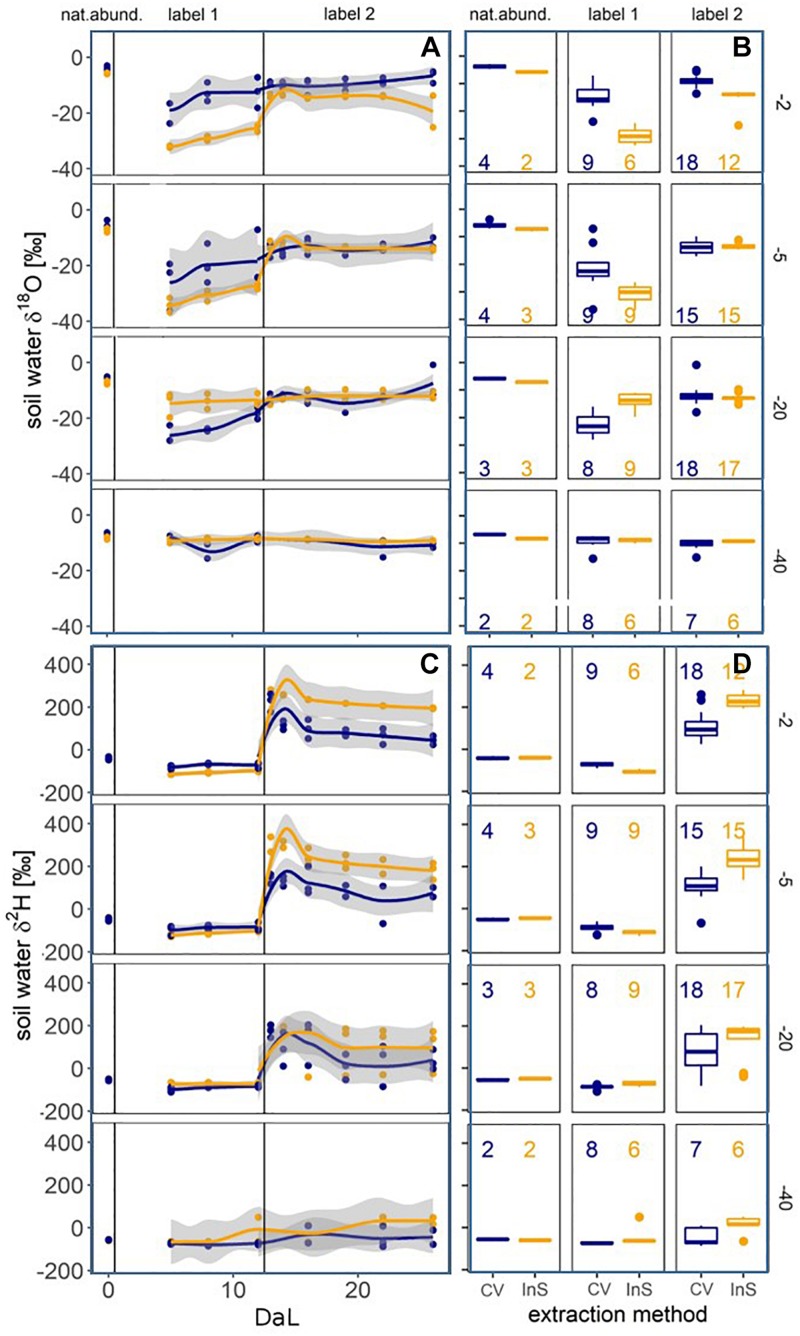
Ecohydrological isotope based field research is often constrained by a lack of temporally explicit soil water data, usually related to the choice of destructive sampling in the field and subsequent analysis in the laboratory. New techniques based on gas permeable membranes allow to sample soil water vapor and infer soil liquid water isotopic signatures. Here, a membrane-based soil water vapor sampling method was tested at a grassland site in Freiburg, Germany. It was further compared with two commonly used destructive sampling approaches for determination of soil liquid water isotopic signatures: cryogenic vacuum extraction and centrifugation. All methods were tested under semi-controlled field conditions, conducting an experiment with dry-wet cycling and two isotopically different labeling irrigation waters. We found mean absolute differences between cryogenic vacuum extraction and vapor measurements of 0.3-14.2‰ (δO) and 0.4-152.2‰ (δH) for soil liquid water. The smallest differences were found under natural abundance conditions of H and O, the strongest differences were observed after irrigation with labeled waters. Labeling strongly increased the isotopic variation in soil water: Mean soil water isotopic signatures derived by cryogenic vacuum extraction were -11.6 ± 10.9‰ (δO) and +61.9 ± 266.3‰ (δH). The soil water vapor method showed isotopic signatures of -12.5 ± 9.4‰ (δO) and +169.3 ± 261.5‰ (δH). Centrifugation was unsuccessful for soil samples due to low water recovery rates. It is therefore not recommended. Our study highlights that the soil water vapor method captures the temporal dynamics in the isotopic signature of soil water well while the destructive approach also includes the natural lateral isotopic heterogeneity. The different advantages and limitations of the three methods regarding setup, handling and costs are discussed. The choice of method should not only consider prevailing environmental conditions but the experimental design and goal. We see a very promising tool in the soil water vapor method, capturing both temporal developments and spatial variability of soil water processes.
基于生态水文同位素的野外研究常常受到缺乏时间明确的土壤水分数据的限制,这通常与野外破坏性采样的选择以及随后在实验室进行的分析有关。基于透气膜的新技术能够对土壤水汽进行采样,并推断土壤液态水的同位素特征。在此,在德国弗莱堡的一个草地站点对一种基于膜的土壤水汽采样方法进行了测试。该方法还与两种常用的用于测定土壤液态水同位素特征的破坏性采样方法进行了比较:低温真空萃取法和离心法。所有方法均在半控制的野外条件下进行测试,开展了干湿循环实验以及使用两种同位素不同的标记灌溉水进行的实验。我们发现,对于土壤液态水,低温真空萃取法与水汽测量值之间的平均绝对差值在δO方面为0.3 - 14.2‰,在δH方面为0.4 - 152.2‰。在H和O的自然丰度条件下差异最小,在用标记水灌溉后观察到的差异最大。标记显著增加了土壤水分中的同位素变化:通过低温真空萃取法得出的土壤水分平均同位素特征在δO方面为 - 11.6 ± 10.9‰,在δH方面为 + 61.9 ± 266.3‰。土壤水汽法显示的同位素特征在δO方面为 - 12.5 ± 9.4‰,在δH方面为 + 169.3 ± 261.5‰。由于水回收率低,离心法对土壤样品不适用。因此不推荐使用。我们的研究强调,土壤水汽法能很好地捕捉土壤水分同位素特征的时间动态,而破坏性方法还包含了自然的横向同位素非均质性。讨论了这三种方法在设置、操作和成本方面的不同优缺点。方法的选择不仅应考虑当前的环境条件,还应考虑实验设计和目标。我们认为土壤水汽法是一种非常有前景的工具,能够捕捉土壤水分过程的时间发展和空间变异性。