Department of Nutrition, University of Montreal, Montreal, Quebec, H3T 1A8, Canada.
Centre Hospitalier Universitaire Sainte-Justine, Montreal, Quebec, H3T 1C5, Canada.
Nutrients. 2020 Apr 27;12(5):1233. doi: 10.3390/nu12051233.
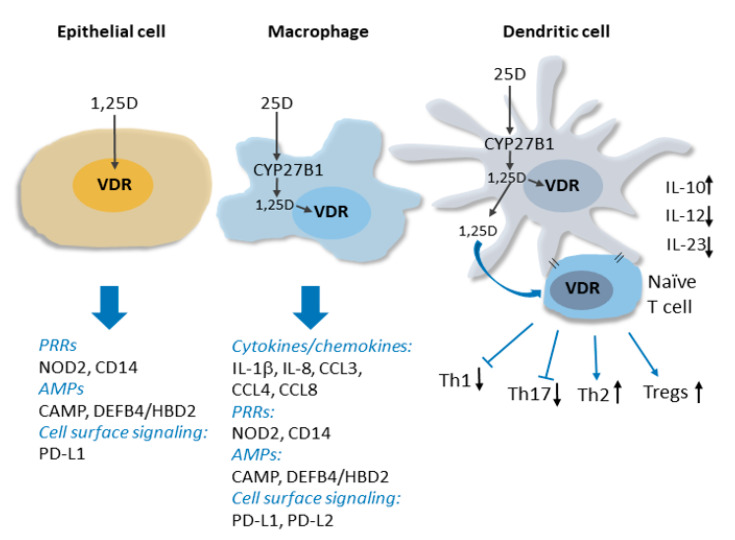
The last couple of decades have seen an explosion in our interest and understanding of the role of vitamin D in the regulation of immunity. At the molecular level, the hormonal form of vitamin D signals through the nuclear vitamin D receptor (VDR), a ligand-regulated transcription factor. The VDR and vitamin D metabolic enzymes are expressed throughout the innate and adaptive arms of the immune system. The advent of genome-wide approaches to gene expression profiling have led to the identification of numerous VDR-regulated genes implicated in the regulation of innate and adaptive immunity. The molecular data infer that vitamin D signaling should boost innate immunity against pathogens of bacterial or viral origin. Vitamin D signaling also suppresses inflammatory immune responses that underlie autoimmunity and regulate allergic responses. These findings have been bolstered by clinical studies linking vitamin D deficiency to increased rates of infections, autoimmunity, and allergies. Our goals here are to provide an overview of the molecular basis for immune system regulation and to survey the clinical data from pediatric populations, using randomized placebo-controlled trials and meta-analyses where possible, linking vitamin D deficiency to increased rates of infections, autoimmune conditions, and allergies, and addressing the impact of supplementation on these conditions.
在过去的几十年中,我们对维生素 D 在免疫调节中的作用的兴趣和理解呈爆炸式增长。在分子水平上,维生素 D 的激素形式通过核维生素 D 受体 (VDR) 发出信号,VDR 是一种配体调节转录因子。VDR 和维生素 D 代谢酶在先天和适应性免疫系统中均有表达。全基因组方法进行基因表达谱分析的出现,导致了许多与先天和适应性免疫调节相关的 VDR 调节基因的鉴定。分子数据推断,维生素 D 信号应该增强针对细菌或病毒病原体的先天免疫。维生素 D 信号还抑制了自身免疫和调节过敏反应的炎症免疫反应。这些发现得到了将维生素 D 缺乏与感染、自身免疫和过敏发生率增加联系起来的临床研究的支持。我们的目标是提供对免疫系统调节的分子基础的概述,并调查儿科人群的临床数据,尽可能使用随机安慰剂对照试验和荟萃分析,将维生素 D 缺乏与感染、自身免疫和过敏发生率增加联系起来,并解决补充对这些情况的影响。