Research Unit for Dietary Studies, The Parker Institute, Bisbebjerg og Frederiksberg Hospital, Nordre Fasanvej 57, 2000 Frederiksberg, Denmark.
Danish Center for Neonatal Screening, Department of Clinical Biochemistry and Immunology, Statens Serum Institute, 2300 Copenhagen, Denmark.
Nutrients. 2020 Mar 21;12(3):842. doi: 10.3390/nu12030842.
low vitamin D status in pregnancy can influence the offspring's lung function and contribute to childhood asthma development. The objective of this study was to examine the influence of neonatal vitamin D status on the development of asthma among children age 3-9 years in a large population sample.
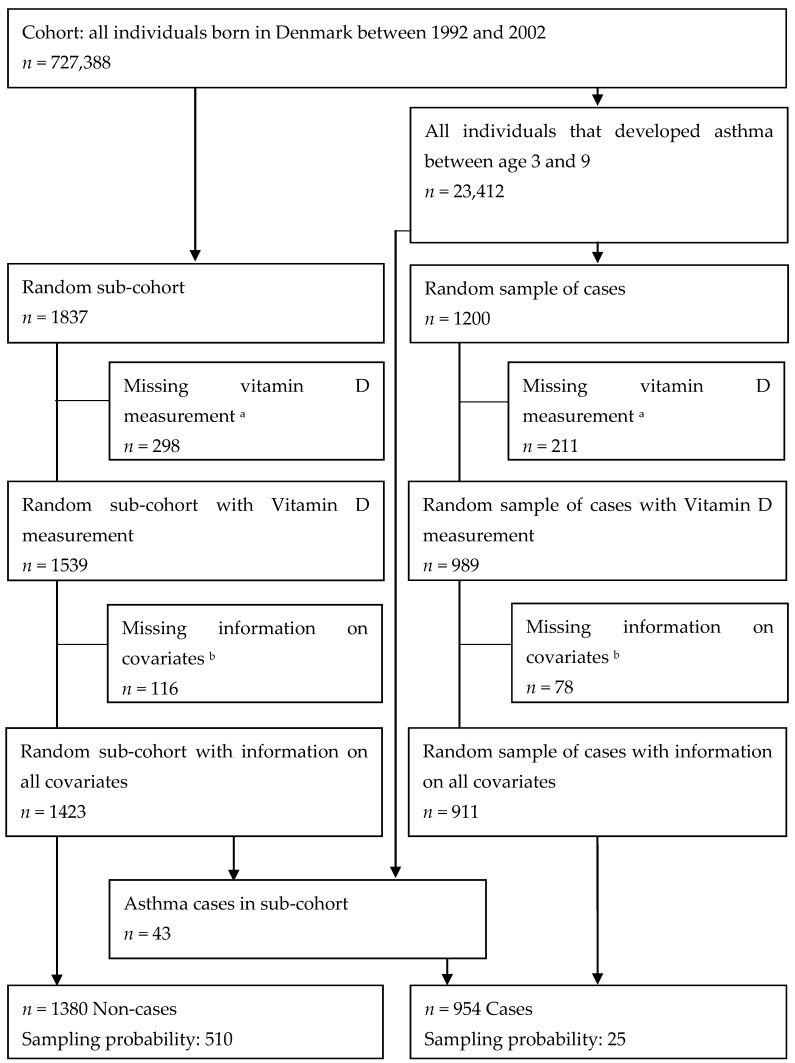
in a case-cohort study utilizing a Danish biobank and register data we examined the association between neonatal 25-hydroxyvitamin D (25(OH)D) concentrations and incidence of asthma among children aged 3-9 years. Cases of asthma ( = 911) were randomly selected among all cases of asthma in the Danish National Patient Register from children born between 1992 and 2002. The sub-cohort ( = 1423) was randomly selected among all children born in the same period. We used a weighted Cox proportional hazard model assessing the hazard of first asthma diagnoses by quintiles of 25(OH)D.
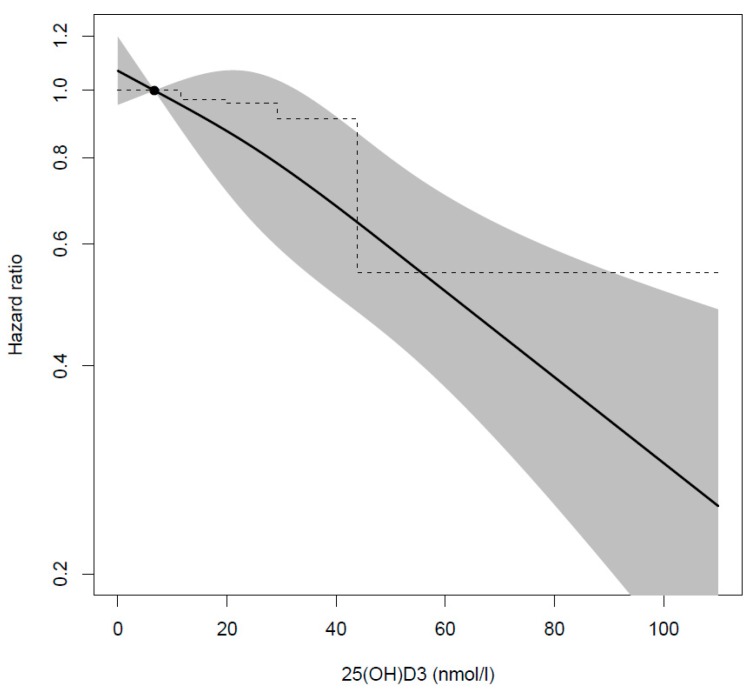
the median 25(OH)D3 (interquartile range) for asthma cases was 23 nmol/L (14-35) and the sub-cohort 25 nmol/L (14-40). The hazard ratio for developing asthma between ages 3 and 9 years was lower for children in the fifth quintile of neonatal 25(OH)D compared to children in the first quintile, both in the unadjusted (0.61 95% CI: 0.46-0.80) and adjusted (0.55 95% CI: 0.39-0.77) analyses.
the results from our study suggest that higher neonatal vitamin D concentration may reduce the risk of developing childhood asthma at ages 3-9 years, indicating that neonatal vitamin D status as a proxy of vitamin D status during the prenatal period is important for normal immune- and lung development.
孕妇体内维生素 D 水平较低会影响后代的肺功能,并导致儿童哮喘的发生。本研究旨在探讨新生儿维生素 D 状态对丹麦大样本儿童 3-9 岁时哮喘发生的影响。
在一项利用丹麦生物库和登记数据的病例对照研究中,我们检测了新生儿 25-羟维生素 D(25(OH)D)浓度与 3-9 岁儿童哮喘发病率之间的关系。从 1992 年至 2002 年期间出生的儿童中,通过丹麦国家患者登记处随机选择哮喘病例(=911)作为哮喘病例。在同一时期出生的所有儿童中,随机选择亚组(=1423)。我们使用加权 Cox 比例风险模型评估按 25(OH)D 五分位数划分的首次哮喘诊断的风险。
哮喘病例的中位 25(OH)D3(四分位间距)为 23 nmol/L(14-35),亚组为 25 nmol/L(14-40)。与五分位 1 的儿童相比,五分位 5 的新生儿 25(OH)D 水平的儿童在 3-9 岁时发生哮喘的风险较低,在未调整分析中(0.61 95%CI:0.46-0.80)和调整分析中(0.55 95%CI:0.39-0.77)。
本研究结果表明,新生儿维生素 D 浓度较高可能降低儿童在 3-9 岁时发生哮喘的风险,这表明新生儿维生素 D 状态作为产前维生素 D 状态的替代指标对正常免疫和肺发育很重要。