Department of Occupation Therapy, Chung Shan Medical University, Occupational Therapy Room, Chung Shan Medical University Hospital, No.110, Sec.1, Jianguo N.Rd, Taichung City, 40201, Taiwan, Republic of China.
Department of Information Management, National Chung Cheng University, No.168, Sec. 1, University Rd., Minhsiung, Chiayi, 62102, Taiwan, Republic of China.
BMC Med Inform Decis Mak. 2020 Apr 29;20(1):82. doi: 10.1186/s12911-020-1090-7.
Information systems implementation projects have been historically plagued by failures for which user resistance has consistently been identified as a salient reason. Most prior studies investigated either the causes or the consequences of Resistance to Change (RTC) of medical related Information Systems. In this study, we simultaneously explore the causes and impacts of RTC of Disability Determination System (DDS).
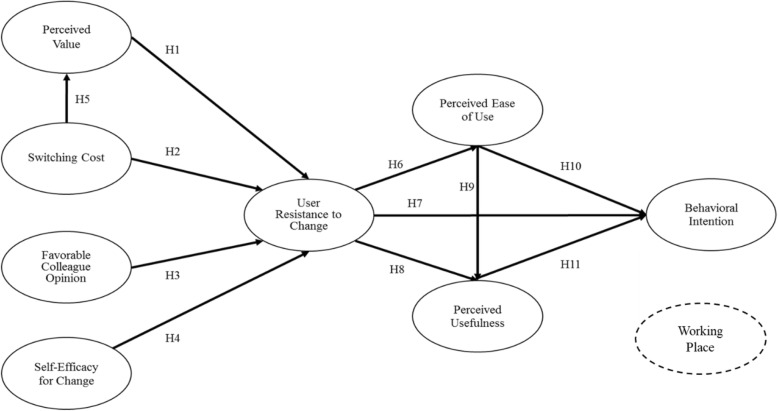
This study adopts the Status Quo Bias perspective and combines the information systems usage model and Technology Acceptance Model (TAM) as theoretical foundation to investigates the causes and impacts of users' RTC on their intention to use the DDS. Data were obtained through internet questionnaire survey. Totally, 326 respondents from 22 local governments and 142 hospitals were collected, of which 252 were valid samples and were analyzed using structure model analysis.
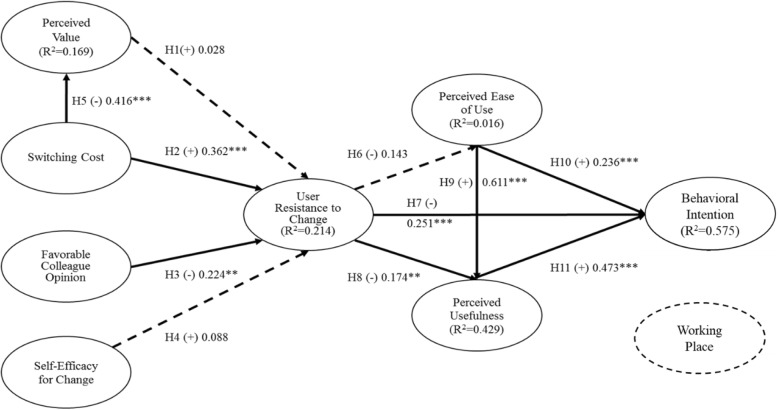
The research model is proved with eight out of 11 hypotheses being supported. The antecedents of RTC can explain 21.4% of the RTC variation, and the RTC impacts can explain 57.5% of the variation of intention to use DDS.
Combining the Status Quo Bias perspective and key component of TAM provides an adequate explanation of adopting intention of changing systems and extend the existing knowledge of information systems adoption. The results provide as a reference for managing users' RTC and enhance the effects and efficiency of new systems adoption.
信息系统实施项目历来饱受失败之苦,而用户抵制一直被认为是一个突出的原因。大多数先前的研究要么调查医疗相关信息系统的抵制变革(RTC)的原因,要么调查其后果。在这项研究中,我们同时探讨了残疾鉴定系统(DDS)的 RTC 的原因和影响。
本研究采用现状偏见视角,并结合信息系统使用模型和技术接受模型(TAM)作为理论基础,调查用户对 DDS 的 RTC 对其使用意图的原因和影响。数据通过互联网问卷调查获得。共收集了来自 22 个地方政府和 142 家医院的 326 名受访者,其中 252 名是有效样本,并使用结构模型分析进行了分析。
研究模型得到了 11 个假设中的 8 个的验证。RTC 的前因可以解释 RTC 变化的 21.4%,而 RTC 的影响可以解释 DDS 使用意图变化的 57.5%。
将现状偏见视角与 TAM 的关键组成部分相结合,为改变系统的采用意图提供了充分的解释,并扩展了信息系统采用的现有知识。研究结果为管理用户的 RTC 提供了参考,并提高了新系统采用的效果和效率。