Zhou Jingyang, Wang Haihong, Che Jinhui, Xu Lu, Yang Weizhong, Li Yunjiu, Zhou Wuyuan
1Class 182, Queen Mary School, Medical Department, Nanchang University, Nanchang, 330031 People's Republic of China.
Department of Hepatopancreatobillary Surgery, Xuzhou City Cancer Hospital, No. 131 Huancheng Rd., Gulou District, Xuzhou, 221000 Jiangsu People's Republic of China.
Cancer Cell Int. 2020 Apr 25;20:134. doi: 10.1186/s12935-020-01210-1. eCollection 2020.
Recent studies have emphasized determining the ability of microRNAs (miRNAs) as crucial regulators in the occurrence and development of pancreatic cancer (PC), which continues to be one of the deadliest malignancies with few effective therapies. The study aimed to investigate the functional role of miR-135b and its associated mechanism to unravel the biological characteristics of tumor growth in pancreatic cancer stem cells (PCSCs).
Microarray analyses were initially performed to identify the PC-related miRNAs and genes. The expression of miR-135b and PCSC markers in PC tissues and cells was determined by RT-qPCR and western blot analysis, respectively. The potential gene (JADE-1) that could bind to miR-135b was confirmed by the dual-luciferase reporter assay. To investigate the tumorigenicity, migration, invasion, and stemness of PC cells, several gain-of-function and loss-of-function genetic experiments were conducted. Finally, tumor formation in nude mice was conducted to confirm the results in vivo.
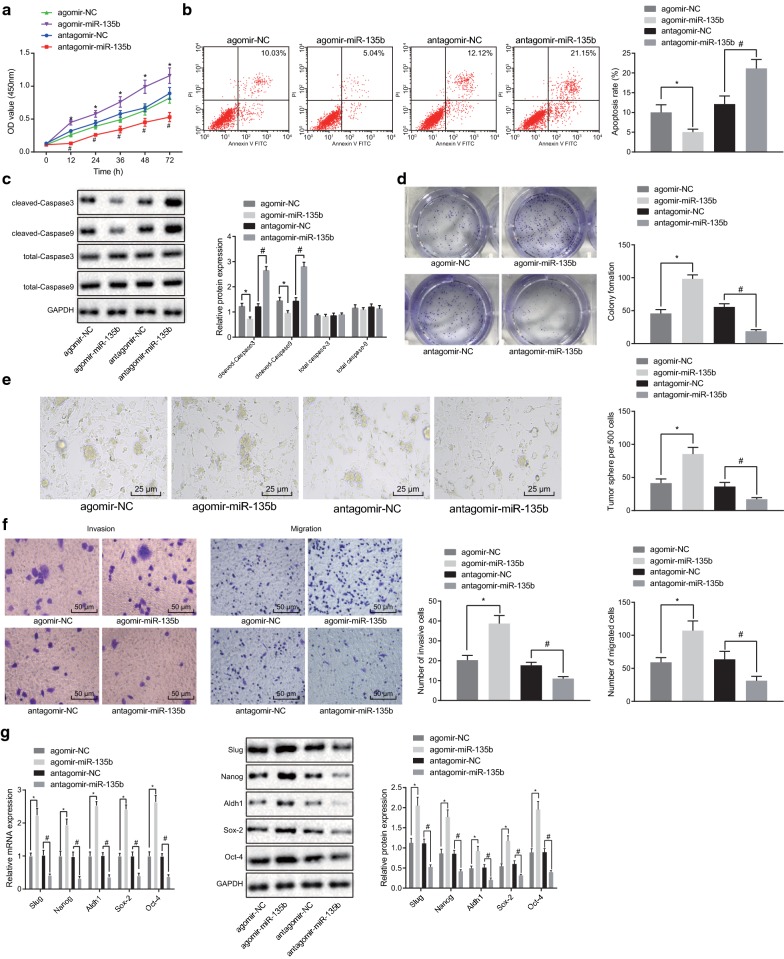
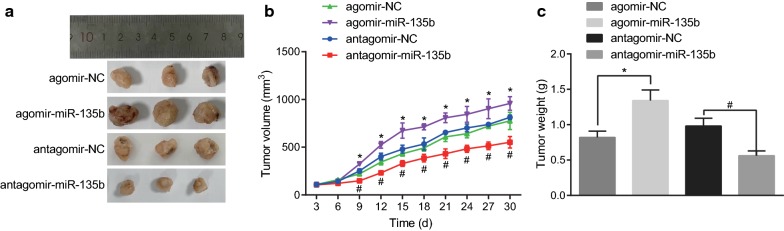
miR-135b was highly-expressed in PC tissues and PCSCs, which was identified to specifically target JADE-1. The overexpression of miR-135b promoted proliferation, migration, and invasion of PCSC, inhibited cell apoptosis and increased the expression of stemness-related factors (Sox-2, Oct-4, Nanog, Aldh1, and Slug). Moreover, miR-135b could promote the expression of phosphorylated AKT and phosphorylated mTOR in the AKT/mTOR pathway. Additionally, miR-135b overexpression accelerated tumor growth in nude mice.
Taken together, the silencing of miR-135b promotes the JADE-1 expression, which inactivates the AKT/mTOR pathway and ultimately results in inhibition of self-renewal and tumor growth of PCSCs. Hence, this study contributes to understanding the role of miR-135 in PCSCs and its underlying molecular mechanisms to aid in the development of effective PC therapeutics.
近期研究强调确定微小RNA(miRNA)作为胰腺癌(PC)发生和发展中关键调节因子的能力,胰腺癌仍是最致命的恶性肿瘤之一,有效治疗方法很少。本研究旨在探讨miR-135b的功能作用及其相关机制,以阐明胰腺癌干细胞(PCSC)中肿瘤生长的生物学特性。
最初进行微阵列分析以鉴定与PC相关的miRNA和基因。分别通过RT-qPCR和蛋白质印迹分析确定PC组织和细胞中miR-135b和PCSC标志物的表达。通过双荧光素酶报告基因测定法确认可与miR-135b结合的潜在基因(JADE-1)。为了研究PC细胞的致瘤性、迁移、侵袭和干性,进行了多项功能获得和功能丧失的基因实验。最后,在裸鼠中进行肿瘤形成实验以在体内证实结果。
miR-135b在PC组织和PCSC中高表达,经鉴定其特异性靶向JADE-1。miR-135b的过表达促进了PCSC的增殖、迁移和侵袭,抑制细胞凋亡并增加了干性相关因子(Sox-2、Oct-4、Nanog、Aldh1和Slug)的表达。此外,miR-135b可促进AKT/mTOR通路中磷酸化AKT和磷酸化mTOR的表达。另外,miR-135b过表达加速了裸鼠中的肿瘤生长。
综上所述,miR-135b的沉默促进了JADE-1的表达,这使AKT/mTOR通路失活并最终导致PCSC的自我更新和肿瘤生长受到抑制。因此,本研究有助于理解miR-135在PCSC中的作用及其潜在分子机制,以助力有效PC治疗方法的开发。