Department of Neuroscience, Peter O'Donnell Jr. Brain Institute, University of Texas Southwestern Medical Center, Dallas, TX 75390-9111.
Gladstone/University of California San Francisco Center for Cell Circuitry, Gladstone Institutes, San Francisco, CA 94158.
Proc Natl Acad Sci U S A. 2020 May 12;117(19):10350-10356. doi: 10.1073/pnas.1922388117. Epub 2020 May 1.
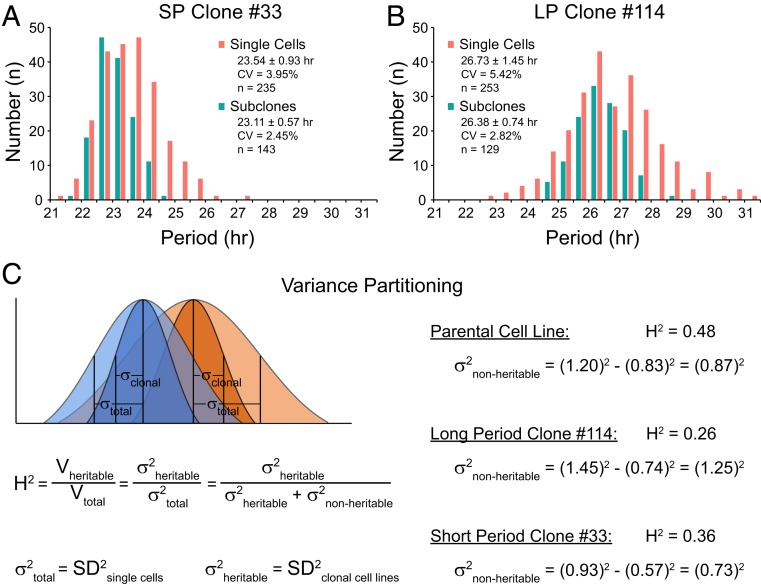
Nongenetic cellular heterogeneity is associated with aging and disease. However, the origins of cell-to-cell variability are complex and the individual contributions of different factors to total phenotypic variance are still unclear. Here, we took advantage of clear phenotypic heterogeneity of circadian oscillations in clonal cell populations to investigate the underlying mechanisms of cell-to-cell variability. Using a fully automated tracking and analysis pipeline, we examined circadian period length in thousands of single cells and hundreds of clonal cell lines and found that longer circadian period is associated with increased intercellular heterogeneity. Based on our experimental results, we then estimated the contributions of heritable and nonheritable factors to this variation in circadian period length using a variance partitioning model. We found that nonheritable noise predominantly drives intercellular circadian period variation in clonal cell lines, thereby revealing a previously unrecognized link between circadian oscillations and intercellular heterogeneity. Moreover, administration of a noise-enhancing drug reversibly increased both period length and variance. These findings suggest that circadian period may be used as an indicator of cellular noise and drug screening for noise control.
非遗传细胞异质性与衰老和疾病有关。然而,细胞间变异的起源很复杂,不同因素对总表型变异的个体贡献仍不清楚。在这里,我们利用克隆细胞群体中昼夜节律振荡的明显表型异质性来研究细胞间变异性的潜在机制。使用全自动跟踪和分析管道,我们检查了数千个单细胞和数百个克隆细胞系的昼夜周期长度,发现较长的昼夜周期与细胞间异质性的增加有关。基于我们的实验结果,我们然后使用方差分解模型估计遗传和非遗传因素对昼夜周期长度变化的贡献。我们发现,非遗传噪声主要驱动克隆细胞系中细胞间的昼夜周期变化,从而揭示了昼夜振荡与细胞间异质性之间以前未被认识到的联系。此外,噪声增强药物的给药可可逆地增加周期长度和方差。这些发现表明,昼夜周期可以用作细胞噪声的指标,并可用于噪声控制的药物筛选。