Laboratory of Animal Geneti cs and Breeding and Molecular Design of Jiangsu Province, Yangzhou University, Yangzhou 225009, P.R. China.
Waterfowl Institute of Yangzhou, Songqiao 225651, P.R. China.
Poult Sci. 2020 May;99(5):2500-2507. doi: 10.1016/j.psj.2019.10.039. Epub 2020 Apr 8.
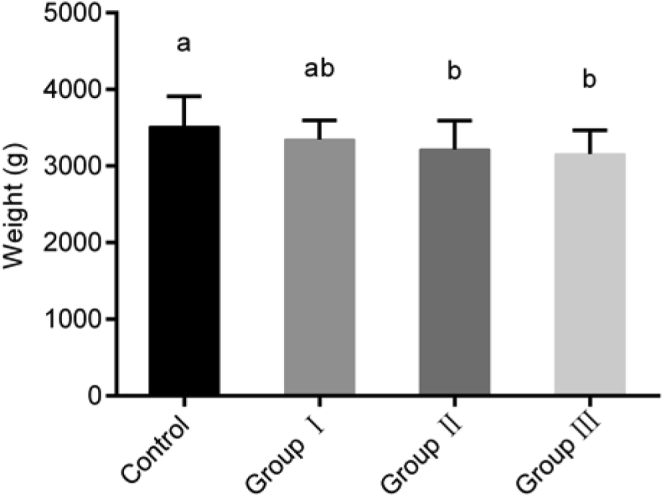
This study was conducted to determine the effects of diet with different proportions of ryegrass on breast meat quality of geese. In total, 240 healthy male Yangzhou geese (28-day-old) with similar body weight were divided randomly into 4 diet groups (control group: fed commercial diets; treatment groups I, II, and III: fed ryegrass and commercial diet in the ratios of 1.5:1, 2:1, and 3:1, respectively), the birds being fed from the age of 29 to 70 D. The results shows that the body weights of 70-day-old geese of treatment groups II and III were lower than those in the control group, whereas those of geese of treatment group I were similar to those of the control group. The contents of flavor amino acid and total (essential) amino acids in treatment groups I and II were higher than those in treatment group III (P < 0.05). In addition, grass supplementation reduced saturated fatty acid content and increased that of omega-3 (n-3) polyunsaturated fatty acids, relative to the control group (P < 0.05). Finally, among the 6 minerals analyzed in breast muscle, differences existed in Zn, Se, and Cu contents among the geese fed with different proportions of ryegrass. Zn content of geese from treatment groups II and III was significantly higher than that of those of the control group; Cu content was lower with grass intake and was significantly higher in the control group than in treatment group III; Se content was significantly higher in the control group than in both groups II and III (all at P < 0.05). The results from this study indicated that geese fed with low proportions of ryegrass (1.5:1 or 2:1) showed good growth performance and increased total (essential) amino acid, flavor amino acid, n-3 polyunsaturated fatty acid, and Zn content in meat, which had a certain guiding value for the production of high-quality goose meat under intensive feeding conditions.
本研究旨在确定不同比例黑麦草饲粮对鹅胸肉品质的影响。共选择 28 日龄、体重相近的健康雄性扬州鹅 240 只,随机分为 4 个饲粮处理组(对照组:饲喂商品饲粮;处理组 I、II 和 III:分别饲喂黑麦草与商品饲粮比例为 1.5:1、2:1 和 3:1 的饲粮),从 29 日龄开始至 70 日龄进行饲养。结果表明,处理组 II 和 III 的 70 日龄鹅体重均显著低于对照组(P<0.05),而处理组 I 的鹅体重与对照组无显著差异。处理组 I 和 II 的风味氨基酸和总(必需)氨基酸含量均显著高于处理组 III(P<0.05)。此外,饲粮中添加黑麦草降低了饱和脂肪酸含量,增加了 ω-3(n-3)多不饱和脂肪酸含量,与对照组相比均有显著差异(P<0.05)。最后,在胸肌分析的 6 种矿物质中,不同比例黑麦草饲粮组鹅的 Zn、Se 和 Cu 含量存在差异。处理组 II 和 III 的 Zn 含量显著高于对照组;Cu 含量随饲粮中黑麦草添加量的增加而降低,对照组显著高于处理组 III;Se 含量对照组显著高于处理组 II 和 III(均 P<0.05)。本研究表明,饲粮中添加低比例黑麦草(1.5:1 或 2:1)时,鹅生长性能良好,提高了胸肉中的总(必需)氨基酸、风味氨基酸、n-3 多不饱和脂肪酸和 Zn 含量,对集约化饲养条件下生产优质鹅肉具有一定的指导意义。