Division of Infection and Immunity, University College London, London, UK; UCL Genetics Institute, University College London, London, UK; Africa Health Research Institute, Durban, South Africa.
Africa Health Research Institute, Durban, South Africa.
EBioMedicine. 2020 May;55:102747. doi: 10.1016/j.ebiom.2020.102747. Epub 2020 Apr 28.
Studying within-host genetic diversity of Mycobacterium tuberculosis (Mtb) in patients during treatment may identify adaptations to antibiotic and immune pressure. Understanding the significance of genetic heteroresistance, and more specifically heterozygous resistance-associated variants (RAVs), is clinically important given increasing use of rapid molecular tests and whole genome sequencing (WGS).
We analyse data from six studies in KwaZulu-Natal, South Africa. Most patients (>75%) had baseline rifampicin resistance. Sputum was collected for culture at baseline and at between two and nine intervals until month six. Positive cultures underwent WGS. Mixed infections and reinfections were excluded from analysis.
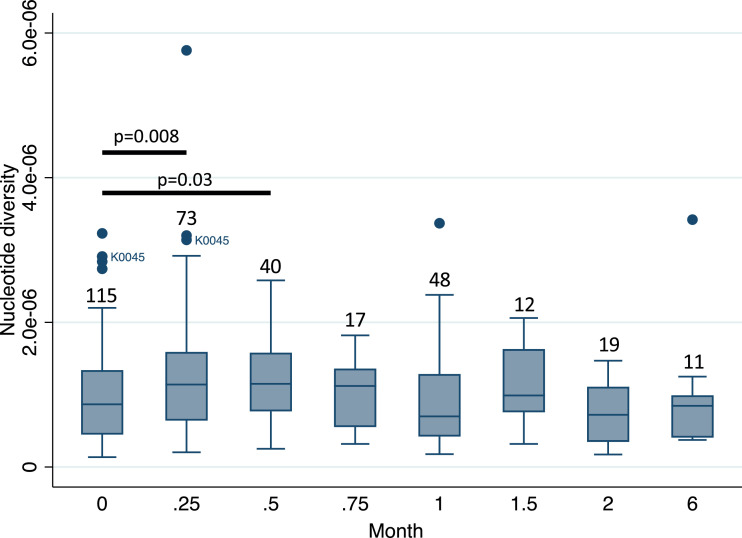
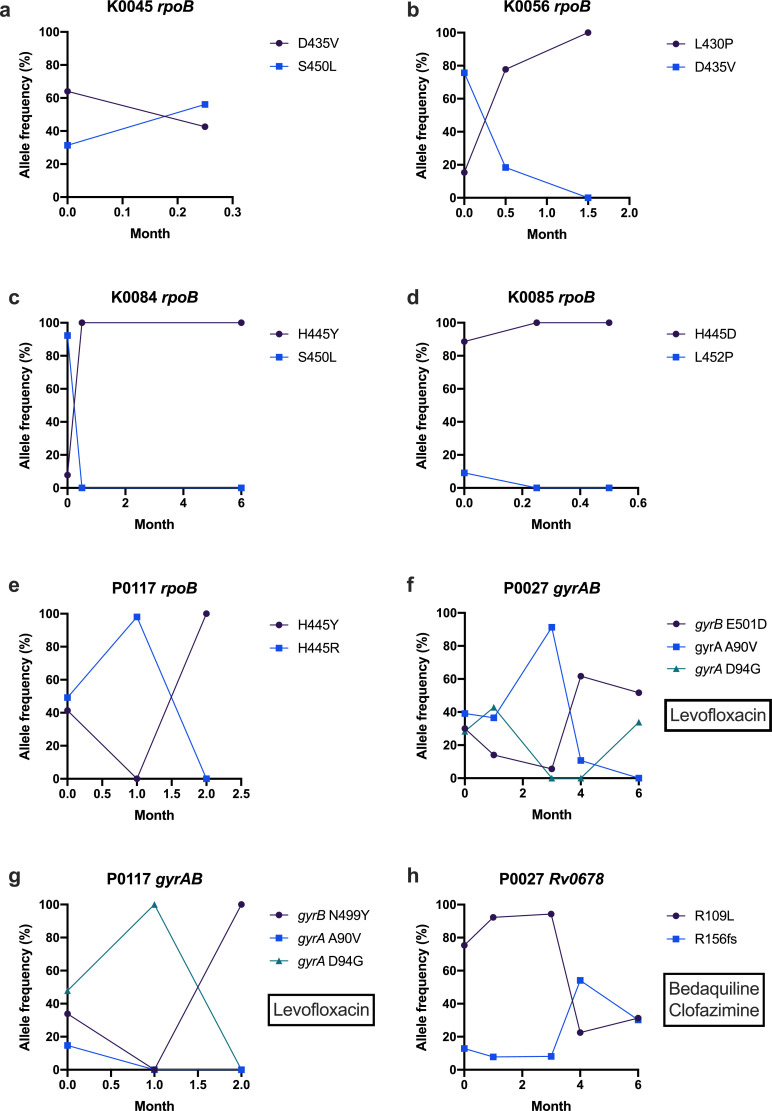
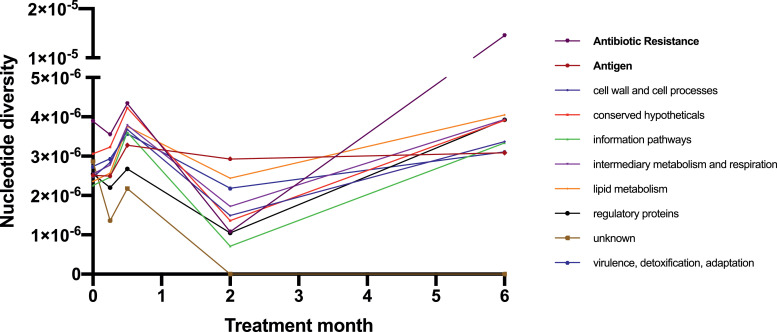
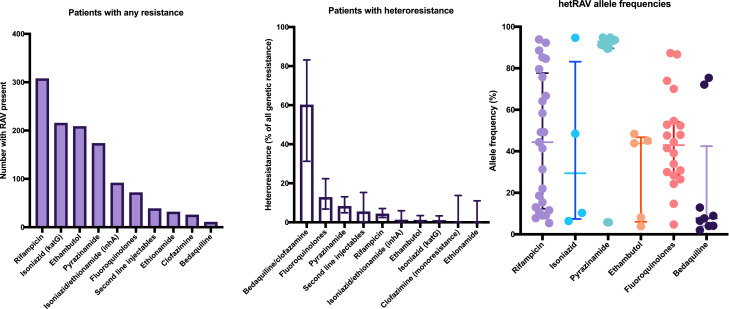
Baseline Mtb overall genetic diversity (at treatment initiation or major change to regimen) was associated with cavitary disease, not taking antiretroviral therapy if HIV infected, infection with lineage 2 strains and absence of second-line drug resistance on univariate analyses. Baseline genetic diversity was not associated with six-month outcome. Genetic diversity increased from baseline to weeks one and two before returning to previous levels. Baseline genetic heteroresistance was most common for bedaquiline (6/10 [60%] of isolates with RAVs) and fluoroquinolones (9/62 [13%]). Most patients with heterozygous RAVs on WGS with sequential isolates available demonstrated RAV persistence or fixation (17/20, 85%). New RAVs emerged in 9/286 (3%) patients during treatment. We could detect low-frequency RAVs preceding emergent resistance in only one case, although validation of deep sequencing to detect rare variants is required.
In this study of single-strain Mtb infections, baseline within-host bacterial genetic diversity did not predict outcome but may reveal adaptations to host and drug pressures. Predicting emergent resistance from low-frequency RAVs requires further work to separate transient from consequential mutations.
Wellcome Trust, NIH/NIAID.
在治疗期间研究结核分枝杆菌(Mtb)患者体内的遗传多样性,可能有助于识别对抗生素和免疫压力的适应。鉴于快速分子检测和全基因组测序(WGS)的应用日益增多,理解遗传异质性耐药的意义,特别是异质耐药相关变异体(RAV),具有重要的临床意义。
我们对南非夸祖鲁-纳塔尔省的六项研究进行了数据分析。大多数患者(>75%)基线时存在利福平耐药。在基线和治疗后 2 至 9 个时间点收集痰液进行培养,直至第 6 个月。阳性培养物进行 WGS 检测。混合感染和再感染不纳入分析。
基线 Mtb 总体遗传多样性(在开始治疗或方案重大改变时)与空洞性疾病、HIV 感染者未接受抗逆转录病毒治疗、感染 2 谱系菌株以及无二线药物耐药性相关,在单变量分析中具有相关性。基线遗传多样性与 6 个月的结局无关。遗传多样性从基线到第 1 周和第 2 周增加,然后恢复到以前的水平。基线遗传异质性最常见于贝达喹啉(6/10 [60%] 的分离株有 RAVs)和氟喹诺酮类药物(9/62 [13%])。大多数在 WGS 中具有异质 RAVs 且有连续分离株可用的患者,均表现出 RAV 持续存在或固定(17/20,85%)。在 286 名患者中有 9 名(3%)在治疗期间出现新的 RAVs。尽管需要对深度测序检测稀有变异进行验证,但我们仅在一个病例中检测到了先前耐药性出现之前的低频 RAVs。
在这项单菌株 Mtb 感染的研究中,基线宿主内细菌遗传多样性与结局无关,但可能反映了对宿主和药物压力的适应。从低频 RAVs 预测新出现的耐药性需要进一步工作,以区分瞬时突变和后果性突变。
惠康信托基金会,美国国立卫生研究院/国家过敏和传染病研究所。