Harding Eleanor, Hammond Jennifer, Chitty Lyn S, Hill Melissa, Lewis Celine
BSc Paediatrics and Child Health, The UCL Great Ormond Street Institute of Child Health, London, UK.
London North Genomic Laboratory Hub, Great Ormond Street Hospital for Children NHS Foundation Trust, London, UK.
Prenat Diagn. 2020 Jul;40(8):1028-1039. doi: 10.1002/pd.5729. Epub 2020 May 24.
Tests in pregnancy such as chromosomal microarray analysis and exome sequencing are increasing diagnostic yield for fetal structural anomalies, but have greater potential to result in uncertain findings. This systematic review investigated the experiences of prospective parents about receiving uncertain results from these tests.
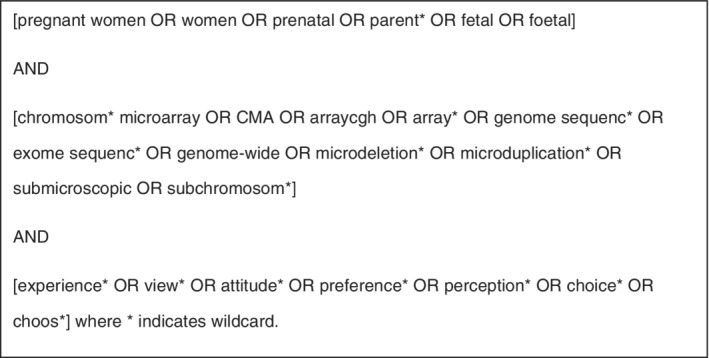
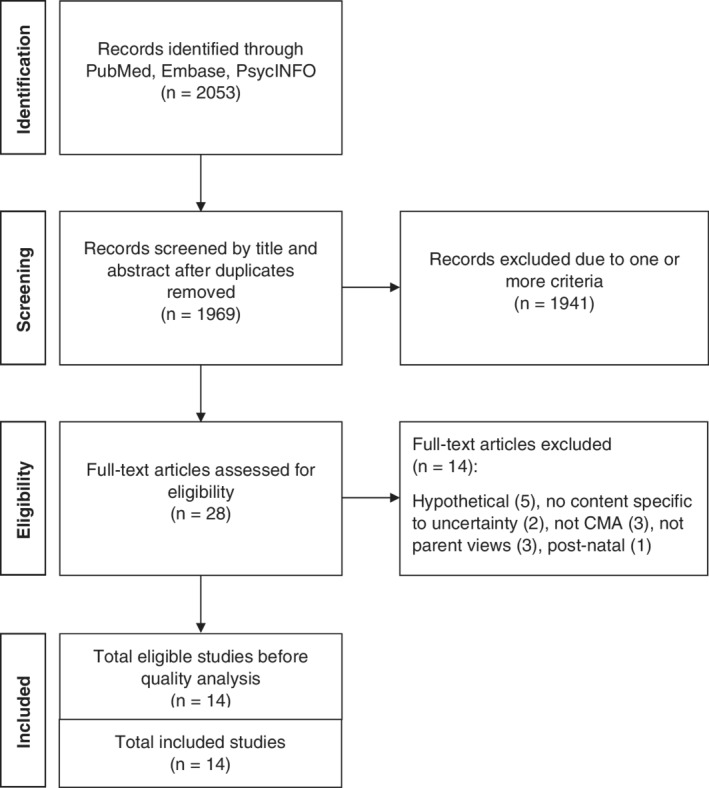
A systematic search of three electronic databases was conducted. Data extraction was performed for studies that met the eligibility and quality criteria. Results were synthesised following the principles of thematic analysis.
Fourteen studies (10 qualitative, 4 quantitative) were included. Findings were grouped into three overarching themes. Sources of uncertainty included the testing procedure, the diagnosis and prognosis, and health professionals' own uncertainty. The clinical impact of the uncertainty included parents struggling to make clinical decisions with the information available, the emotional impact included decisional-regret, shock, worry and feeling overwhelmed. To manage the uncertainty, parents sought support from healthcare professionals, friends, family, the internet and other parents as well as remaining hopeful.
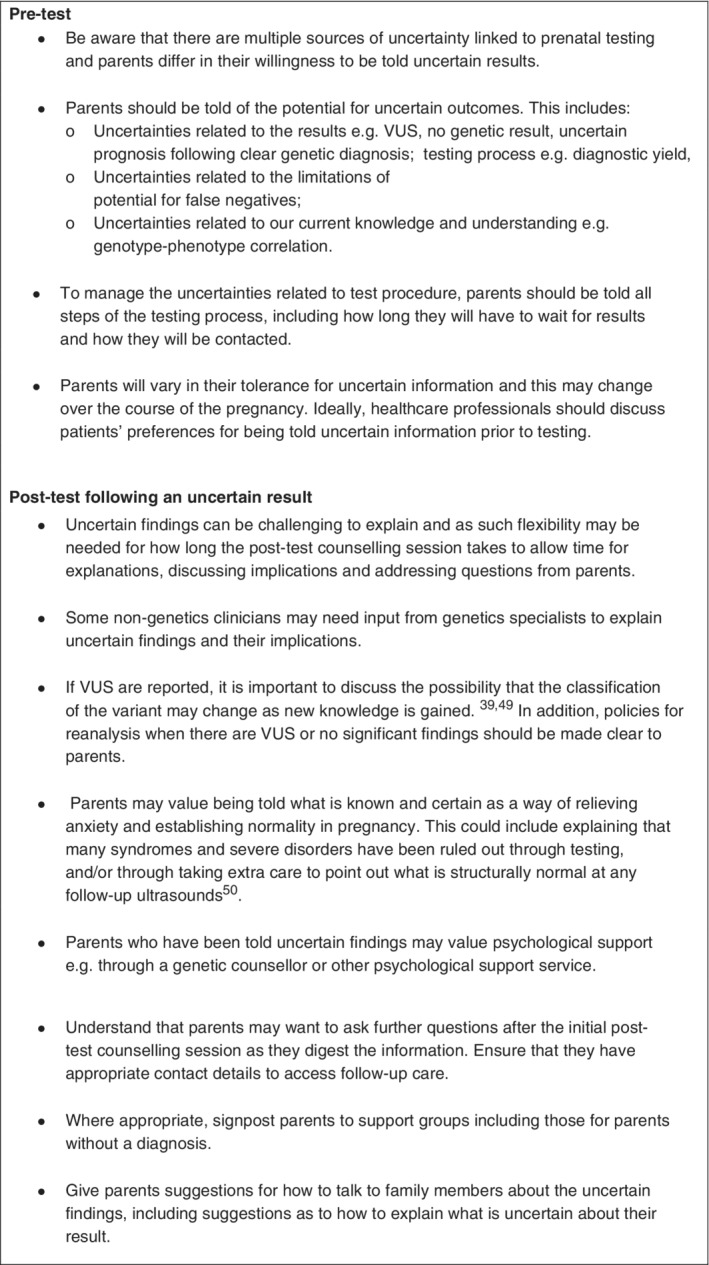
Prospective parents experience a myriad of uncertainties in the prenatal setting, which must be handled sensitively. Future research should explore optimal ways of managing uncertainty to minimise harm. Recommendations are made for discussing uncertainty during pre- and post-test counseling.
孕期检测,如染色体微阵列分析和外显子组测序,提高了胎儿结构异常的诊断率,但更有可能产生不确定的结果。本系统评价调查了准父母收到这些检测不确定结果的经历。
对三个电子数据库进行系统检索。对符合纳入标准和质量标准的研究进行数据提取。按照主题分析原则对结果进行综合。
纳入14项研究(10项定性研究,4项定量研究)。研究结果分为三大主题。不确定性来源包括检测程序、诊断和预后以及医疗专业人员自身的不确定性。不确定性的临床影响包括父母难以根据现有信息做出临床决策,情感影响包括决策后悔、震惊、担忧和不知所措。为应对不确定性,父母向医疗专业人员、朋友、家人、互联网和其他父母寻求支持,并保持希望。
准父母在产前环境中经历了无数的不确定性,必须谨慎处理。未来的研究应探索管理不确定性的最佳方法,以尽量减少危害。对检测前和检测后咨询中讨论不确定性提出了建议。