Division of Epidemiology & Communicable Diseases, Indian Council of Medical Research, New Delhi, India.
ICMR-National Institute of Epidemiology, Chennai, Tamil Nadu, India.
Indian J Med Res. 2020;151(2 & 3):210-215. doi: 10.4103/ijmr.IJMR_1166_20.
BACKGROUND & OBJECTIVES: Nearly 5,500 tests for coronavirus disease 2019 (COVID-19) had been conducted on March 31, 2020 across the Indian Council of Medical Research (ICMR)-approved public and private laboratories in India. Given the need to rapidly increase testing coverage, we undertook an exercise to explore and quantify interventions to increase the daily real-time reverse transcription-polymerase chain reaction (qRT-PCR)-based testing capacity over the next few months. The objective of this exercise was to prepare a potential plan to scale-up COVID-19 testing in India in the public sector.
Potential increase in daily testing capacity of the existing public laboratories was calculated across the three base scenarios of shifts (9, 16 and 24 h). Additional testing capacity was added for each shift scenario based on interventions ranging from procurement of additional qRT-PCR machines, leveraging spare capacity on available qRT-PCR machines not drafted into COVID-19 testing, to in-laboratory process optimization efforts.
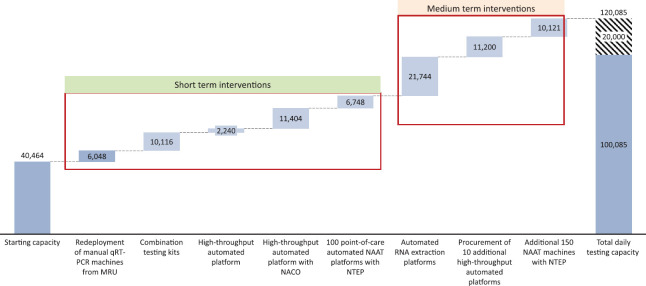
Moving to a 24 h working model in the existing approved laboratories can enhance the daily testing capacity to 40,464 tests/day. The capacity can be further bolstered by leveraging qRT-PCR and nucleic acid amplification test (NAAT)-based machines available with the Multidisciplinary Research Units (MRUs), National AIDS Control Organisation (NACO) and National Tuberculosis Elimination Programme (NTEP). Using combination/multiplex kits, and provision of automated RNA extraction platforms at all laboratories could also optimize run time and contribute to capacity increase by 1.5-2 times.
INTERPRETATION & CONCLUSIONS: Adopting these interventions could help increase public sector's daily testing capacity to nearly 100,000-120,000 tests/day. It is important to note that utilization of the scaled-up testing capacity will require deployment of additional workforce, procurement of corresponding commodities for testing and scale-up of sample collection and transportation efforts.
截至 2020 年 3 月 31 日,印度医学研究理事会(ICMR)批准的公立和私立实验室已对近 5500 例新型冠状病毒疾病(COVID-19)进行了检测。鉴于需要快速提高检测覆盖面,我们开展了一项工作,探索并量化了在未来几个月内提高每日实时逆转录聚合酶链反应(qRT-PCR)检测能力的干预措施。这项工作的目的是制定在印度公共部门扩大 COVID-19 检测的潜在计划。
在 9 小时、16 小时和 24 小时三种基本情况下,计算了现有公立实验室的每日检测能力的潜在增加量。在每个班次情景中,根据从采购额外 qRT-PCR 机器到利用未用于 COVID-19 检测的现有 qRT-PCR 机器的备用能力,再到实验室内部流程优化等干预措施,增加了额外的检测能力。
将现有已批准的实验室改为 24 小时工作制,可将每日检测能力提高到 40464 次/天。通过利用多学科研究单位(MRUs)、国家艾滋病控制组织(NACO)和国家结核病消除计划(NTEP)现有的 qRT-PCR 和核酸扩增试验(NAAT)机器,还可以进一步增强这种能力。使用组合/多重试剂盒,并在所有实验室提供自动化 RNA 提取平台,也可以优化运行时间,并使检测能力提高 1.5-2 倍。
采用这些干预措施可帮助公共部门将每日检测能力提高到近 100000-120000 次/天。需要注意的是,要利用扩大的检测能力,需要部署更多的劳动力,采购相应的检测用品,并扩大样本采集和运输工作。