Pucino Valentina, Certo Michelangelo, Varricchi Gilda, Marone Giancarlo, Ursini Francesco, Rossi Francesca Wanda, De Paulis Amato, Mauro Claudio, Raza Karim, Buckley Christopher Dominic
Institute of Inflammation and Ageing, College of Medical and Dental Sciences, University of Birmingham, Birmingham, United Kingdom.
Rheumatology Research Group, Institute for Inflammation and Ageing, College of Medical and Dental Sciences, University of Birmingham, Queen Elizabeth Hospital, Birmingham, United Kingdom.
Front Physiol. 2020 Apr 17;11:347. doi: 10.3389/fphys.2020.00347. eCollection 2020.
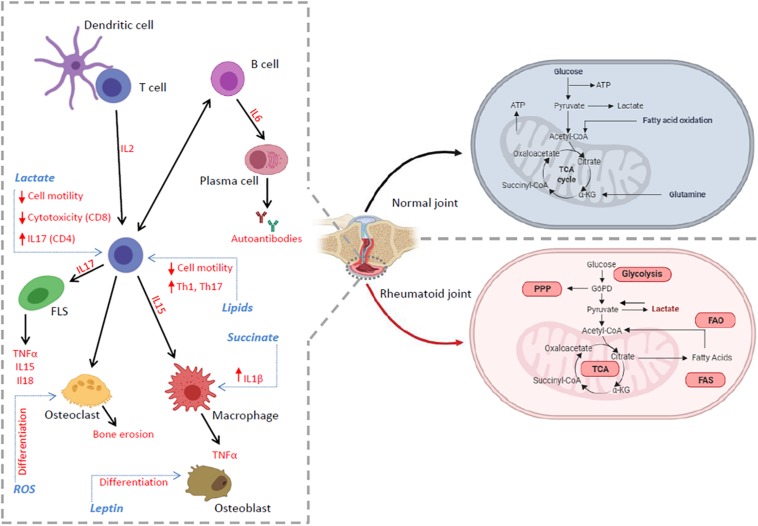
Several studies have highlighted the interplay between metabolism, immunity and inflammation. Both tissue resident and infiltrating immune cells play a major role in the inflammatory process of rheumatoid arthritis (RA) via the production of cytokines, adipo-cytokines and metabolic intermediates. These functions are metabolically demanding and require the most efficient use of bioenergetic pathways. The synovial membrane is the primary site of inflammation in RA and exhibits distinctive histological patterns characterized by different metabolism, prognosis and response to treatment. In the RA synovium, the high energy demand by stromal and infiltrating immune cells, causes the accumulation of metabolites, and adipo-cytokines, which carry out signaling functions, as well as activating transcription factors which act as metabolic sensors. These events drive immune and joint-resident cells to acquire pro-inflammatory effector functions which in turn perpetuate chronic inflammation. Whether metabolic changes are a consequence of the disease or one of the causes of RA pathogenesis is still under investigation. This review covers our current knowledge of cell metabolism in RA. Understanding the intricate interactions between metabolic pathways and the inflammatory and immune responses will provide more awareness of the mechanisms underlying RA pathogenesis and will identify novel therapeutic options to treat this disease.
多项研究强调了代谢、免疫与炎症之间的相互作用。组织驻留免疫细胞和浸润免疫细胞均通过细胞因子、脂肪细胞因子和代谢中间体的产生,在类风湿性关节炎(RA)的炎症过程中发挥主要作用。这些功能对代谢要求很高,需要最有效地利用生物能量途径。滑膜是RA炎症的主要部位,呈现出具有不同代谢、预后和治疗反应特征的独特组织学模式。在RA滑膜中,基质细胞和浸润免疫细胞对能量的高需求导致代谢产物、具有信号传导功能的脂肪细胞因子以及作为代谢传感器的激活转录因子的积累。这些事件促使免疫细胞和关节驻留细胞获得促炎效应功能,进而使慢性炎症持续存在。代谢变化是该疾病的结果还是RA发病机制的原因之一仍在研究中。本综述涵盖了我们目前对RA细胞代谢的认识。了解代谢途径与炎症和免疫反应之间的复杂相互作用,将使我们更深入地认识RA发病机制的潜在机制,并确定治疗该疾病的新疗法。