Li Wanpeng, Lu Hanyu, Liu Juan, Liu Quan, Wang Huan, Zhang Huankang, Sun Xicai, Hu Li, Zhao Weidong, Gu Yurong, Li Houyong, Wang Dehui
Department of Otolaryngology-Head and Neck Surgery, Affiliated Eye Ear Nose and Throat Hospital, Fudan University, Shanghai, China.
Front Oncol. 2020 Apr 17;10:437. doi: 10.3389/fonc.2020.00437. eCollection 2020.
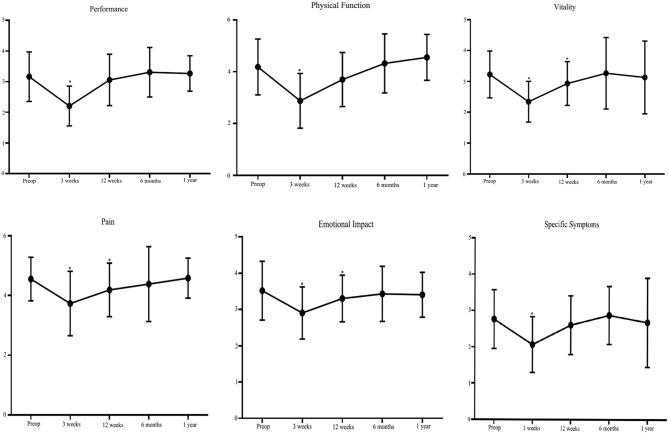
This study aimed to assess the effect of endoscopic nasopharyngectomy in patients with recurrent nasopharyngeal carcinoma (NPC) on site-specific and sinonasal-related quality of life (QoL) before and after surgery using validated instruments. Consecutive adult patients with recurrent NPC, who were treated via salvage endoscopic nasopharyngectomy, were prospectively enrolled at a single institution from January 2018 to December 2019. Each patient completed the Anterior Skull Base Questionnaire (ASBQ) and the 22-Item Sino-Nasal Outcome Test (SNOT-22) preoperatively, and then at regular intervals after surgery to assess their perceived QoL. Forty patients fulfilled the inclusion criteria. The median follow-up was 12 months (range, 2-24 months). Overall scores on the ASBQ and SNOT-22 at 3 or 12 weeks after surgery decreased significantly compared with before surgery ( < 0.05). At 6 months and 1 year postoperatively, there was no significant difference from the preoperative score. Subtotal resection was associated with worse overall ASBQ scores at 6 months and 1 year after endoscopic nasopharyngectomy ( < 0.05). Worse QoL was also associated with advanced T stage (rT3 and rT4) and pathological World Health Organization type III. Sex, age (<50 years), tumor necrosis, lymph node metastasis, and use of a nasoseptal flap approach did not impact postoperative QoL. Site-specific and sinonasal-related QoL, measured using validated tools, demonstrated an overall maintenance of postoperative compared with preoperative QoL. Endoscopic endonasal resection is a valuable management choice in patients with recurrent NPC. In addition, subtotal resection was an important factor that negatively influenced postoperative QoL; as such, gross-total resection should be attempted in all patients to optimize QoL after surgery.
本研究旨在使用经过验证的工具,评估复发性鼻咽癌(NPC)患者接受鼻内镜下鼻咽切除术前后,特定部位及鼻窦相关生活质量(QoL)的变化。2018年1月至2019年12月期间,在一家机构前瞻性纳入了连续的成年复发性NPC患者,这些患者接受了挽救性鼻内镜下鼻咽切除术。每位患者在术前完成前颅底问卷(ASBQ)和22项鼻窦结局测试(SNOT-22),然后在术后定期进行评估,以了解他们感知到的生活质量。40例患者符合纳入标准。中位随访时间为12个月(范围2 - 24个月)。术后3周或12周时,ASBQ和SNOT-22的总体评分与术前相比显著降低(<0.05)。术后6个月和1年时,与术前评分无显著差异。在内镜下鼻咽切除术后6个月和1年时,次全切除与ASBQ总体评分较差相关(<0.05)。较差的生活质量还与晚期T分期(rT3和rT4)及世界卫生组织病理III型相关。性别、年龄(<50岁)、肿瘤坏死、淋巴结转移以及使用鼻中隔瓣入路对术后生活质量无影响。使用经过验证的工具测量的特定部位及鼻窦相关生活质量显示,与术前相比,术后总体维持稳定。鼻内镜下经鼻切除是复发性NPC患者的一种有价值的治疗选择。此外,次全切除是对术后生活质量产生负面影响的重要因素;因此,应尝试对所有患者进行全切除,以优化术后生活质量。