Ezaz Ghideon, Trivedi Hirsh D, Connelly Margery A, Filozof Claudia, Howard Kellie, L Parrish Mark, Kim Misung, Herman Mark A, Nasser Imad, Afdhal Nezam H, Jiang Z Gordon, Lai Michelle
Division of Hepatology Icahn School of Medicine at Mount Sinai New York NY.
Division of Gastroenterology & Hepatology Beth Israel Deaconess Medical Center Harvard Medical School Boston MA.
Hepatol Commun. 2020 Mar 13;4(5):670-680. doi: 10.1002/hep4.1501. eCollection 2020 May.
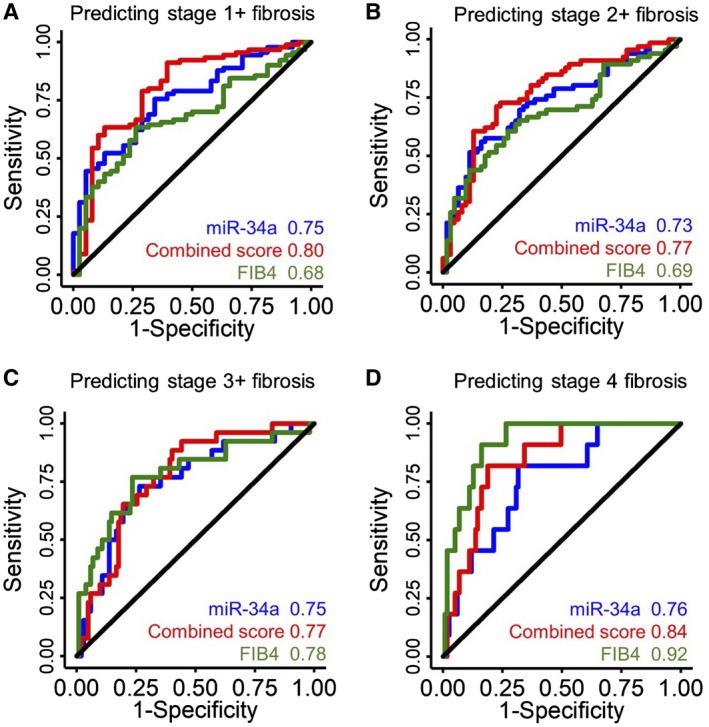
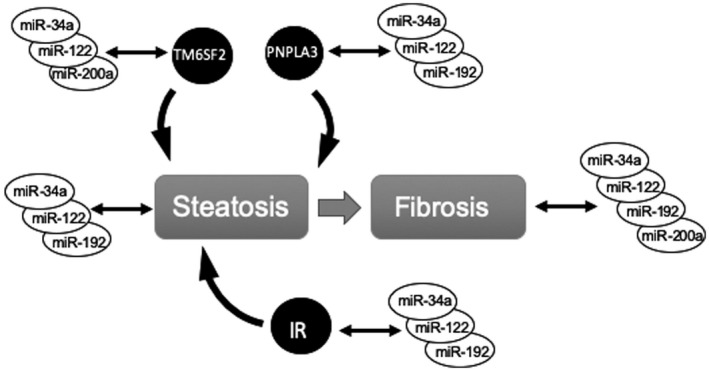
Nonalcoholic fatty liver disease (NAFLD) is a heterogeneous disease driven by genetic and environmental factors. MicroRNAs (miRNAs) serve as pleiotropic post-transcriptional regulators of cellular pathways. Although several miRNAs have been associated with NAFLD and fibrosis, there are limited studies in humans examining their differential association with pathogenic factors or histological features of NAFLD. We examined the differential relationships of five of the best-described circulating microRNAs (miR-34a, miR-122, miR-191, miR-192, and miR-200a) with histological features and pathogenic factors of NAFLD. A cross-sectional study was conducted to examine the relationship between relative levels of circulating microRNAs standardized by -scores and histological features of NAFLD, common NAFLD genetic polymorphisms, and insulin resistance measured by the enhanced lipoprotein insulin resistance index in 132 subjects with biopsy-proven NAFLD. We found that miR-34a, miR-122, miR-192, miR-200a, but not miR-191, strongly correlate with fibrosis in NAFLD by increases of 0.20 to 0.40 SD ( < 0.005) with each stage of fibrosis. In multivariate analysis, miR-34a, miR-122, and miR-192 levels are independently associated with hepatic steatosis and fibrosis, but not lobular inflammation or ballooning degeneration, whereas miR-200a is only associated with fibrosis. Among the four miRNAs, miR-34a, miR-122, and miR-192 are associated with pathogenic factors of NAFLD, including insulin resistance measured by eLP-IR, patatin-like phospholipase domain containing 3 I148M, and transmembrane 6 superfamily 2 (TM6SF2) E167K polymorphisms. In contrast, miR-200a is only associated with the TM6SF2 E167K variant. Finally, miR-34a has the strongest predictive value for various stages of fibrosis, with C-statistic approximates-combined predictive score for miRNAs. miR-34a, miR-122, miR-192, and miR-200a demonstrate strong associations with NAFLD severity by histology, but differential associations with pathogenic factors.
非酒精性脂肪性肝病(NAFLD)是一种由遗传和环境因素驱动的异质性疾病。微小RNA(miRNA)作为细胞通路的多效性转录后调节因子。尽管已有几种miRNA与NAFLD和肝纤维化相关,但在人类中研究它们与NAFLD致病因素或组织学特征的差异关联的研究有限。我们研究了五种描述最详尽的循环微小RNA(miR-34a、miR-122、miR-191、miR-192和miR-200a)与NAFLD组织学特征和致病因素之间的差异关系。进行了一项横断面研究,以检查经z分数标准化的循环微小RNA相对水平与132例经活检证实为NAFLD患者的NAFLD组织学特征、常见的NAFLD基因多态性以及通过增强脂蛋白胰岛素抵抗指数测量的胰岛素抵抗之间的关系。我们发现,miR-34a、miR-122、miR-192、miR-200a(而非miR-191)与NAFLD中的肝纤维化密切相关,随着纤维化的每个阶段增加0.20至0.40标准差(P<0.005)。在多变量分析中,miR-34a、miR-122和miR-192水平与肝脂肪变性和肝纤维化独立相关,但与小叶炎症或气球样变性无关,而miR-200a仅与肝纤维化相关。在这四种miRNA中,miR-34a、miR-122和miR-192与NAFLD的致病因素相关,包括通过eLP-IR测量的胰岛素抵抗、含patatin样磷脂酶结构域3 I148M以及跨膜6超家族2(TM6SF2)E167K多态性。相比之下,miR-200a仅与TM6SF2 E167K变体相关。最后,miR-34a对纤维化的各个阶段具有最强的预测价值,C统计量近似于miRNA的联合预测评分。miR-34a、miR-122、miR-192和miR-200a通过组织学显示与NAFLD严重程度密切相关,但与致病因素存在差异关联。