U.O.C di Medicina Interna con Stroke Care, Dipartimento di Promozione della Salute, Materno-Infantile, di Medicina Interna e Specialistica di Eccellenza "G. D'Alessandro", University of Palermo, Palermo, Italy.
Molecular and Clinical Medicine PhD Programme, University of Palermo, Palermo, Italy.
Aging (Albany NY). 2020 May 3;12(9):8423-8433. doi: 10.18632/aging.103149.
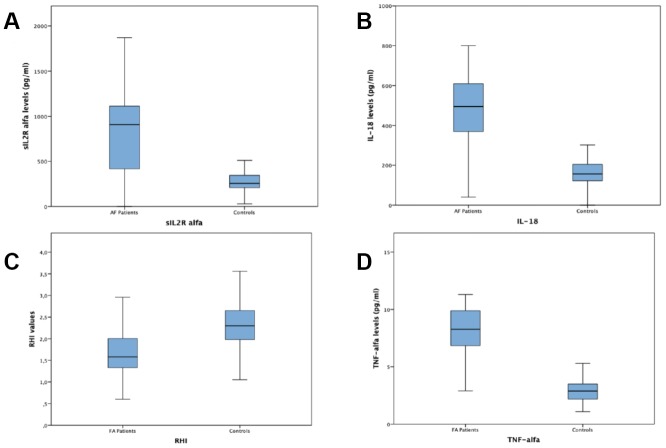
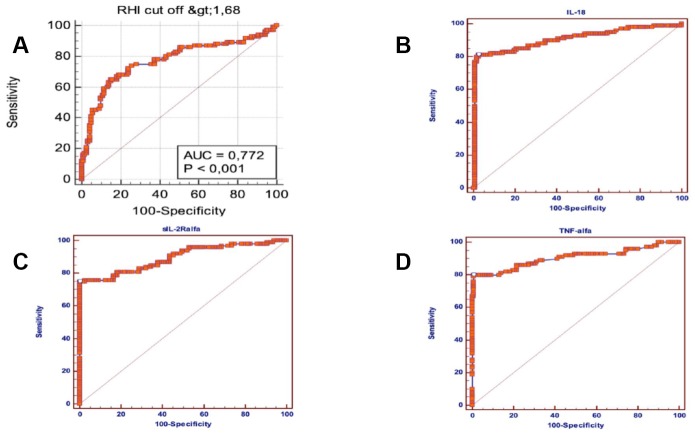
In recent years a growing body of evidence supported the role of inflammation in the initiation, maintenance and outcome of atrial fibrillation (AF). Nevertheless, despite a large amount of information, whether AF or the underlying structural heart disease (SHD) is the cause of the inflammatory process is still under debate. We, therefore, sought to determine if the inflammatory process reflect an underlying disease or the arrhythmia 'per se'. We evaluated plasma levels of soluble Interleukin 2 Receptor Alpha (sIL-2Rα), TNF-α and IL-18 in 100 consecutive patients with permanent AF, (43 with a SHD and 57 without a SHD) compared to 121 age and sex-matched controls which had normal sinus rhythm. We also evaluated the endothelial function in both groups of patients using reactive hyperemia index (RHI) values measured by Endo-PAT2000. Compared to controls, AF patients showed higher circulating levels of inflammatory markers and a lower mean value of RHI. At multiple logistic regression analysis, the inflammatory markers and RHI were significantly associated with AF presence, whereas ROC curve analysis had good sensitivity and specificity in inflammatory variables and RHI for AF presence. No significant association was observed in the group of permanent AF patients, between inflammatory markers and the presence of an underlying SHD. These findings could help to clarify the role of inflammation in subjects with AF and suggest that the markers of systemic inflammation are not associated with the underlying cardiovascular disease, rather with the atrial fibrillation 'per se'.
近年来,越来越多的证据支持炎症在心房颤动(AF)的发生、维持和结局中的作用。尽管有大量的信息,但 AF 或潜在的结构性心脏病(SHD)是否是炎症过程的原因仍存在争议。因此,我们试图确定炎症过程是反映潜在疾病还是心律失常“本身”。我们评估了 100 例持续性 AF 患者(43 例有 SHD,57 例无 SHD)和 121 例年龄和性别匹配的对照组的血浆可溶性白细胞介素 2 受体 alpha(sIL-2Rα)、TNF-α 和 IL-18 水平。我们还使用 Endo-PAT2000 测量的反应性充血指数(RHI)值评估了两组患者的内皮功能。与对照组相比,AF 患者的循环炎症标志物水平更高,平均 RHI 值更低。多变量逻辑回归分析显示,炎症标志物和 RHI 与 AF 的存在显著相关,而 ROC 曲线分析显示炎症变量和 RHI 对 AF 存在具有良好的敏感性和特异性。在永久性 AF 患者组中,炎症标志物与潜在 SHD 的存在之间未观察到显著相关性。这些发现有助于阐明炎症在 AF 患者中的作用,并表明系统性炎症标志物与潜在的心血管疾病无关,而是与心房颤动“本身”有关。