Department of Trauma, Hand and Reconstructive Surgery, Goethe University Frankfurt, 60438 Frankfurt am Main, Germany.
Experimental Radiology, Department of Radiology and Nuclear Medicine, Otto von Guericke University Magdeburg, 39108 Magdeburg, Germany.
Int J Mol Sci. 2020 Apr 30;21(9):3196. doi: 10.3390/ijms21093196.
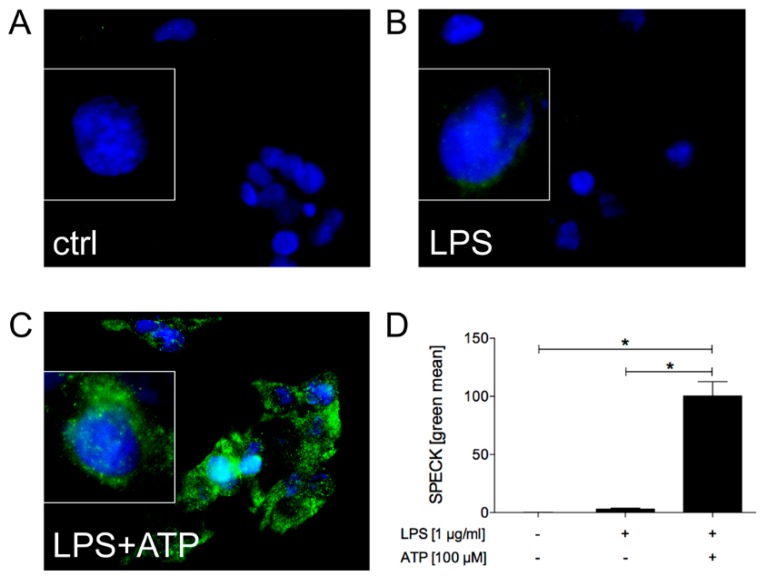
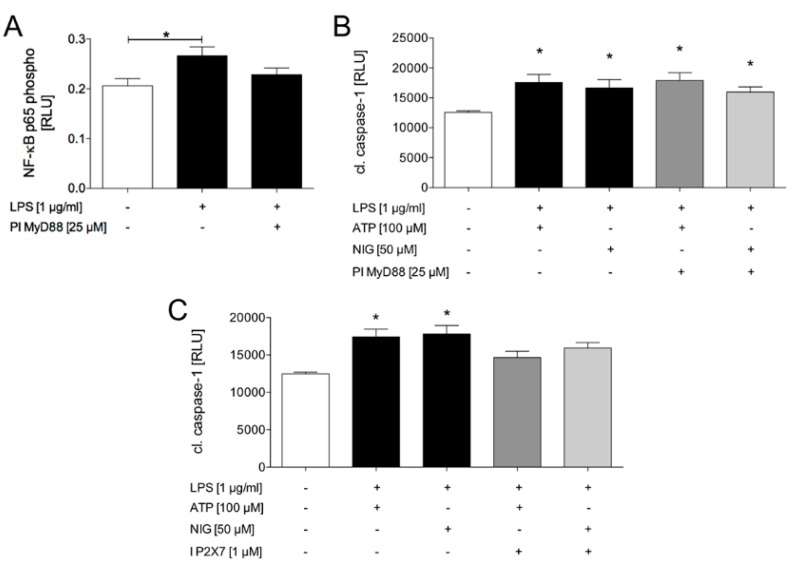
This paper discusses how the assembly of pro-caspase-1 and apoptosis-associated speck-like protein containing a caspase-recruitment domain (ASC) in macromolecular protein complexes, inflammasomes, activates caspase-1. The present study investigates the molecular mechanisms of inflammasome activation in HepG2 cells and examines how short exposures to ethanol (EtOH) affect inflammasome activation. HepG2 cells were treated with lipopolysaccharide (LPS), ATP or nigericin (NIG) in a two-step model. After LPS priming, ATP or NIG were added. As inhibitors, sodium orthovanadate (general inhibitor of tyrosine phosphatases), AC-YVAD-CMK (caspase-1 inhibitor) or AZ10606120 (purinergic receptor P2X7R inhibitor) were applied after LPS priming. To monitor the inflammasome activation, the caspase-1 activity, ASC speck formation, reactive oxygen species (ROS) production and cell death were analyzed. To elucidate the mechanistical approach of EtOH to the inflammasome assembly, the cells were treated with EtOH either under simultaneous LPS administration or concurrently with ATP or NIG application. The co-stimulation with LPS and ATP induced a significant ASC speck formation, caspase-1 activation, cell death and ROS generation. The inhibition of the ATP-dependent purinoreceptor P2X7 decreased the caspase-1 activation, whereas sodium orthovanadate significantly induced caspase-1. Additional treatment with EtOH reversed the LPS and ATP-induced caspase-1 activation, ASC speck formation and ROS production. The ASC speck formation and caspase-1 induction require a two-step signaling with LPS and ATP in HepG2 cells. Inflammasome activation may depend on P2X7. The molecular pathway of an acute effect of EtOH on inflammasomes may involve a reduction in ROS generation, which in turn may increase the activity of tyrosine phosphatases.
本文讨论了半胱氨酸天冬氨酸蛋白酶-1(caspase-1)前体与包含半胱氨酸天冬氨酸蛋白酶募集结构域的凋亡相关斑点样蛋白(ASC)在大分子蛋白复合物——炎性小体中的组装,以及该组装如何激活 caspase-1。本研究旨在探讨 HepG2 细胞中炎性小体激活的分子机制,并研究短时间接触乙醇(EtOH)对炎性小体激活的影响。采用两步法处理 HepG2 细胞,先用脂多糖(LPS)孵育,再用三磷酸腺苷(ATP)或 Nigericin(NIG)孵育。采用正钒酸钠(酪氨酸磷酸酶的通用抑制剂)、AC-YVAD-CMK(caspase-1 抑制剂)或 AZ10606120(嘌呤能受体 P2X7R 抑制剂)作为抑制剂,在 LPS 预孵育后添加。通过分析 caspase-1 活性、ASC 斑点形成、活性氧(ROS)生成和细胞死亡来监测炎性小体激活。为阐明 EtOH 作用于炎性小体组装的机制,将 EtOH 与 LPS 同时给药或与 ATP 或 NIG 同时给药来处理细胞。LPS 和 ATP 的共同刺激诱导了明显的 ASC 斑点形成、caspase-1 激活、细胞死亡和 ROS 生成。P2X7 依赖的 ATP 嘌呤能受体的抑制降低了 caspase-1 的激活,而正钒酸钠则显著诱导了 caspase-1。进一步用 EtOH 处理可逆转 LPS 和 ATP 诱导的 caspase-1 激活、ASC 斑点形成和 ROS 生成。LPS 和 ATP 的两步信号刺激可诱导 HepG2 细胞中炎性小体的激活。炎性小体的激活可能依赖于 P2X7。EtOH 对炎性小体的急性作用的分子途径可能涉及 ROS 生成减少,这反过来又可能增加酪氨酸磷酸酶的活性。