Department of General Surgery, The 74th Group Army Hospital, Guangzhou, 510220, China.
Department of General Surgery, Tangdu Hospital, Air Force Military Medical University, Xi'an, 710032, Shaanxi, China.
Cell Death Dis. 2020 May 4;11(5):313. doi: 10.1038/s41419-020-2509-x.
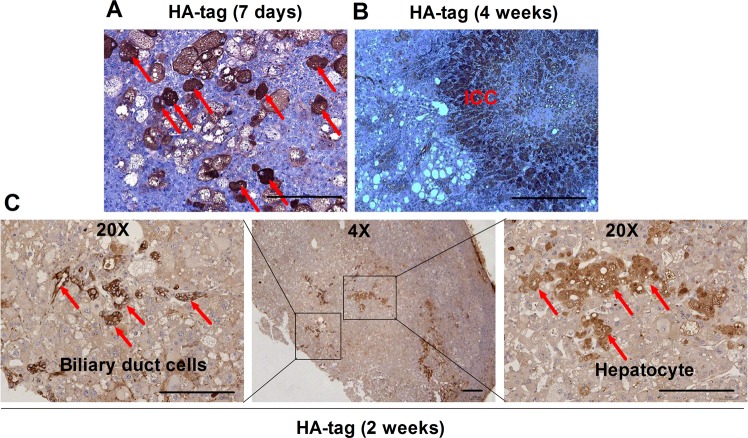
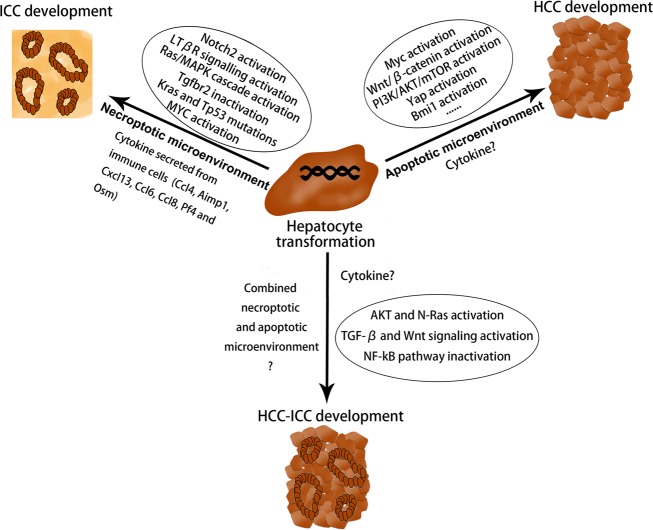
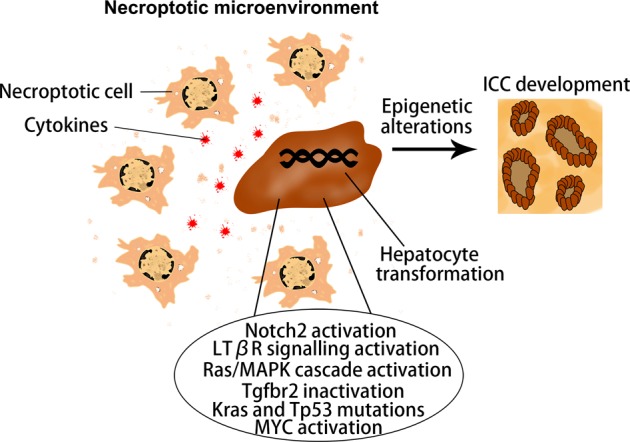
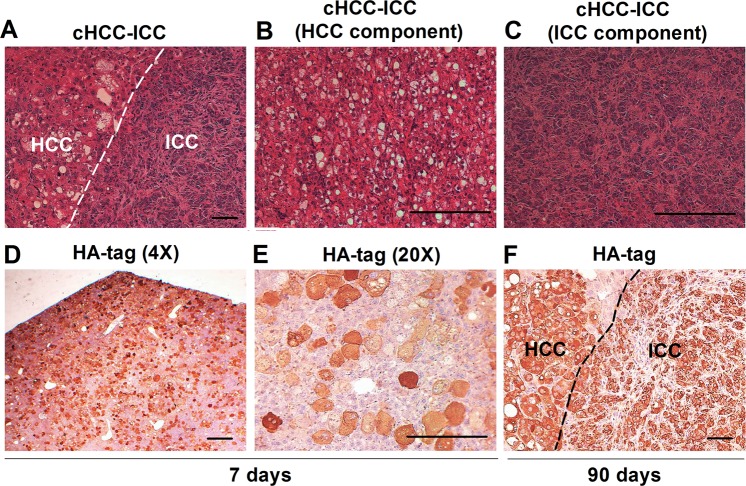
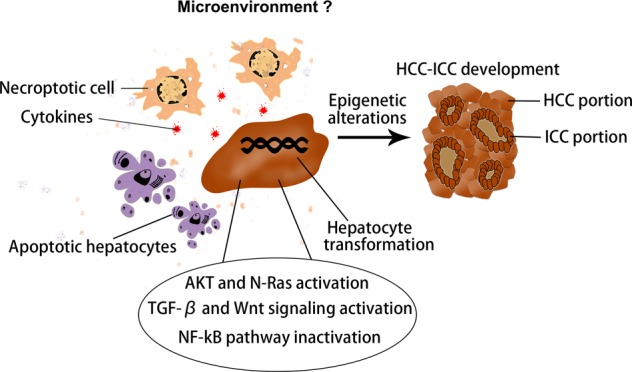
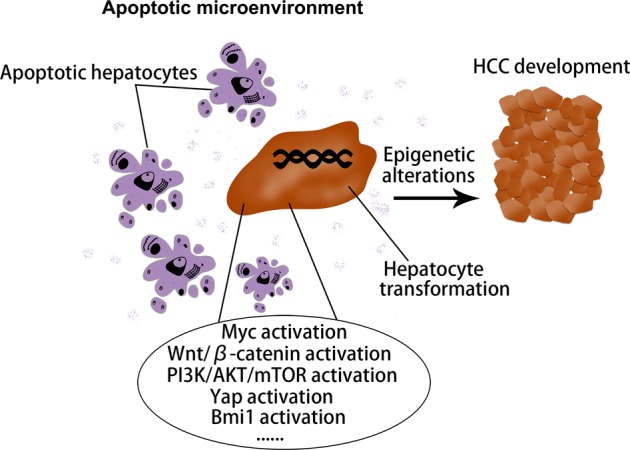
Primary liver cancer (PLC) may be mainly classified as the following four types: hepatocellular carcinoma (HCC), intrahepatic cholangiocarcinoma (ICC), hepatoblastoma (HB), and combined hepatocellular carcinoma and intrahepatic cholangiocarcinoma (cHCC-ICC). The majority of PLC develops in the background of tumor microenvironment, such as inflammatory microenvironments caused by viral hepatitis, alcoholic or nonalcoholic steatohepatitis, carbon tetrachloride (CCl), 3,5-diethoxycarbonyl-1,4-dihydrocollidine (DDC), and necroptosis-associated hepatic cytokine microenvironment caused by necroptosis of hepatocytes. However, the impact of different types of microenvironments on the phenotypes of PLC generated by distinct oncogenes is still unclear. In addition, the cell origin of different liver cancers have not been clarified, as far as we know. Recent researches show that mature hepatocytes retain phenotypic plasticity to differentiate into cholangiocytes. More importantly, our results initially demonstrated that HCC, ICC, and cHCC-ICC could originate from mature hepatocytes rather than liver progenitor cells (LPCs), hepatic stellate cells (HSCs) and cholangiocytes in AKT-driven, AKT/NICD-driven and AKT/CAT-driven mouse PLC models respectively by using hydrodynamic transfection methodology. Therefore, liver tumors originated from mature hepatocytes embody a wide spectrum of phenotypes from HCC to CC, possibly including cHCC-ICC and HB. However, the underlying mechanism determining the cancer phenotype of liver tumors has yet to be delineated. In this review, we will provide a summary of the possible mechanisms for directing the cancer phenotype of liver tumors (i.e., ICC, HCC, and cHCC-ICC) in terms of oncogenic driver genes and tumor microenvironment. Moreover, this study initially revealed the cell origin of different types of liver cancer.
原发性肝癌(PLC)主要可分为以下四种类型:肝细胞癌(HCC)、肝内胆管细胞癌(ICC)、肝母细胞瘤(HB)以及肝细胞癌和肝内胆管细胞癌混合型(cHCC-ICC)。大多数 PLC 的发生都与肿瘤微环境有关,如病毒性肝炎、酒精性或非酒精性脂肪性肝炎、四氯化碳(CCl)、3,5-二乙氧基羰基-1,4-二氢吡啶(DDC)引起的炎症微环境,以及由肝细胞坏死引起的与坏死相关的肝细胞细胞因子微环境。然而,不同类型的微环境对不同致癌基因引起的 PLC 表型的影响仍不清楚。此外,就我们所知,不同肝癌的细胞起源尚未阐明。最近的研究表明,成熟肝细胞保留向胆管细胞分化的表型可塑性。更重要的是,我们的研究结果初步表明,在 AKT 驱动、AKT/NICD 驱动和 AKT/CAT 驱动的小鼠 PLC 模型中,HCC、ICC 和 cHCC-ICC 分别来源于成熟肝细胞,而不是肝祖细胞(LPCs)、肝星状细胞(HSCs)和胆管细胞,我们通过使用水力转染方法证实了这一结果。因此,起源于成熟肝细胞的肝肿瘤表现出从 HCC 到 CC 的广泛表型,可能包括 cHCC-ICC 和 HB。然而,决定肝肿瘤癌症表型的潜在机制尚未阐明。在本综述中,我们将根据致癌驱动基因和肿瘤微环境,为肝肿瘤(即 ICC、HCC 和 cHCC-ICC)的癌症表型提供可能的机制总结。此外,本研究初步揭示了不同类型肝癌的细胞起源。